


So how did this happen?
There are the obvious factors:
Launching an unpopular war that impacts gas prices while Americans were already feeling pessimistic about the economy
The unpopularity of deportations of people who were in the country illegally but committed no further crimes
The disastrous expectation management and poor follow-through on the Epstein files
But this was also a death by a thousand cuts.
Trump has ceaselessly antagonized both liberals and independents since being sworn in, in ways that were totally avoidable.
There is a difference between how one should run a campaign and how one should run a country.
During his 2024 presidential run, Trump could relentlessly dig at Sleepy Joe Biden, post memes about the Democrats, criticize the media as Fake News, and generally focus all of the attention on the opposition.
That’s because Trump’s record wasn’t on the ballot—Biden’s was.
Trump’s successes and failures from his first term were 4 years old.
And we all have recency bias—recent results are much more top of mind than results from years past.
In a sense, all of Trump’s excesses—his insults, disrespectful comments, and norm-breaking—were permissible to independents who had watched inflation skyrocket, the border thrown open, and the far left obsess over causes like transgenderism.
Because to a degree, Trump’s words were on the ballot. But to a much greater degree, Biden’s actions were, too.
But when you’re the incumbent, as Trump is now, both your words and actions are on the ballot.
And Trump gave his critics ammunition almost daily.
The ICE deportation reels set to Pokémon and Selena Gomez music.
The video on Truth Social that depicted the Obamas as monkeys. As I wrote at the time in A Tale of Two “Racists”, I think this was a careless mistake, not intentional. But the lack of ownership and apology made the effect the same.
Using Rob Reiner’s murder as an opportunity to punch down on a dead man.
Putting up a “Sleepy Joe Biden” plaque on the White House Colonnade, the walk he takes world leaders down.
Classless comments about people’s appearance—most recently Nicki Minaj’s butt.
I’ve commented on these excesses at times.
But there are too many to comment on, and, frankly, it’s exhausting and intellectually uninteresting. How many ways can one say that his actions are needlessly offensive?
On election night in 2024, Trump gave a fairly unifying speech. I hoped his penchant for retaliation would relent since he’d won. That hope was dashed in short order. The provocation didn’t stop after the election. It intensified.
And in the post-win elation, Trump’s base justified every bit of it with short-sighted excuses:
“Well, look at what the left does to him.” (A leader is supposed to say and do what’s best for his people, even when his opponents have done their worst to him.)
“Well, what he said is true.” (Truth is not the only virtue. Temperance is one, too.)
Much of MAGA seemed blind to the impact of these statements.
To many, it was written off as just “Trump being Trump.” But the erosion of political capital was clear, especially if you were monitoring liberal sentiment. You needed only to look at the comment section of a liberal influencer to see how much resentment Trump was stoking.
But it’s easy to get blindsided by this. It seems Trump himself was.
Even now, he’s saying that if he had been on the ballot, the GOP would have won “in a landslide.”
That’s incorrect.
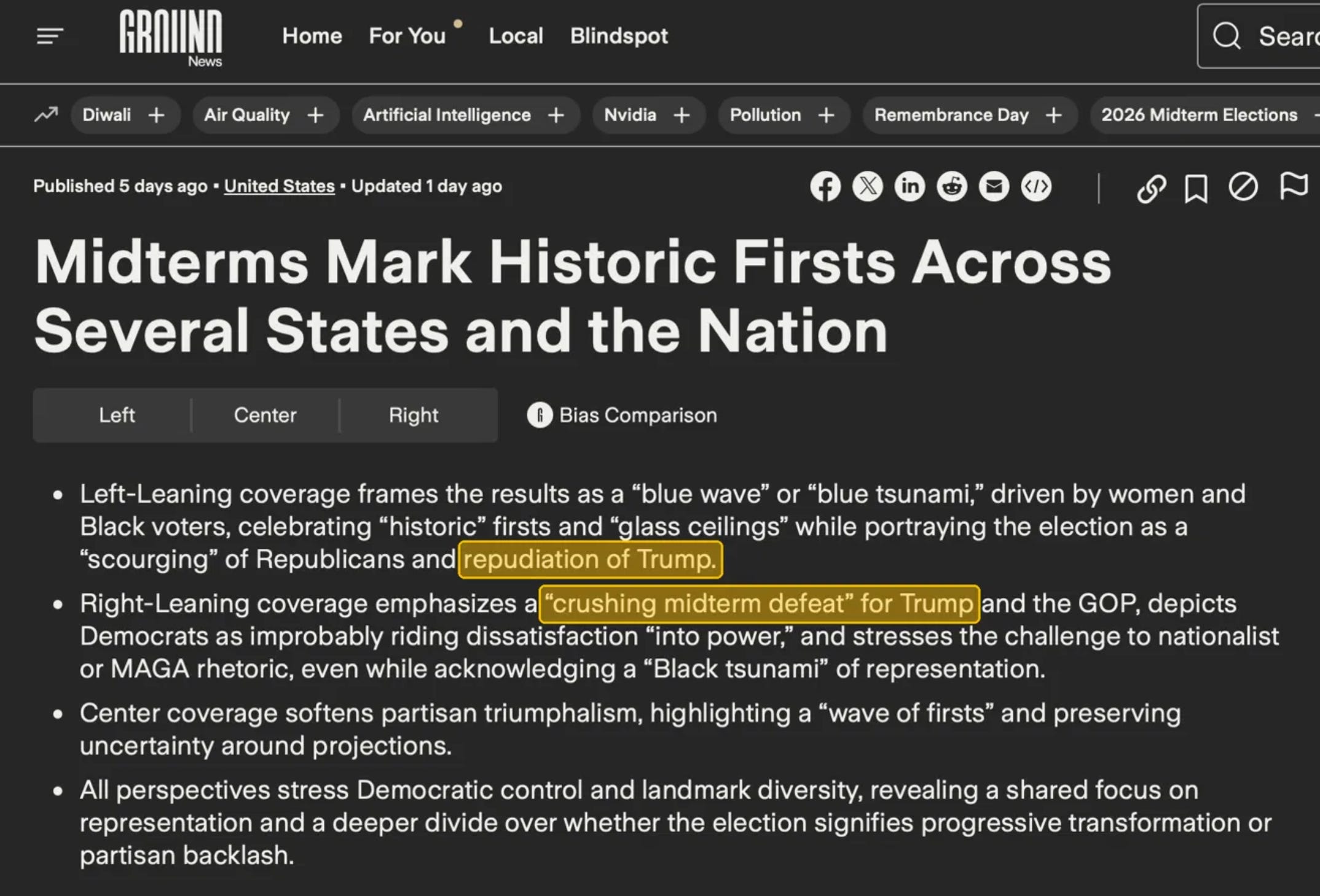
Right-leaning outlets called it a crushing defeat for Trump.
Left-leaning outlets called it a repudiation of Trump.
Trump says if he’d been on the ballot, he’d have won.
To voters, he was on the ballot.
Outlets across the spectrum saw it. The voters saw it. Politicians saw it.
The only person who didn’t was him.
This is a blind spot for Trump. But it’s not unique to him.
If you’re just using X and Instagram, listening to right-wing podcasts, and ingesting right-wing algorithms, the only time you heard about liberals’ and independents’ responses to Trump’s rhetoric was through a lens that made them look overly sensitive and soft.
You only saw the worst version of the liberal response because you, like all of us, are in an algorithmic echo chamber.
The screenshot above is from Ground News. I’ve been using Ground since 2023 to get outside of mine—well before they ever sponsored me. My daily routine still runs through social media, but I also use Ground News, especially its Bias Comparison and Blindspot tools, to see the stories my echo chamber isn’t showing me and the reactions I normally don’t see.
Bias Comparison is the feature I lean on most—that’s what I showed in the screenshot. It shows you how left, center, and right outlets are covering the same story, side by side.
What makes Ground so valuable is that it gives you a quick, high-level summary of how both sides are reporting and reacting to the news, so you don’t have to go looking for it yourself.
Otherwise, how would you get out of your echo chamber? Short of having a second social media account that is curated to show you the other side, it’s extremely difficult to do.
That’s why I consider it an essential tool for anyone who values independent thought and wants to get out of the tribalism that grips this country.
You can get 40% off the Vantage plan, their top tier, at groundnews.com/kaizenx.
Signing up keeps you informed, and it directly supports the work I do here.
I, like many of you I suspect, was prepared for 4 years of rude behavior and needless provocation when I voted for him.
But I assumed that at worst—at least we’d get a correction against the far left.
And at best we’d get a tectonic shift in governance—a path to a golden age where government is made efficient, immigration policy is made rational, economic policy is made beneficial, and foreign policy is made robust.
We did get some of the best case.
I think Trump has made some excellent long-term decisions.
He’s bringing manufacturing back to the United States by stewarding the AI boom. Billions of dollars are being invested in the U.S. to build manufacturing capacity for the AI wave here that otherwise could have been built elsewhere. And it hasn’t just applied to AI. In the car industry, there have been key moves to build plants in America instead of Mexico, largely due to tariff policies and incentives.
He got the Israeli hostages returned from Hamas. And in the year after that ceasefire, deaths in Gaza dropped by more than 90%.
He called the bluff of the Islamic Republic of Iran, which has been playing nuclear poker for decades. And in doing so, he weakened the position of Russia and China, who were friendly to Iran (as I detailed in Why Trump Struck Iran and the rest of my Iran War series).
He checked Chinese and Russian influence in the Western Hemisphere by capturing Maduro. I wrote about that in We Didn’t Capture Maduro Because of Just Drugs or Oil.
He has deported thousands of criminal illegal immigrants.
He closed the border and reduced illegal crossings to historic lows.
So beneath all the noise, Trump has created substantive wins for the American people—and they are wins I don’t think we would have gotten from President Kamala Harris.
The problem is that those wins are:
Long-term
Abstract
Hard to understand
In psychology, there is a framework called Maslow’s hierarchy of needs.
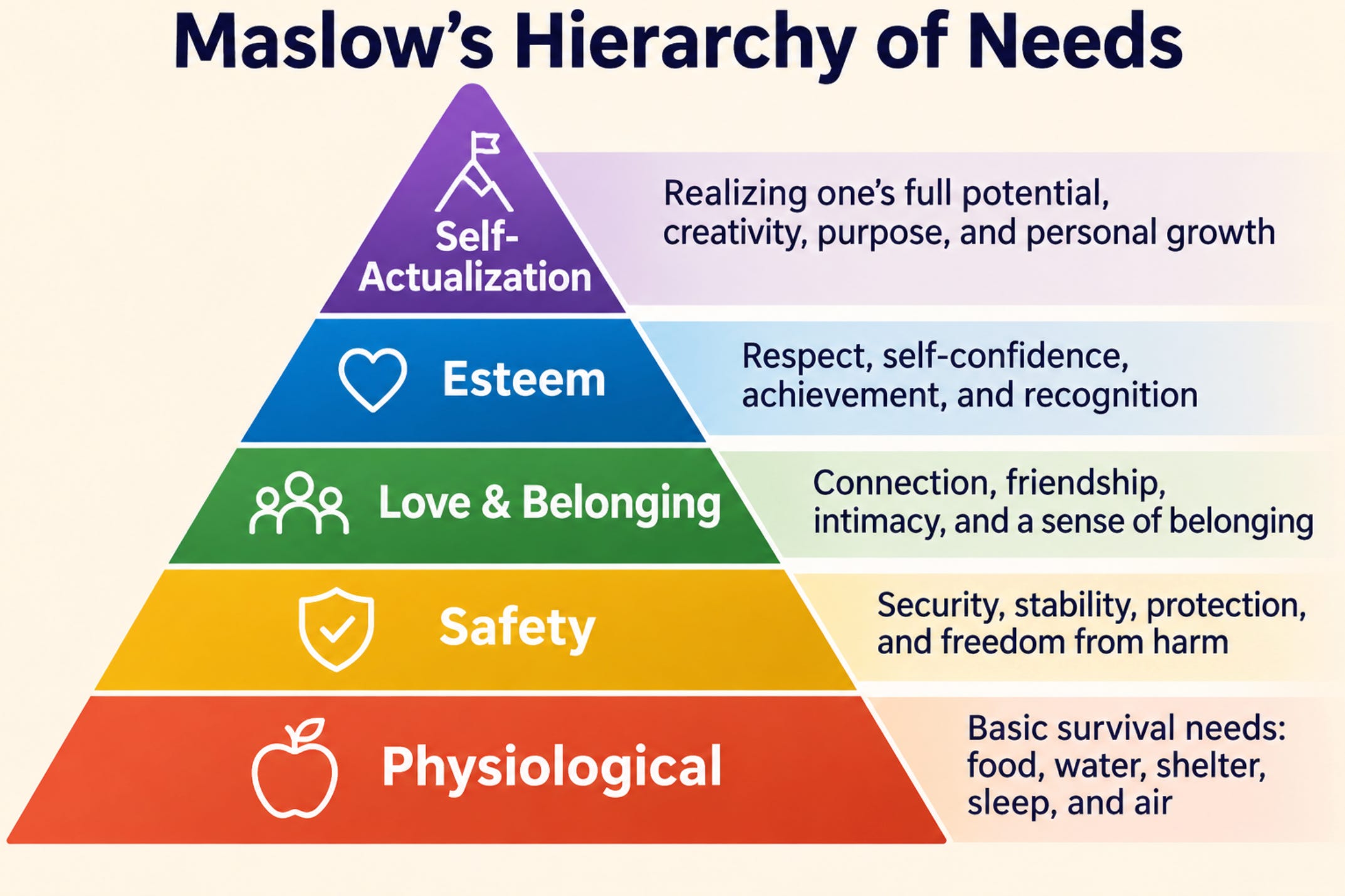
It describes how humans’ basic needs (safety, food, water) have to be met before they have the energy to focus on higher-level needs.
It’s the same with a community.
If members of a community are living paycheck to paycheck and are permanent renters, they don’t have the patience to understand the global chess game being played between the U.S. and Europe versus the Chinese-Russian-Iranian axis.
They don’t care that billions of dollars of investment is being made in America by AI companies that otherwise would have been made in Europe or the Middle East.
They don’t care about the coalition of radical Islam, socialism, and the left.
They can’t connect the dots between the accelerated decay of Western Europe, immigration, and how it could happen in the U.S.
All of this sounds like abstract philosophizing when you’re paying $5 for a gallon of gas.
Exacerbating this is Trump’s penchant for blaming others when things go wrong, not himself.
MAGA got its first taste of this when Trump dismissed his base’s outrage over the botched release of the Epstein files and called the concerned “past supporters” and “weaklings,” stating “he doesn’t want their support anymore.”
It wasn’t the first time that Trump belittled someone’s concern, but it was the first time that he did so to his own supporters so blatantly.
This is frustrating and exhausting to write about because it was all avoidable.
Trump could have communicated much more clearly about what the war was about. Simply pointing out that, according to the UN’s nuclear watchdog, Iran had enough enriched uranium for roughly ten nuclear bombs would have made an abstract threat concrete.
He also could have waited to prosecute the Iran war until after the midterms, or at least until after delivering clear economic relief to the American people.
Trump could have focused deportation efforts on corporations employing illegal immigrants, thus removing the incentive for illegal immigrants to stay in the U.S. and making the whole process much less inflammatory.
Trump could have done all of the above without antagonizing every group at every turn: the endless personal attacks, the trolling, the White House account running as a meme feed about immigrants.
I hope that this loss is an ego check for Trump—because there is still important work to be done, and he can still do it.
So where can Trump go from here?
From here, you’ll learn:
How Trump reacted once the dust settled, and whether the loss taught him anything
What Republicans losing Congress means for how he governs
The questions that could now be asked of his administration, and what I think is behind them
