


Lindsay Clancy did need help.
Mothers do need postpartum support.
She should get care.
In prison.
What happened
The date of the incident was January 24th, 2023. Duxbury, Massachusetts.
Lindsay Clancy was 32. A labor and delivery nurse at Mass General with three kids. Cora was 5. Dawson was 3. Callan was 8 months.
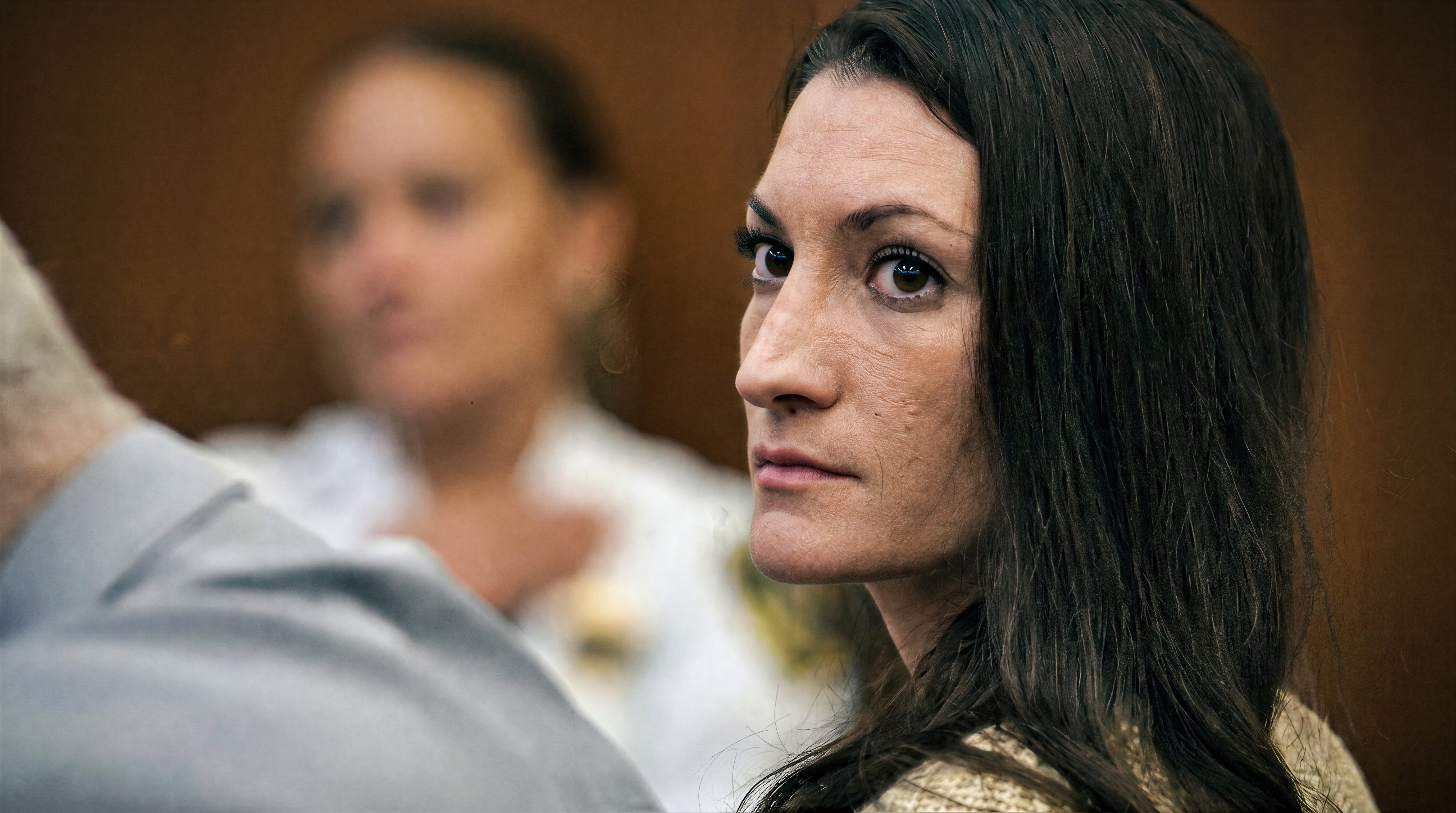
She sent her husband Patrick out to pick up takeout and grab a prescription at CVS.
While he was gone she strangled all three children with exercise bands in the basement.
Then she cut herself and jumped out of a second story window.
She lived. She’s paralyzed from the waist down.
Cora and Dawson were pronounced dead that day. Callan died a few days later.
Patrick came home to it. His 911 call is in evidence. It’s mostly screaming.
Why people are talking about it now
The trial is happening right now in Plymouth Superior Court, and it’s being livestreamed.
Closing arguments are this week.
Lindsay said she killed her 3 children.
Her lawyers aren’t arguing she didn’t do it.
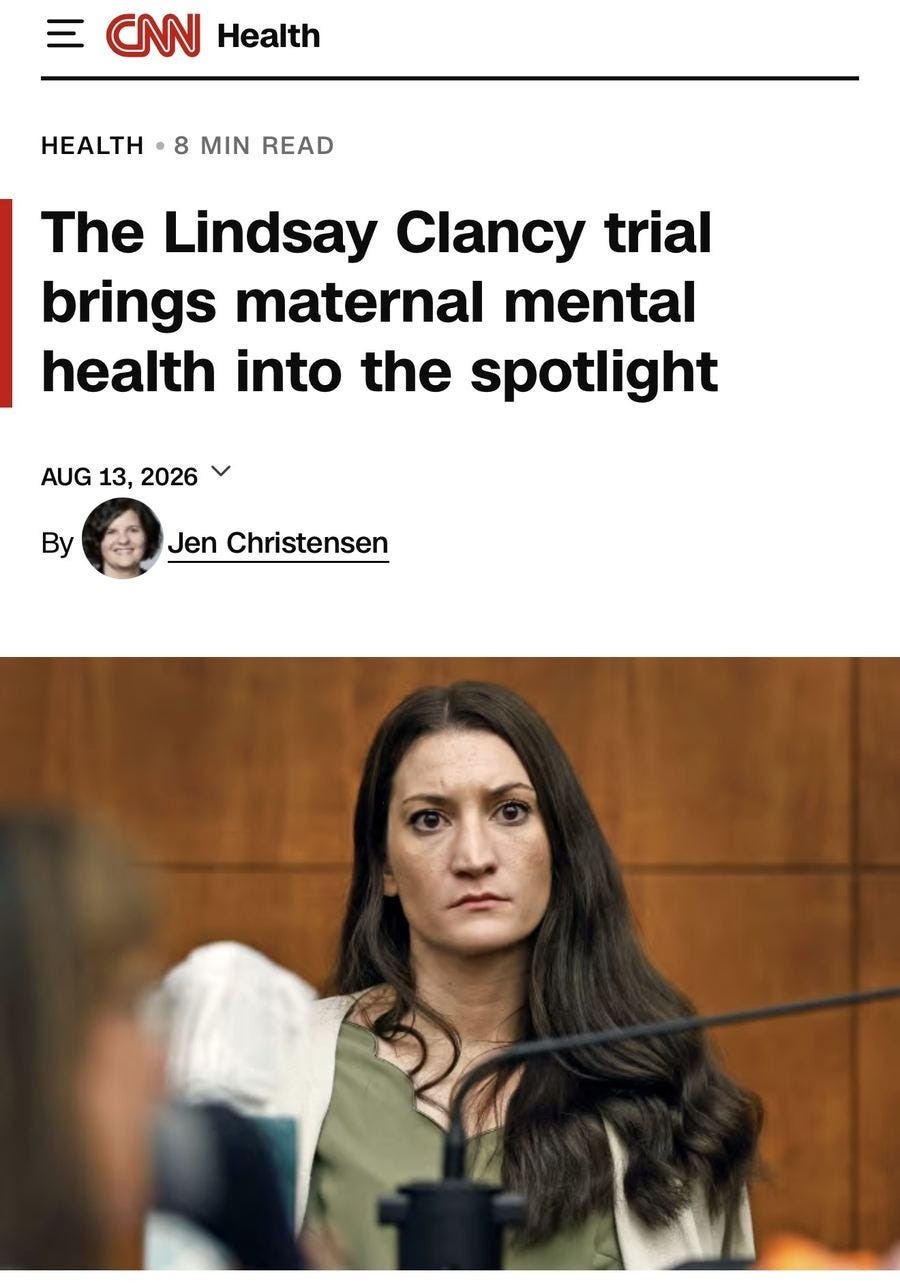
They’re arguing she isn’t criminally responsible, because she was suffering from bipolar disorder and postpartum psychosis.
Guilty means life in prison without parole.
Not criminally responsible means a state mental health facility.
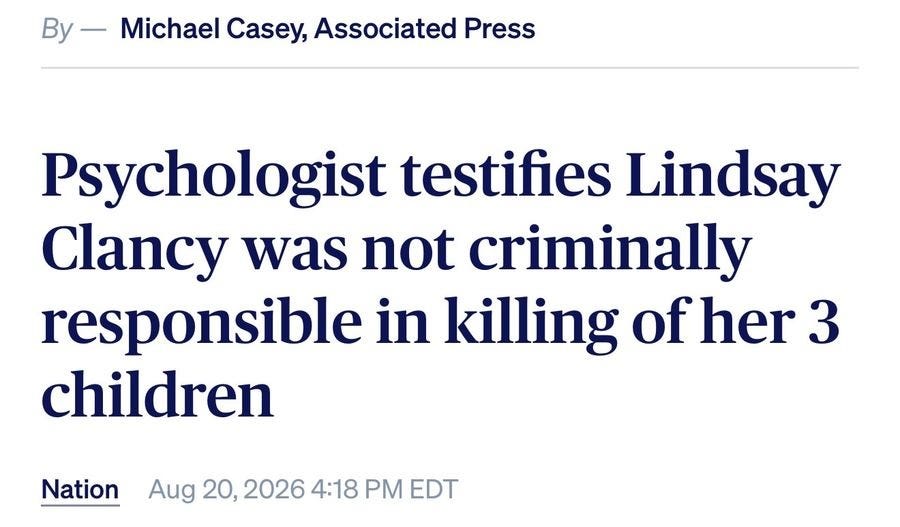
Her husband
Police ruled her husband Patrick out immediately.
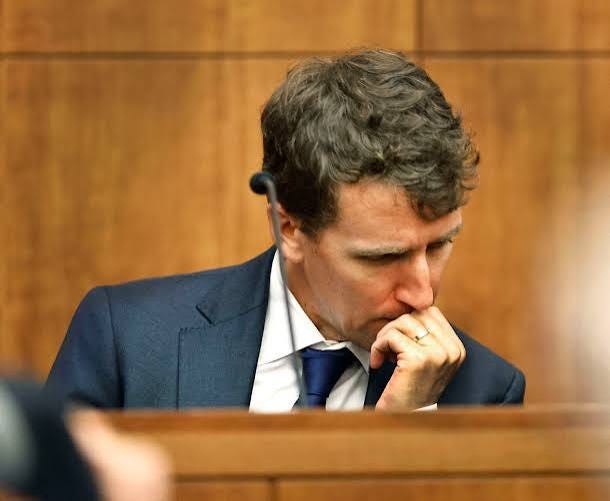
There’s video of him in the pharmacy.
Video of him in the restaurant.
Text messages.
His drive home tracked.
The food and the medicine still sitting on the kitchen island when officers arrived.
Hours before it happened, he texted her calling her a good mama.
Days after, he released a public statement asking people to forgive her, the way he had.
He later said he wasn’t married to “a monster”.
He was married to someone who got sick.
He has since divorced her, remarried, and moved to New York.
The reactions
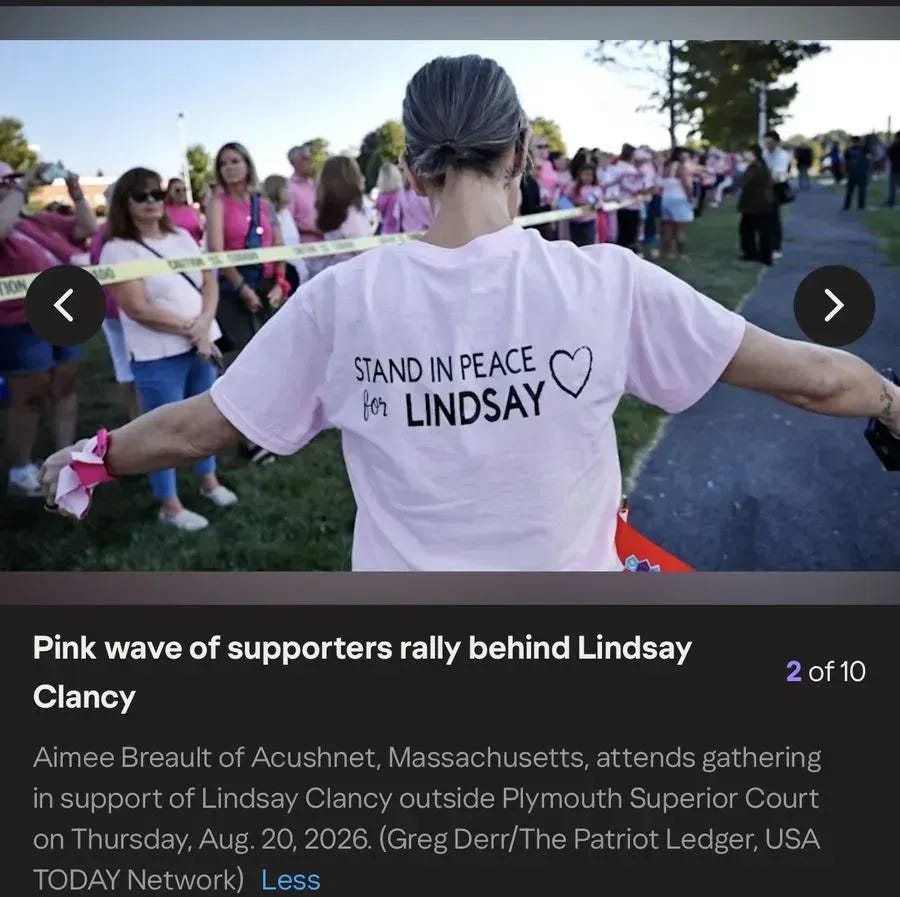
Outside the courthouse, there have been hundreds of women in pink, with shirts reading “Justice For Lindsay” and “She Needed Help”.
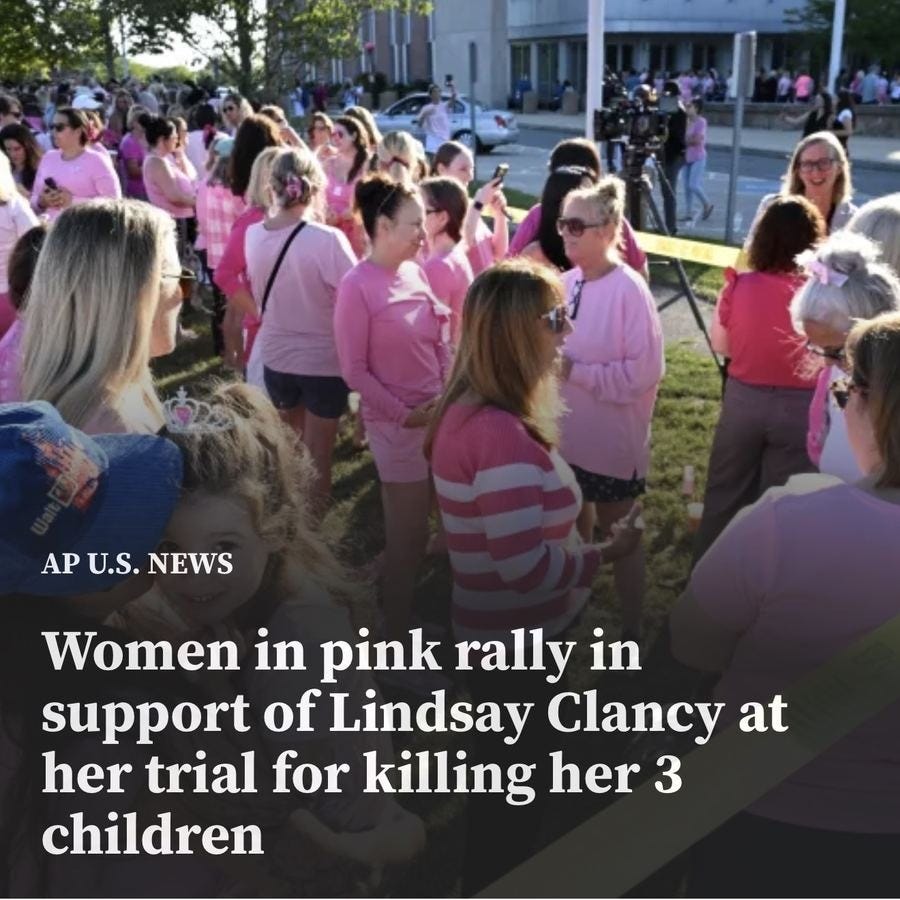
Women in pink rally in support of Lindsay Clancy outside her trial. (AP)
On TikTok, mothers filming their crying babies with the caption “Me too, Lindsay.”
Mothers filming themselves screaming, sobbing on camera in front of their toddlers, throwing things, and framing the rage as solidarity.
It has been widely embraced in the mom corner of TikTok as a healthy way for mothers to express anger.
And then there’s the “alternative theory” wing, which says Patrick did it.
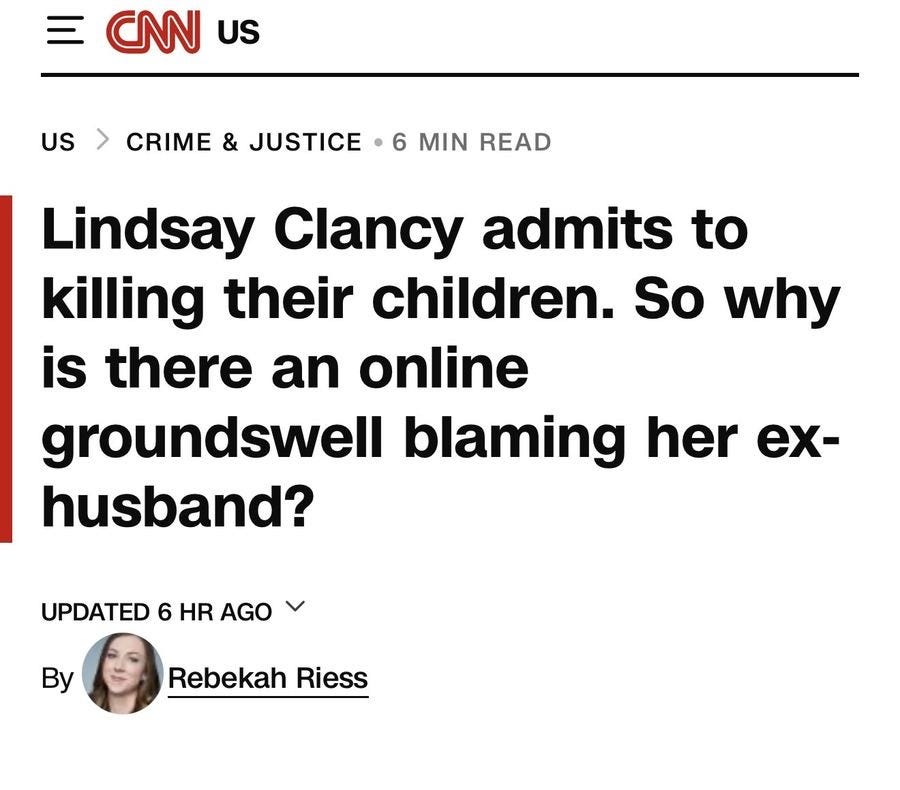
One theory making the rounds: he drugged her, pushed her out the window, strangled the children himself, and framed her so he could marry someone else.
This wing treats his remarriage and move to New York as evidence of this theory.
This wing treats his testimony as evidence too, because people watched him take the stand and decided he sounded wrong.
Lindsay agreed to a stipulation of facts, which meant prosecutors didn’t have to present all of their evidence in court.
That left gaps in a televised trial, and content creators filled the gaps.
The man who begged the public to forgive his wife is now being accused of murdering his own children.
I’ve written about this pattern before — Spencer Pratt's LA mayoral run, Candace Owens' theories about who killed Charlie Kirk, Trump's claim that the 2020 election was stolen. It's a similar pattern every time.
Something happens.
People want answers within hours or days, and rush to find answers.
People have pre-judgments about who is guilty that are informed by their bias.
People confirm their bias by working backward to evidence and call it research.
They say “things don’t add up” or “something doesn’t make sense” — when in reality, they just don’t understand certain systems or technical details.
They say they “just are asking questions” when they are in fact not just asking questions — they are suggesting answers — and those answers are the low probability, high flammability answers that tend to get attention.
They are skeptical of the mainstream narrative as a rule, but don’t apply the same level of skepticism to the alternative narrative. They require perfect evidence to believe the mainstream, and merely possible explanations to believe the alternative.
The Lindsay Clancy case is about as clear a case as exists.
She confessed.
Her own defense team isn’t disputing that she strangled her children.
I’m not going to spend this letter on that theory.
What matters is what these reactions have in common.
Every one of them moves the weight off Lindsay. The alternative theory camp moves it onto Patrick.
The solidarity camp moves it onto her illness and onto a system that failed her.
Almost nobody in this conversation is arguing she should face no consequences at all.
The move is subtler and more corrosive. It’s a reordering of moral attention.
The conversation leads with her suffering.
What is put in the foreground is her mental illness.
The failures of the medical system.
The lack of a village for mothers.
The murder itself recedes into the background.
The three children recede into the background.
The moral center of gravity shifts from what was done to how the person who did it was feeling.
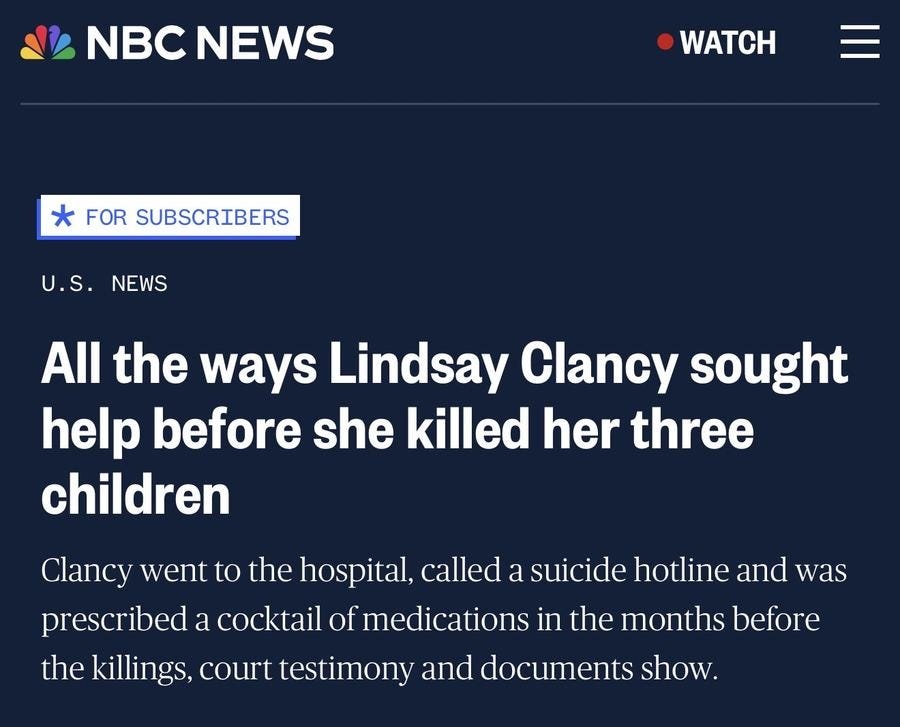
I didn’t hear about the Lindsay Clancy story until last Friday. A friend brought it up over dinner. My first reaction was pure disgust and shock. Three kids. Strangled. How could anyone look at that and start talking about justification or solidarity?
That was the emotional response. After I sat with it for a minute, I realized I didn’t actually know what the people defending her were saying. I only knew my own reaction. So I went looking.
One of the tools that helped me map the conversation quickly was Ground News.
Their bias comparison showed the split in real time.
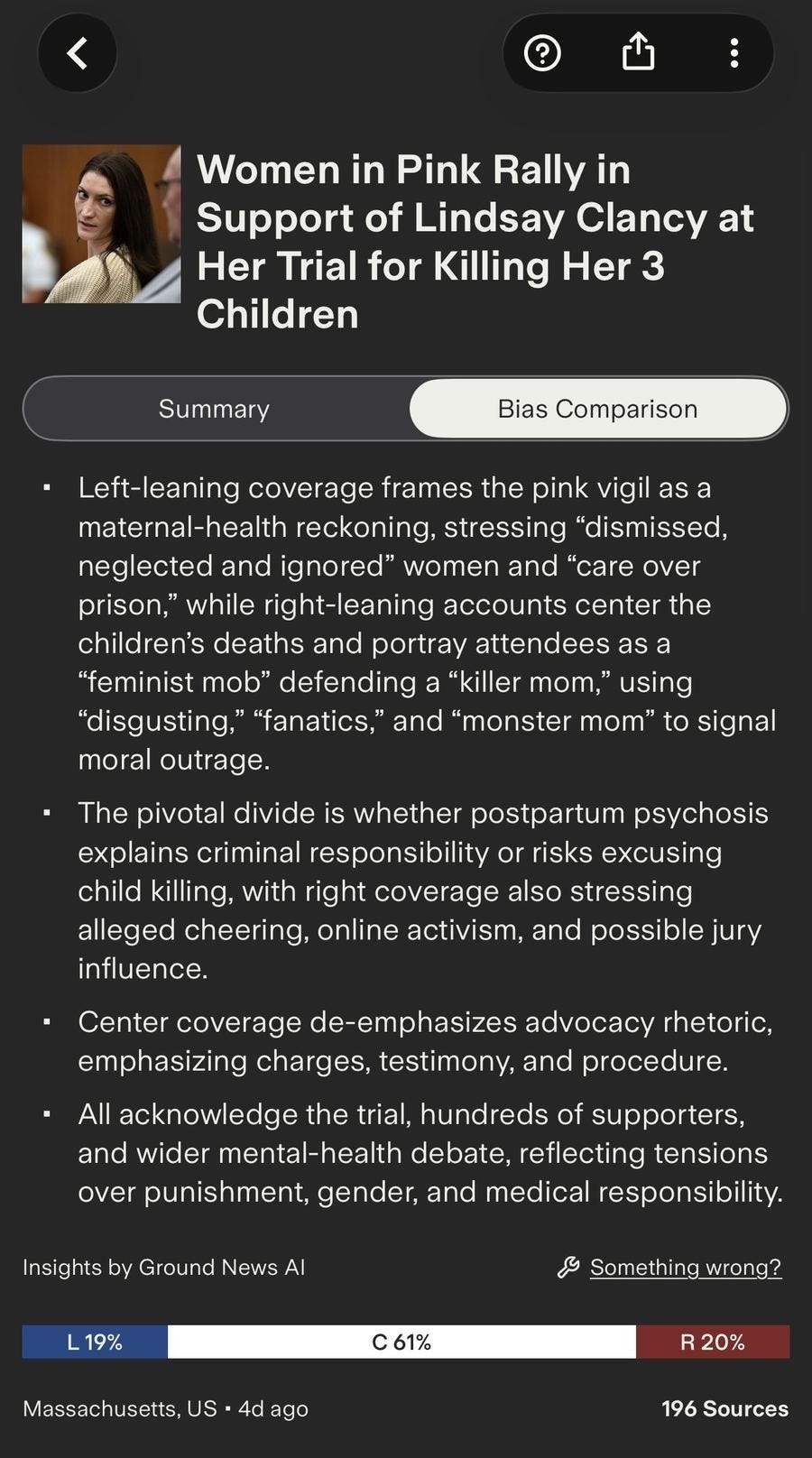
Left-leaning coverage was framing defense of Lindsay as a maternal-health reckoning — language about women being “dismissed, neglected and ignored,” and the repeated line “care over prison.”
Right-leaning coverage stayed locked on the children’s deaths and treated the attendees as a “feminist mob” defending a “killer mom.”
Seeing those frames side by side did two useful things.
First, it showed me the actual argument the supporters were making instead of the cartoon version that shows up in quote-tweets.
Second, it surfaced details that hadn’t come up at dinner, including that a forensic psychiatrist had diagnosed her with postpartum psychosis after the fact.
I still think the emphasis in the coverage defending Lindsay is wrong — but now I understand the best argument for what I think is wrong.
I would rather disagree with the real position than the one I invented in my head.
This is the exact reason I’ve used Ground News for two years, long before they ever sponsored anything I made.
Most of us live inside feeds that validate us.
When a story is this emotionally charged, that becomes dangerous.
You end up reacting to a filtered version of events and calling it clarity.
Ground News is one of the few tools that forces the other framings into view without requiring you to go hunt for them yourself.
I use it on basically every major story I cover now.
If you want the same view, you can get 40% off their Vantage plan through the link below.
It includes the bias comparison feature and the rest of the tools.
Signing up for their Vantage plan empowers you, supports a great company, and enables my work.
Consequences and Compassion — In That Order
Lindsay is a mentally ill person who did a profoundly evil thing.
Her sickness, we should have compassion for.
Her actions, we need consequences for.
And we need to emphasize the consequences first.
The consequences must be in the foreground.
Because the reverse order has consequences of its own.
Internal states are difficult to verify and easy to narrate after the fact.
External actions are not.
A civilization that begins treating the internal state as primary and the external act as secondary will eventually weaken the very incentives that keep disordered people from acting on their worst impulses.
Sometimes humans do the right thing because it is right.
Sometimes we do the right thing because it benefits us.
Sometimes we do it because we fear the social and legal cost of doing the wrong thing.
All three of those motives are required for civilization to function.
Remove or muddy the third, and more evil will follow.
This is why the first and loudest statement must be about the boundary, not the explanation.
That should lead in the rhetoric.
Compassion should follow.
If the first and loudest thing is “she was failed by the system” the lesson is that being failed explains killing three children.
If the first and loudest thing is “this is evil and there will be consequences,” the lesson is that nothing explains killing three children.
Both should be said — and what we choose to emphasize has a meaningful difference.
Lindsay must face consequences.
Not out of spite.
Out of necessity.
Her judgment was compromised by her biology and psychology.
She was on thirteen medications in four months, as providers treated her symptoms and then treated her reactions to the treatments.
A forensic psychiatrist diagnosed her with bipolar disorder and postpartum psychosis after the killings.
Her husband went to her doctor the week before and said they were turning her into a zombie.
All of that is true.
And — Lindsay could have chosen good. She did not.
The voice
She told a hospital chaplain she heard a voice telling her to kill her children and herself.
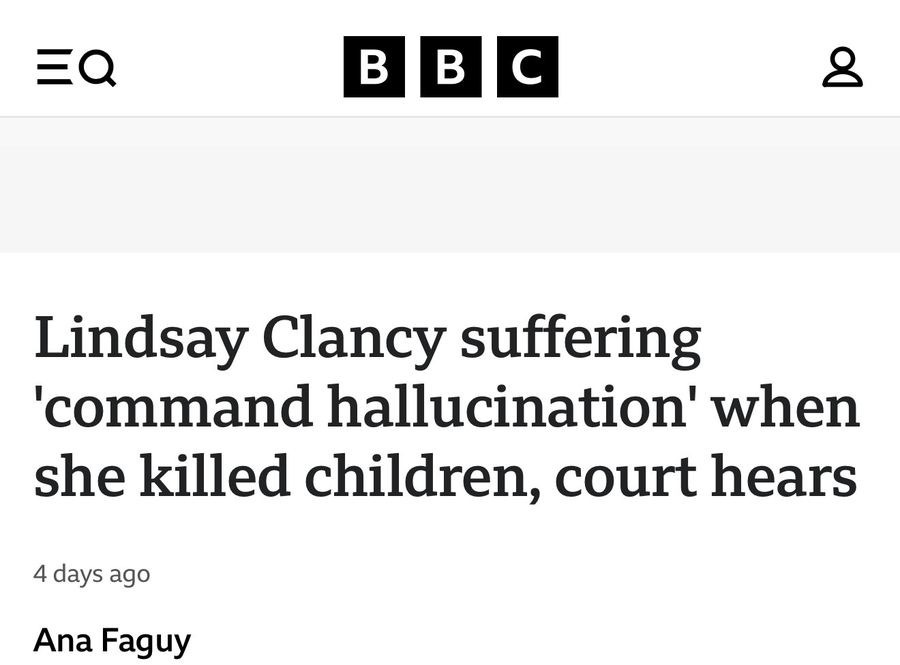
If she heard a voice, there was a Lindsay hearing it. The hearer and the voice are two different things. That is what hearing means.
She could have refused it.
She chose to obey it.
Lindsay is not just her thoughts, feelings, and voices.
Just like you are neither your thoughts, nor your feelings, nor that voice that whispers dark thoughts.
You are you.
You are the one experiencing and responding to your conditions.
You are the cause of your actions, not just the effect of your circumstances.
Every court, every contract, every apology you have ever given or accepted assumes there is a you in there doing the choosing.
No matter how loud that dark voice was, there was another voice that Lindsay did not listen to.
Because even in the most chaotic consciousness, there is a voice that knows right from wrong.
That is called our conscience.
It is harder to hear for the sick. But it is always there.
The voice of society
When the sick struggle to hear their voice of sanity, they need to hear the voice of society.
Which says: if you won’t respond to your conscience, then we must ensure you respond to incentives.
Not to hurt you — to protect everyone.
People do the right thing for three reasons:
Because it’s right
Because it benefits them
Because they’re afraid of what happens if they don’t
The first is not enough and never has been. Before civilization, in a state of nature, there was far more violence.
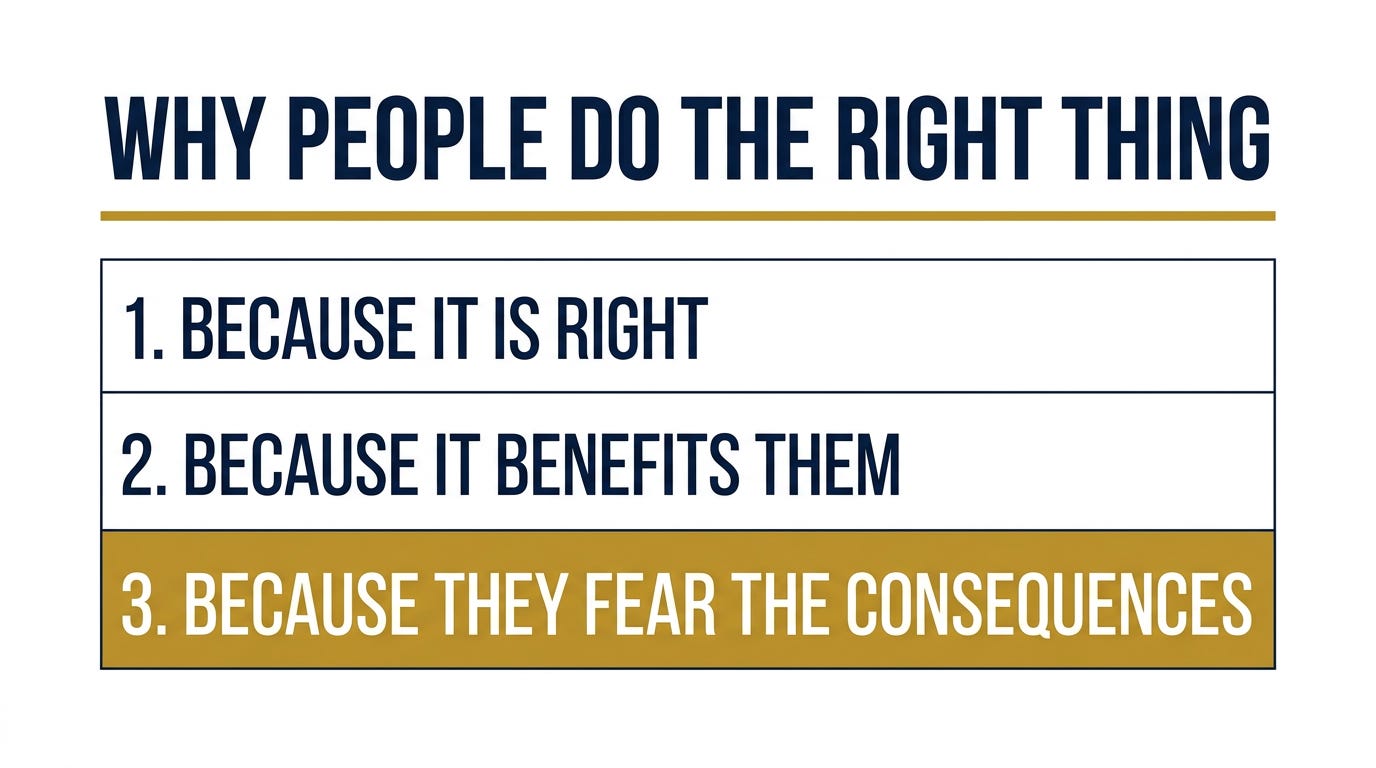
The triumph of modern civilization is that it replaced merely trusting people to do the right thing with laws, contracts, and incentives.
The result is over 8 billion people being able to live on the planet in relative peace.
Consequences are the last defense against the individual not listening to their conscience.
The sicker someone is, the louder the backup needs to be.
That is why the first and loudest thing that all of us, men and women, must say when we see an atrocity like this is: Killing Children Is Wrong.
And we will help you heal, but we won’t let you harm.
Say it clearly. Because softening that boundary doesn’t help the sick.
It weakens the incentive stopping them from acting on their worst impulses.
Blur the line and you remove the last thing standing between a disordered person and ruination for them and those around them.
What compassion is
We need compassion and consequences.
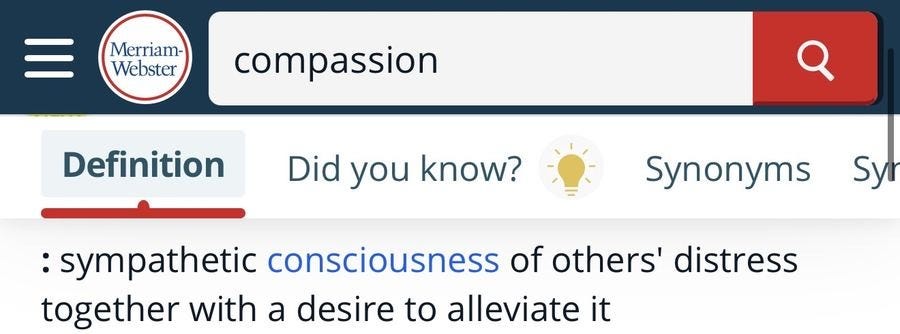
To have compassion means to suffer with another, and to want to alleviate their suffering.
We can feel Lindsay’s suffering.
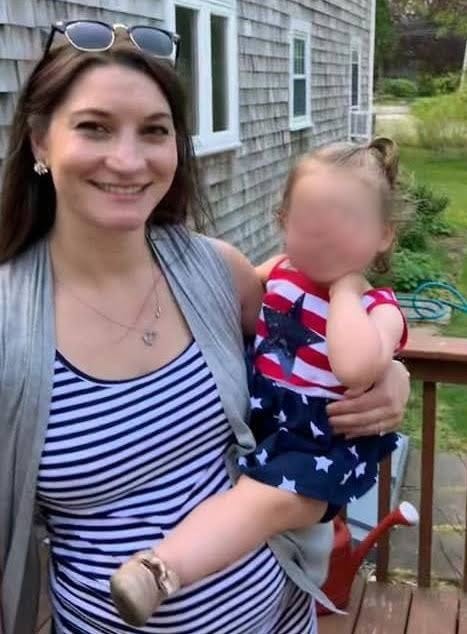
She sought help.
She went to the emergency room.
She called a hotline.
She was turned away from inpatient care.
She is paralyzed from the waist down and will spend the rest of her life knowing what she did.
It is genuinely difficult to be a mother.
After all, it takes a village to raise a child.
And mothers no longer have a village.
But we must never let a desire to alleviate suffering mean alleviating consequences.
The moral center of gravity must be someone’s external actions, not their internal state.
External actions can be verified. Internal states cannot. They are hard to check and easy to narrate after the fact.
Move the center of gravity to how someone felt — no matter what the pathology that led to those feelings — and you have moved it to the one thing nobody else can examine. The one thing that can be rewritten later by whoever tells the story best.
A society that treats the internal state as primary and the external act as secondary weakens the exact incentives that keep disordered people from acting on their worst impulses.
And the message that your internal state takes moral primacy over your actions has mortal impact.
Because the next Lindsay will also choose to obey the voice of evil, because society told her she was powerless to her feelings.
We must speak in one voice and say: she did not do the right thing. Not “she could not do the right thing.”
She was less powerful, but not powerless.
So yes, call for more care for mothers.
After saying that even the sick make choices.
Because there were only 3 people in this case who had no choice.
And they were all her children.

Underneath the division of this story are four additional layers:
The relationship between mental illness and evil.
Belief in, and the role of, free will.
The gender war between men and women.
The purpose of prison.
I address all of this in the paid section.
From here, you’ll learn:
Why the Greek word for sin is an archery term, and what “missing the mark” tells you about every evil act you’ve ever heard about
The claim that all evil is mental illness, and the reason accepting it fully makes pathology useless as a defense
The four words in Lindsay Clancy’s own account that establish she still had a choice, and why they hold up even if you don’t believe in free will
The two grievances men and women each read into this case, both of them partly right, and the point where each one stops being an argument about her
The thought experiment where she gets perfect care: the screening, the bed, the village, and the outcome that remains possible anyway
