


We are 105 days from the midterms.
Prediction markets give Republicans a ~17% chance of keeping Congress.
The single most likely outcome on the board is Democrats taking both chambers, at 48%.
Losing one chamber would be a serious blow to Trump’s ability to deliver anything he promised.
Losing both would be catastrophic.
That’s the backdrop for everything that follows — keep it in mind.
Because Thursday night, Trump gave a primetime address about the 2020 election.
He’s right about what we need to do — pass voter ID.
He’s fighting a worthy battle.
But it comes at the expense of the war.
The war to solve the economic problems that most Americans actually care about — and that are radicalizing the youth.
One more thing before I start.
If you’ve noticed I’ve been pushing back more on figures on the right lately, there’s a reason.
It’s a specific kind of reasoning I want to name — a reflex to treat suspicion as evidence, to turn every irregularity into a conspiracy.
It’s the claims that the election was stolen from Spencer Pratt.
It’s the claims Candace Owens is making about Charlie Kirk’s death.
It’s the claims Trump has made about the 2020 election.
The issue is not making claims.
It’s that the way the claims get made lacks intellectual rigor.
And I think it’s genuinely damaging — to the credibility of the right with independents, who are now the largest political bloc in this country, and to the many correct points people on the right are actually making.
I’m saying this as someone who agrees more with the right than the left.
Someone who voted for Trump, who doesn’t want to see the right lose the midterms, and who doesn’t want to see a Democratic Party that’s drifting further left gain more power in this country.
I’ll explain what I mean at the end. But first, let me tell you where Trump is right.
1. Where He’s Right
Trump is right: We need voter ID.
Not because the last election was stolen.
Because a democracy runs on trust, people have little, and it needs to be restored.
When a large share of the country doesn’t believe the results are clean, that belief is a crisis on its own — whether or not it’s correct.
Voter ID is part of how you rebuild it.
It’s cheap, it’s simple, and roughly 8 in 10 Americans support it.
It’s a no-brainer.
The argument that people have made against the SAVE America Act is that it doesn’t require any old ID — it requires proof of citizenship: a passport or birth certificate.
The former, many have never owned, and the latter can be tedious to get, particularly for poorer people and those with less time.
But getting a birth certificate is a solvable hurdle, not an impossible one.
Where it’s genuinely hard, fund it and make the document free. Lower the cost of clearing the bar. Don’t pretend the bar shouldn’t exist.
This should already be law, and the Democrats are in the way.
He’s Also Right About the Media
ABC and NBC declined to carry the president’s address on their primary broadcast networks.
The sitting president of the United States addresses the nation about the integrity of its elections, and two major networks decided you don’t get to see it on the channel that actually reaches you.
Networks have editorial discretion, and they should keep it.
They should not lose their licenses for this, as Trump has threatened.
But their job — the entire reason the profession exists — is to give people the most relevant information and the context to process it.
When the president speaks to the country about something this fundamental, that should be aired, on the main channel, no matter what you think of him.
If what he’s saying is false, your job is to put it in front of people and counter it — in real time, with your best reporters and the truth.
You don’t fight falsehood by suppressing it.
That just guarantees the claims spread everywhere without fact-checking.
This is exactly the kind of thing that makes people stop trusting the press.
They didn’t protect the public.
They made a decision on the public’s behalf about what it could handle.
Paternalism instead of journalism.
2. The Battle and the War
But while Trump is spending massive amounts of public attention and patience on this battle, he is losing the war of public opinion, and losing political capital.
And the polling reflects that.
The energy he’s pouring into this fight — the primetime slots, the declassified document drops, the running war with the networks — is energy not spent on the thing that actually will decide the midterms, and his ability to execute his agenda.
To the public, it looks like he is majoring in the minors.
The war is not with China, which he’s newly accusing of “compromising” the election.
The war is not with the Democrats, who he accused of stealing the election.
The war is with the economic problems that will make Americans sympathetic to both of them.
It’s that young people can’t afford a home. Can’t afford groceries. Can’t afford gas.
That’s the fertile soil that socialism is growing in.
That’s what makes the Chinese model increasingly appealing to young people, regardless of what China does.
That’s what makes Gen Z — a demographic Trump made historic gains with in 2024 — increasingly far left.
When people feel the system isn’t delivering, they go looking for something — anything — that promises it will, whether that’s a foreign model or a domestic one.
The affordability collapse is the war.
And right now people see the president focused on skirmishes.
3. The China Chapter in the 2020 Election Saga
Look at the address itself through that lens.
Trump released hundreds of pages of declassified intelligence and made three claims.
China illicitly acquired 220 million U.S. voter files.
The intelligence community buried it, filtering China out of his briefings while an FBI official texted that she was running a “shadow government.”
Venezuela ran an experiment swapping votes on its own machines. The implication is that this could happen on our machines.
Then he told Congress to pass the SAVE America Act.
Now watch what’s happened to Trump’s election claims over time.
He changed the enemy. For years, the story was that Democrats stole the election. Thursday night, the villain was China.
He softened the claim. For years, the word was “stolen.” Thursday, it was “compromised” — the system has holes.
Those are different accusations, and “compromised” is the weaker one.
He kept the spectacle, but weakened his claim.
This is not mere semantics.
Look at the statement from John Solomon — the man Trump brought into the White House last month to run this release.
Shortly after the speech, on camera, he admitted the intelligence community has “zero evidence that a foreign power flipped a vote in 2020, ‘22 or ‘24.”
The full document-by-document audit is in the paid section.
So here’s the pattern:
First the election was stolen; now it was compromised.
First it was the Democrats; now it’s China.
It’s whack-a-mole — and every version proves at best intent to meddle, never a stolen vote.
Which, I speculate, is why they swapped “stolen” for “compromised.”
To be clear: we should assume our rivals always want to influence our elections — including China.
That’s a great argument for voter ID. It creates more trust in the eyes of voters.
It is not a reason to keep telling the country its elections were stolen when the government has not presented sufficient evidence six years later.
And it is not a reason to keep spending so much of the public’s attention and limited patience on what is not even a top-three issue for most voters.
This is a battle. And it’s worth passing a bill at some point.
But it is not the war.
And with three and a half months to go until midterms, all the energy needs to go to winning the war.
None of this means the concern is imaginary.
But voter ID is a concern, not a code red.
If a cataclysmic breach were exposed Thursday, or any time in the last six years, that would be one thing.
But that’s not what we got Thursday.
Instead we got more evidence that the system should be improved to create trust, not evidence that it’s broken.
This is a key distinction that keeps getting lost in the election fraud discussion.
I’ll address that later in the article.
4. The Public Doesn’t Like These Priorities
One of the easiest ways to win a campaign is to find an enemy, as Trump has done with the Democrats and is now doing with China.
But right now, the war that needs to be waged is not on a people — it’s on problems.
60% of Americans say Trump is not focused on the country’s most important problems.
The top three, in every poll, all term long: inflation, jobs, the economy.
What people see him focused on is an unpopular war in Iran, ICE, and election fraud.
And at the top of every speech, he tells us the economy is doing great.
That’s not what people feel.
“The economy” is not the stock market to most people.
These kids voting for Zohran Mamdani don’t own stocks.
They own debt.
They need cheap groceries and gas.
They want homes.
That’s the economy that decides elections, and it’s getting 20% of the airtime when it needs 80% — at least.
This is not to say winning the Iran war isn’t important. Or that election security isn’t important.
It’s to point out that everything the president does is important, but not everything is of equal priority.
And right now, to 60% of Americans, Trump’s priorities appear backwards.
Nobody voted in 2024 to reopen the Strait of Hormuz. They voted to afford their lives.
The attention is inverted in the eyes of the public.
Eighty percent of it goes to the twenty percent of issues people care about least.
The public’s attention is a scarce resource. Its patience is scarcer.
And he is spending both on an issue the majority of voters don’t prioritize.
5. The Stakes
Prediction markets give Republicans a ~17% chance of holding Congress.
Nate Silver puts Democrats at 85 to 90% to take the House and says the markets are, if anything, low.
That is the crisis Trump is facing, and if he doesn’t solve this, his ability to solve all of the problems he wants to solve — including election security — will be crippled.
Election security matters, but despite all the pomp and circumstance, Trump’s announcement didn’t reveal a cataclysmic vulnerability in those documents.
Trump’s own task force member said so on camera.
The five-alarm emergency is in the polling, not the intelligence files.
And every day spent on a six-year-old grievance that is low on the list of priorities for most Americans is a day not spent on fixing the real cataclysm — the conditions driving the rise of socialism and its corrosive effect on our country.
I say this as someone who voted for him and wants him to win.
I’m not under any illusions that Trump will ever say he lost the 2020 election fair and square.
But he doesn’t have to say he was wrong to preserve political capital.
He just has to stop investing in this battle, for now.
Take the principle — that elections must be both secure and seen as secure.
Pass the bill without making the campaign for it about 2020 — or pass it later, if needed.
And let the rest go.
That’s the strong move and the smart move at once.
Refusing it is a gift to the people he’s trying to beat.
6. Why It Matters
I still believe Trump was the best option available in 2024.
And given what the Democratic Party is becoming — given the rise of socialism inside it — I’m more against the alternative than ever.
That’s precisely why the wasted attention is a strategic error.
Because the thing pushing young people toward socialism isn’t abstract unproven claims.
It’s not “the economy” in the aggregate, stock market and all.
It’s that they can’t afford a home, or groceries, or gas.
That’s the war.
And if Trump loses Congress in three and a half months, he doesn’t just lose power to fix the smaller things.
He loses power to fix anything — the economy included. Stalled bills, subpoenas, two years of trench warfare, and a wide-open lane for exactly the socialism we’re trying to stop.
He may win the battle over voter ID. He’s winning the battle over the media. He deserves credit for both.
And he is losing the war while he does it.
Pass the bill. Then go fight the fight that the majority of Americans want you to win.
Trump did make new claims about the 2020 election that are worth taking seriously.
In the paid section, I go claim by claim through what was released Thursday night — the 220 million files, the “shadow government” text, the “deliberately massaged” briefings, the Venezuela machines.
What holds up, what collapses, and the one thread that deserves a real investigation no matter which side you’re on.
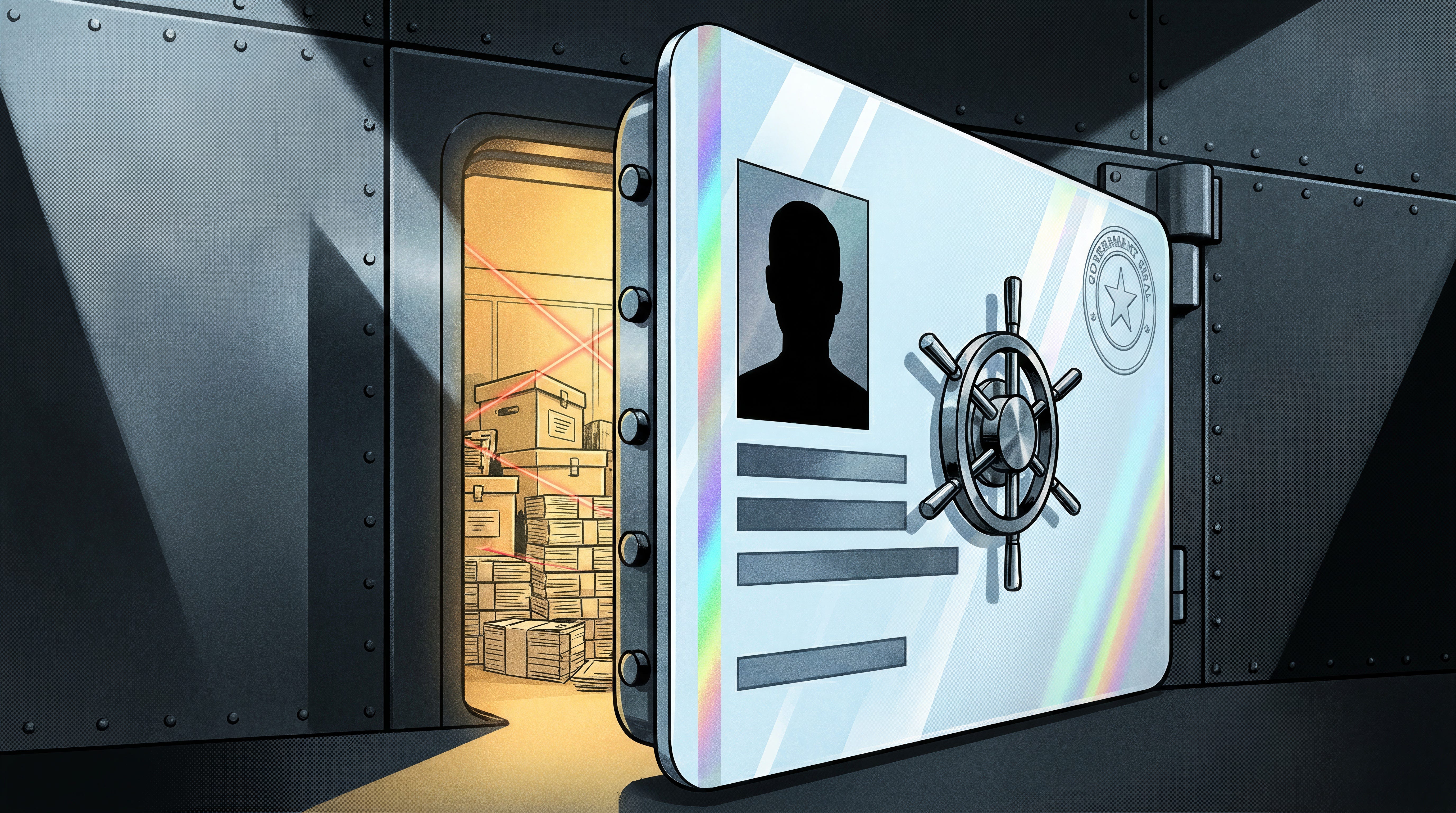
And I answer the question underneath all of it: why this debate won’t die, in one picture — a bank vault — that will help make this whole election fraud conversation make sense.
From here, you’ll learn:
Why invisible safeguards cause election paranoia, and why pointing at an irregularity isn’t proof of a stolen vote.
What China actually downloaded, what was already public data, and what the intel actually proves.
The recalled field report from Albany: the one live thread that holds actual weight and deserves answers.
Why these claims trace back to a compromised source and actually argue against their own headlines.
How treating suspicion as evidence sabotages credibility with independents when it matters most.
