This letter is part of my ongoing series on socialism and capitalism. The last entry: Mamdani’s City-Run Grocery Plan Doesn’t Work. Just Like Socialism.
You can check out Clear Thinker Academy here.
I’ve been in Colombia for the last three months.
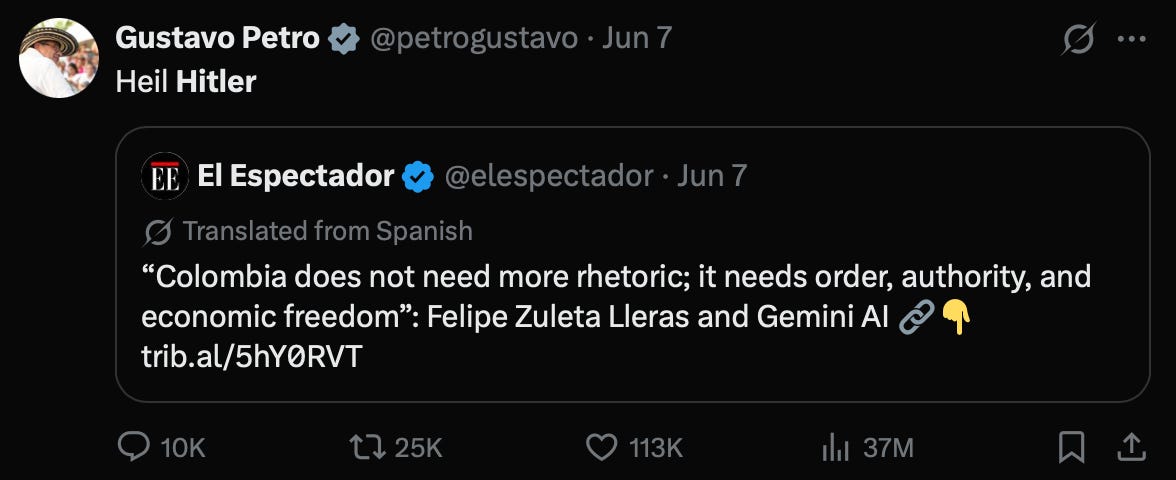
Yesterday, right-wing Abelardo de la Espriella, aka “The Tiger,” was sworn into office, succeeding left-wing self-proclaimed socialist Gustavo Petro.
Colombia, Bolivia, Peru, Honduras, Ecuador, Argentina, Chile, El Salvador — all of these Latin American countries had explicitly socialist, far-left, or Marxist governments that they rejected within the last three years:
Bolivia. Last October, voters ended two decades of rule by a party named the Movement Toward Socialism.
Chile. In December, voters chose José Antonio Kast over a Communist Party candidate.
Honduras. In November, they voted out the democratic socialist party of President Xiomara Castro.
Ecuador. Rejected the heirs of Rafael Correa’s socialist project for the second time in two years.
El Salvador. In 2024, the party of former Marxist guerrillas that governed for a decade — during which the country became the murder capital of the world — was wiped from the legislature entirely. Zero seats.
Peru. Two weeks ago, Keiko Fujimori was sworn in after defeating a leftist who served in the cabinet of Pedro Castillo, the Marxist president Peruvians impeached and imprisoned.
Argentina. The left-wing governments that ran the country for most of two decades nationalized the oil company, the airline, and private pension funds. Inflation passed 200%. In 2023 voters elected Javier Milei, who campaigned on reversing all of that.
Applying the socialist label can be tricky, because it’s an abstract ideology.
Some will argue that a few of the examples I gave aren’t socialism.
They’re right — about the labels.
These movements went by different names.
Some called themselves socialists.
Some were Marxists who never used the word.
Some skipped labels entirely and just governed the same way — nationalizing industries, centralizing control.
Different branding. Same ideology: state control over the market, and wealth as something to seize and redistribute rather than create.
That’s what I mean by “socialism” in this letter.
That’s the worldview that the leaders of all of these countries had.
And it’s what voters rejected.
It’s an abstract ideology, with some variation.
I’ll get more into what socialism technically is later to make things concrete.
But what wasn’t abstract were the results these administrations produced: increased crime, gang violence, unchecked immigration, economic problems.
What wasn’t abstract was the experience of voters who had to live with the actual results of abstract theories — and rejected them.
Meanwhile, in America — the country people fleeing socialism risk everything to reach — socialism is growing in popularity.
66% of Democrats now view socialism positively.
62% of Americans under 30 have a favorable view of socialism.
South America is moving away from socialism, after having tried it.
North America is moving toward socialism, having never tried it.
We shouldn’t have to learn this lesson the hard way.
In my first month in Colombia, on my way back from Spanish class, I met a man who explains all of this better than any thinkpiece could — a deported Venezuelan who called Trump the modern-day Hitler.
But then thanked him in the same conversation.
More on that later.
Americans Don’t Know What Socialism Actually Is
The problem with discussing socialism is that often when it’s discussed, we’re not all talking about the same thing.
Many of the Americans excited by socialism think it’s defined by universal healthcare, affordable housing, free childcare.
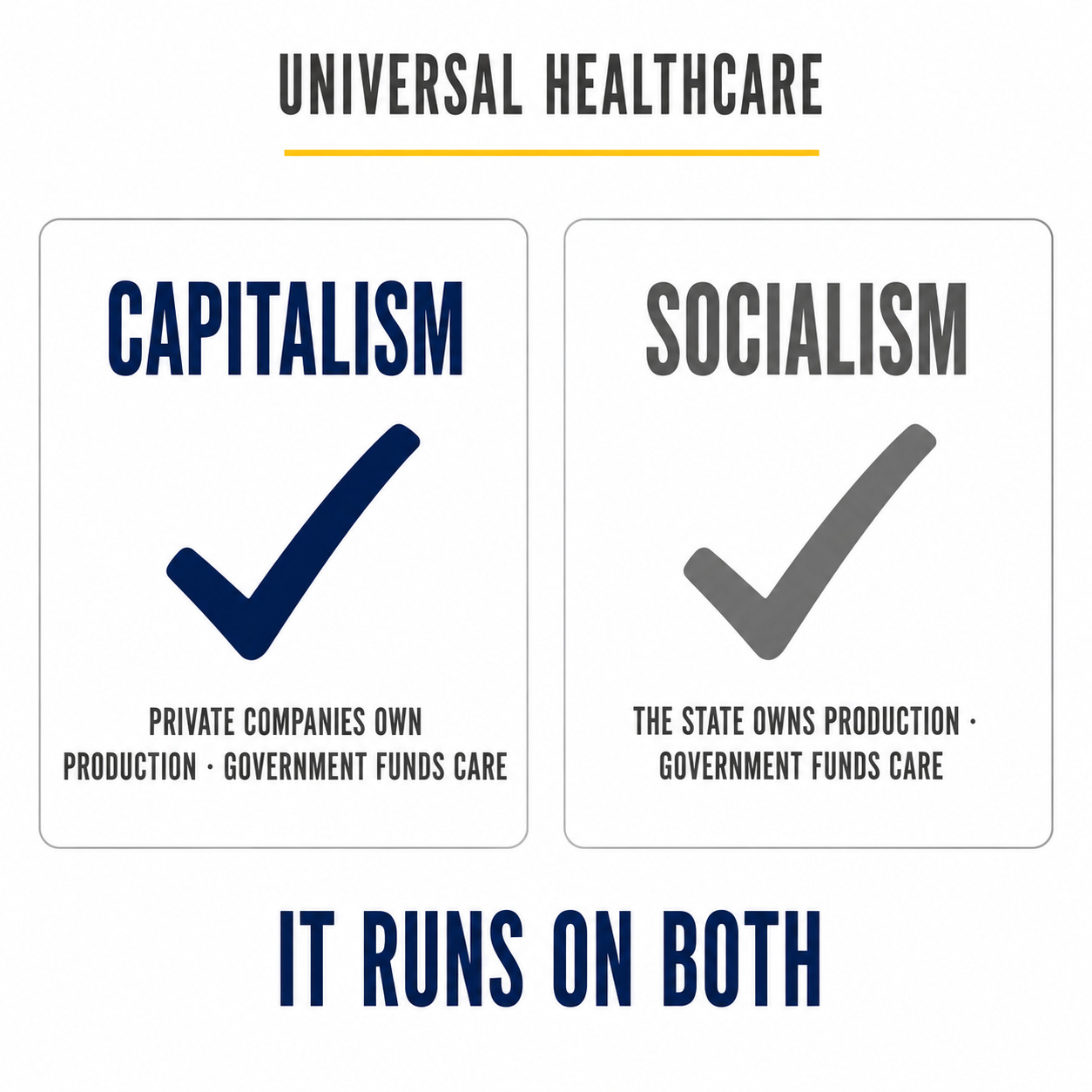
That is incorrect.
Many Americans also think socialism is what Scandinavian countries (Norway, Sweden, Denmark) do.
That is also incorrect.
In the words of Denmark’s own prime minister, from a talk he gave at Harvard in 2015: “Denmark is far from a socialist planned economy. Denmark is a market economy.”
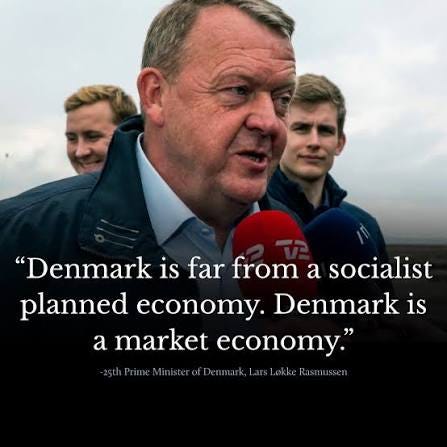
AKA — capitalist.
The confusion is measurable.
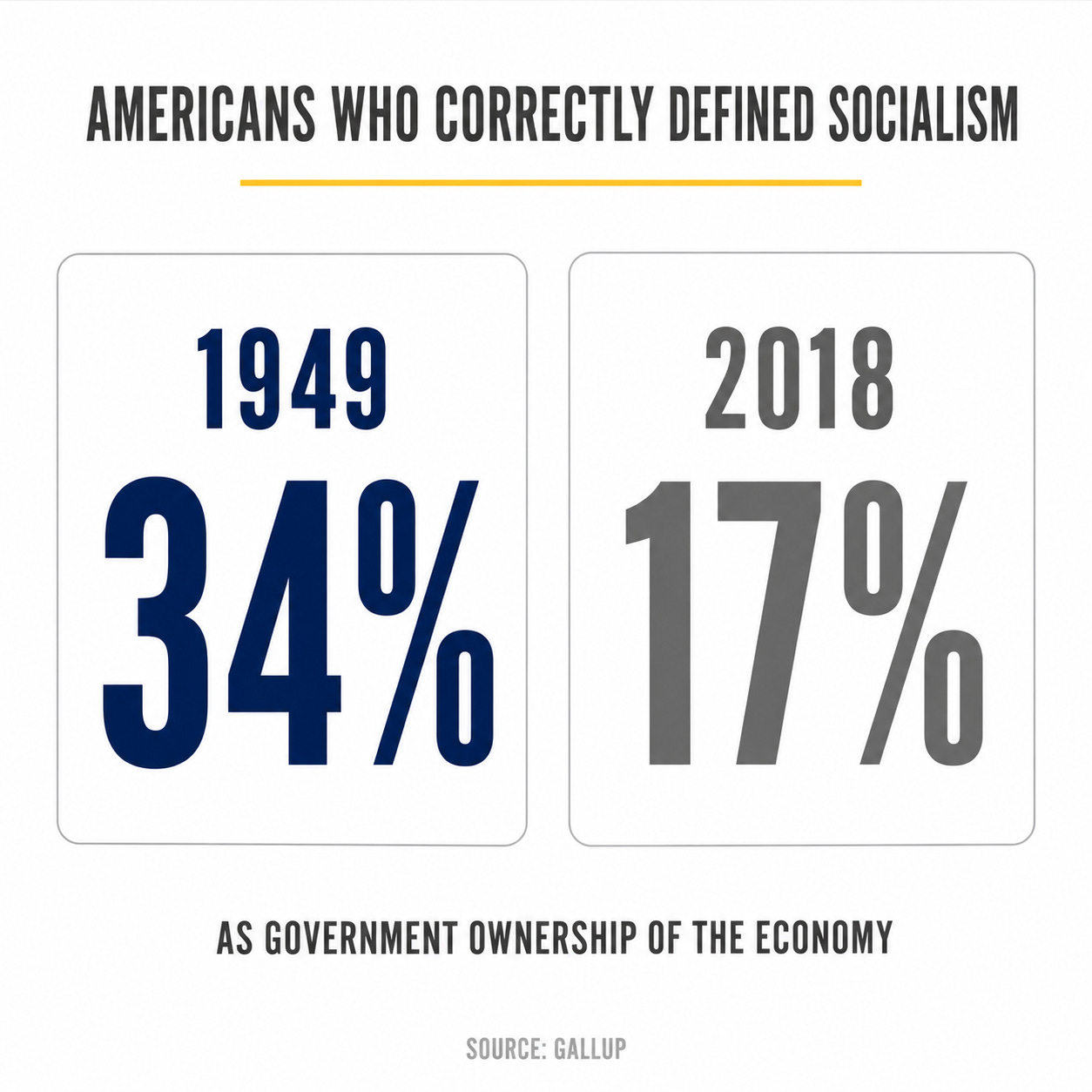
According to Gallup polling: in 1949, 34% of Americans defined socialism as government ownership or control of the economy, and only 2% said “benefits and services.”
The 34% were correct.
By 2018, government ownership had fallen to 17% while “equality” had climbed to 23% — the single most common answer.
The word has drifted from being understood correctly as a description of how an economy operates, to a vibe about fairness.
So let’s restore the definition, because clear thinking requires clear definitions.
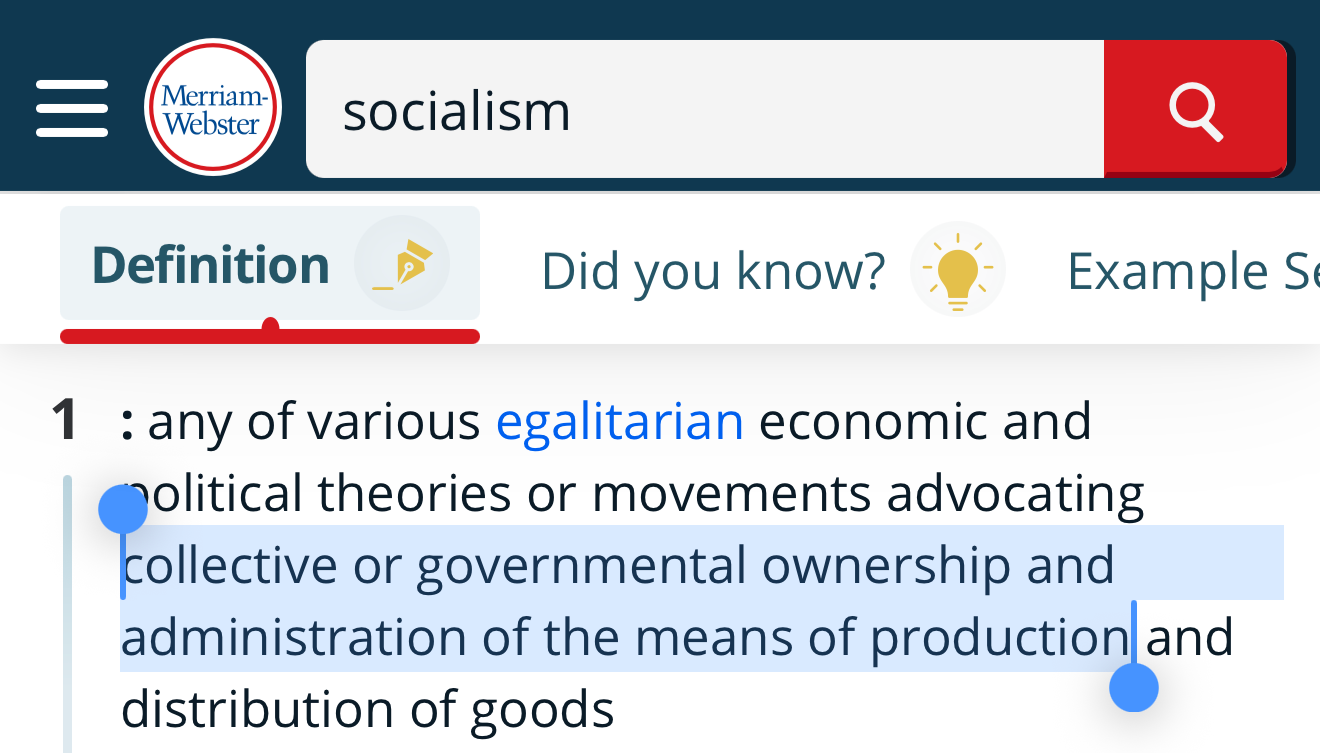
Socialism is defined by one thing: who owns the means of production.
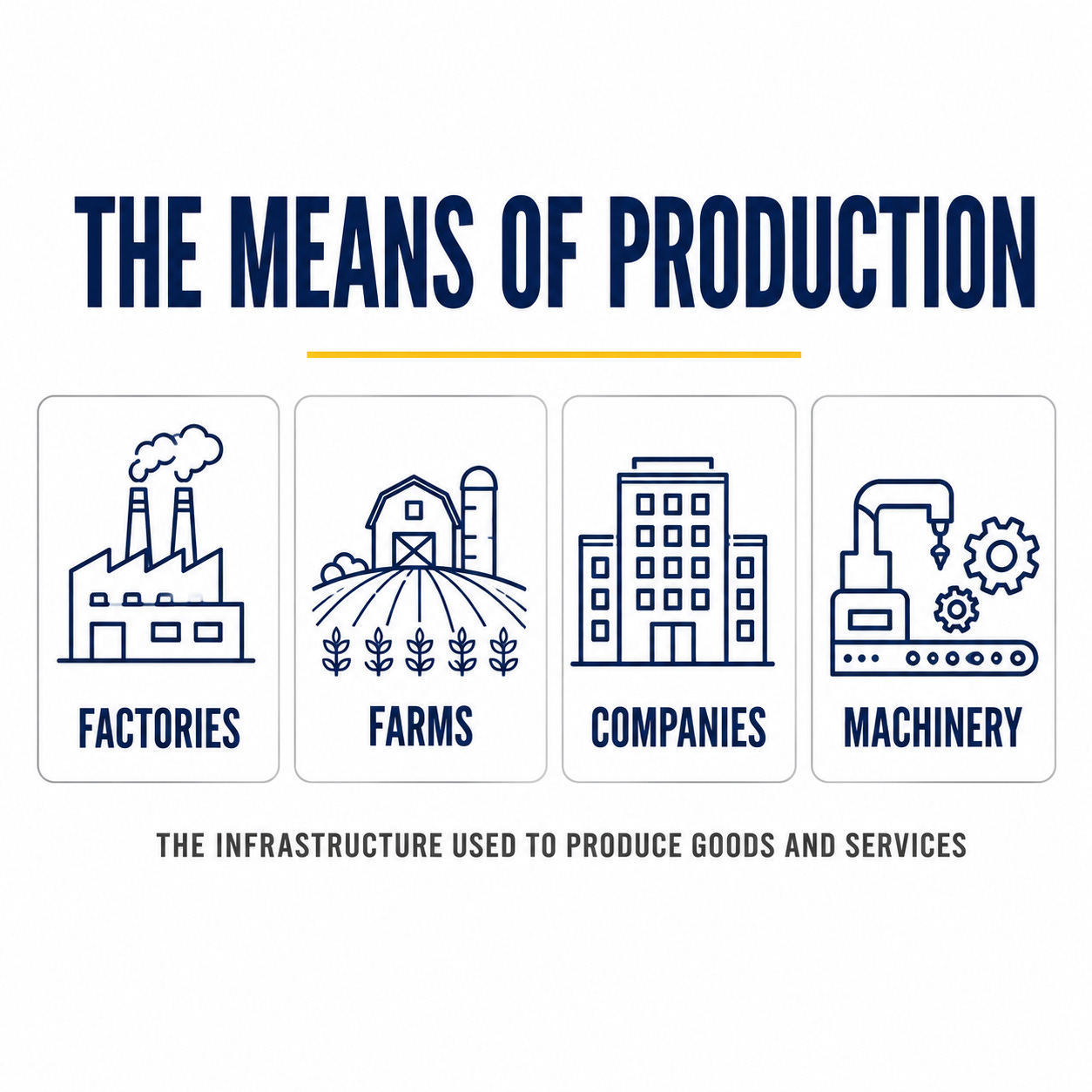
The “means of production” are the infrastructure used to produce goods and services — factories, land, firms, capital. Whoever owns them captures the wealth they generate.
Under capitalism, private individuals own the means of production and keep the profits.
Under socialism, that ownership is through collectives, or the government.
In practice, it’s almost always the government.
That’s the dividing line. Not tax rates. Not government benefits. Not wealth inequality. Not social justice.
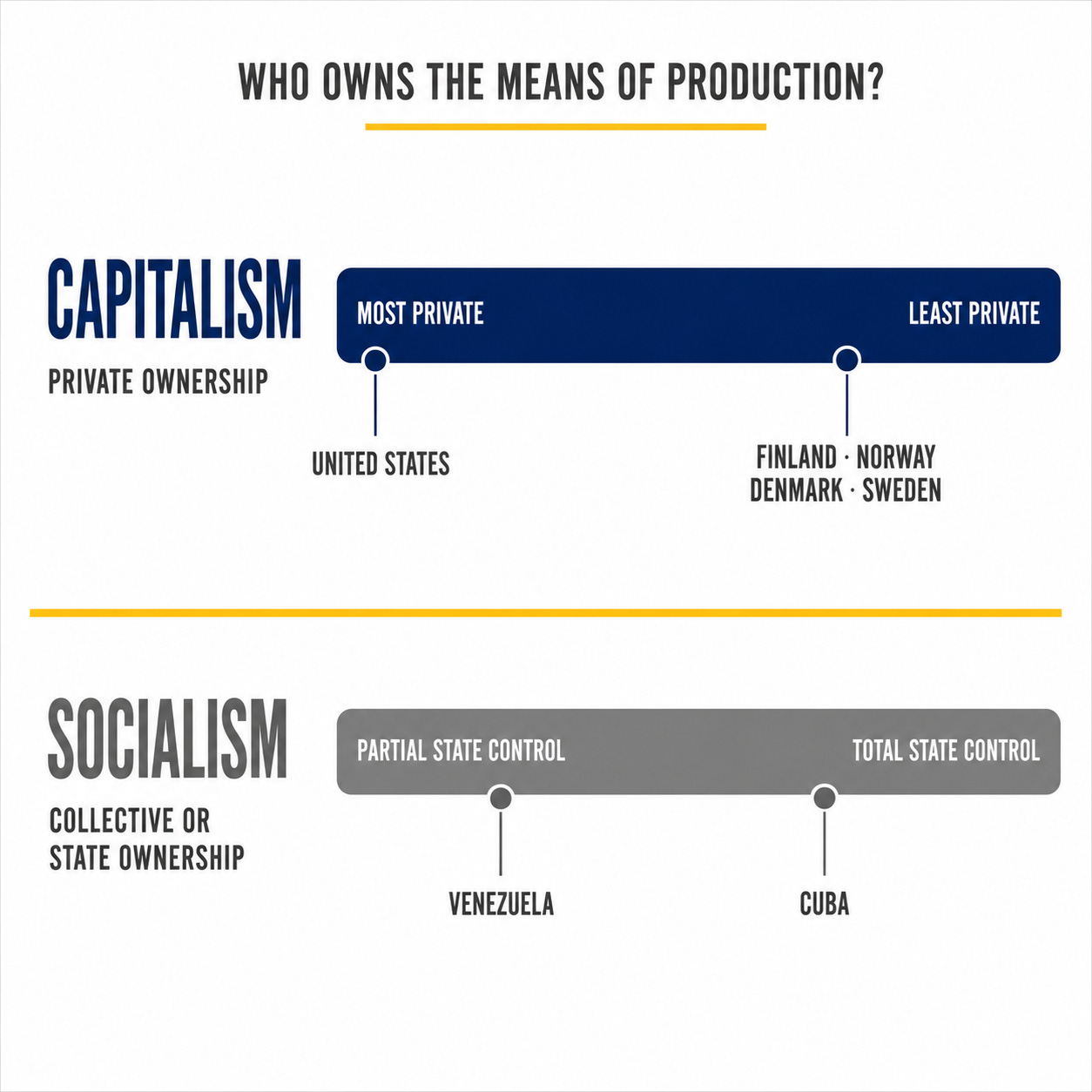
You can have a capitalist system with high taxes, high government benefits, and low wealth inequality — that’s what Scandinavian countries are.
You can also have a capitalist system with low taxes, low government benefits, and high wealth inequality — like Singapore.
Or you can have America — which is in between.
And there are socialist countries where the state controls the money, benefits are generous on paper, and inequality is low. Venezuela. Cuba.
Countries where the taxes are high, but the money doesn’t actually help people.
Countries where government benefits are high on paper, but low quality in reality.
Countries where there’s low wealth inequality — because everyone is poor.
Fortunately for the Latin American countries that recently rejected socialism, they cut the socialism experiment short before it wrecked them.
Some countries, like Venezuela, weren’t so fortunate.
The Venezuelan Who Called Trump Hitler — and Thanked Him
While in Medellín, I met a man who was born in Venezuela and brought to America by his parents when he was a boy.
He lived in America for 34 years.
He was deported by ICE and is now homeless on the streets of Medellín.
He asked me for money, so I gave him some.
We had a conversation about his experiences.
He described Donald Trump as the modern-day Adolf Hitler.
Now you might wonder — why is a Venezuelan-born man who was deported from America living in Colombia? Why not go back to Venezuela?
Because Venezuela has been ruined by socialists.
How bad must the effect of socialism be for a man who literally thinks Trump is the new Hitler to be grateful to him for invading his country of birth and removing its leader?
I’ve heard this story over and over from the many Venezuelans I’ve met here.
Because it turns out that there are many Venezuelans in Colombia.
Because they left Venezuela.
Because of socialism.
Venezuela, which used to be a thriving society — with a capitalist system, oil wealth, and a well-educated population — is just one of the many countries that fell victim to the false promises of socialism.
And in doing so, it’s impacted other countries too.
Like Colombia, which has a large population of Venezuelans looking for a better life, and now has to deal with the challenges of integrating a large foreign population fleeing socialism.
While Colombia itself suffers from the effects of guerrilla violence, which increased under Petro.
Most Americans, especially those under 30, aren’t well-educated on the actual impact of socialism in history or modernity.
I’ve had multiple Venezuelans tell me in frustration that they see Americans who don’t know anything about Venezuela standing and protesting Trump’s arrest of Maduro, while those who actually lived under Maduro are thrilled to see him go.
Venezuela followed a familiar pattern:
Socialists and Marxists promise people abundant free services and equity, and get in power.
They redistribute wealth — through taxes, seizures, and state revenues.
They replace private industry with government control.
Initially, things seem to be going well.
Over time, less wealth is created, because private industry is always better than government at creating wealth.
Over time, the public sector goes from being controlled by the people to being controlled by the bureaucrats.
Bureaucrats continue to seize control, because the people don’t have economic leverage (the wealth has been seized) and don’t have physical leverage (they don’t have weapons).
Removal of the bureaucrats becomes impossible without force — which the people no longer have.
At least everyone is equal now — equally poor.
Socialism hasn’t just “not been done right.”
It almost certainly can’t work, because it destroys the source of wealth it seeks to redistribute.
I say “almost” because there’s a nonzero chance technology someday makes massive, efficient government possible.
Unless today’s socialists have a secret AI model that can do this — that day is not today.
“But That’s Not Real Socialism”
Most of these countries never completed the conversion to socialism.
That doesn’t mean socialism wasn’t tried. An ideology is tried whenever the people who hold it get power — and it’s judged by what they do with it.
Petro said it plainly in 2025: “I am a socialist.” He never made Colombia socialist. His worldview still ran the country for four years.
Mamdani is running New York right now. If the city declines under him, “but New York never became fully socialist” will not be a defense of socialism. A socialist with power, governing from a socialist worldview — that is socialism being tried, whether or not the conversion completes.
That’s what happened across Latin America.
Voters didn’t reject an abstract ideology.
They rejected its concrete results.
And the deeper the conversion went, the worse it got — Venezuela went furthest and fell hardest.
“It just needed more time” is not the lesson.
The reverse objection comes from the other direction: “Norway’s government owns oil companies, so Norway is socialist.”
No. Socialism is when public ownership is the rule. A few state-owned companies are the exception that proves the rule — Alaska has oil revenue too.
How to Talk Someone Out of Socialism Without Losing Them
I’m writing a lot about socialism because I think it’s a bad idea.
That said, simply calling something a bad idea doesn’t change people’s minds.
Many of you have friends or family who find socialism appealing.
Here are some concrete instructions to help you in those conversations.
First. Never argue against socialism in the abstract. You’ll both lose. Do this instead.
Step one: ask them to define it. “When you say socialism, what do you mean by that?” Nine times out of ten you’ll hear: healthcare people can afford, housing people can afford, childcare, education.
Step two: agree with the goals. Sincerely — assuming you share them, and I do. “I want people to have healthcare and housing they can afford too.” You’ve just converted a duel into a collaboration. Most political conversations die before this sentence gets said.
Step three: offer the actual definition. “Can I share what socialism technically means? It’s about who owns the farms, factories, grocery stores, and companies that produce everything. Socialism moves that ownership from entrepreneurs and businesses to centralized control — usually the government. The question it answers is who owns production, rather than which services people receive.”
Step four (if they bring up Scandinavia): “The countries you’re pointing to are market economies with strong safety nets — funded by taxing private wealth creation. Their own leaders insist on this. So what you might want is better capitalism — and that, we can build.”
Step five: only now, the evidence. Venezuela, where socialism went all the way. A continent’s rejections everywhere it went partway. Presented as data to consider, rather than as a gotcha.
We practice conversational strategies like this in Clear Thinker Academy, and help people be honest without losing relationships.
If you’d rather train these skills than just read about them, that’s what the Academy is for: clearthinkeracademy.com
The Fix: Revert to the Previous Working Version of Capitalism
The worst way to fight socialism is to defend the current version of capitalism. The current version is the recruiting poster for socialism.
What we’re running now is captured capitalism.

Since Citizens United, outside political spending exploded from $574 million in 2008 to $4.5 billion in 2024.
A single billionaire matched the combined donations of three million small donors.
Corporations shipped labor abroad, institutional investors outbid families for starter homes, and the rules are increasingly written by the industries they’re supposed to govern.
Young people conclude the game is rigged because, in the ways that touch their lives most, it is.
Socialism’s appeal is a symptom. Captured capitalism is the disease.
And the cure isn’t even theoretical.
We can start by just reverting to the previous working version of capitalism.
In 1996, socialism had no constituency in this country.
Because capitalism was delivering: rising wages, attainable homes, a middle class that could plan a future.
That system — markets that compete, a government that isn’t totally for sale — was the last working version, and restoring it is a repair job: through campaign finance reform and smarter laws so more housing can be built.
The way to beat socialism is to give people a capitalism worth keeping.
Know a Tree by Its Fruits
You don’t need history books to evaluate socialism anymore.
You don’t even need a passport.
You can go look at the results in the present day — or talk to the people in America who escaped them.
The evidence is alive, it speaks Spanish, and for three years it has been voting — in country after country — against socialism.
An entire continent tried this worldview at every level of intensity and is climbing out of the hole.
America needn’t stand at the edge of that hole, asking what would happen if we jumped in too.
Below the paywall, four more analyses:
A Latin American socialist associated his opponent with “Hitler” — sound familiar?
The socialist playbook — the same tactics, in every country, and the tells to watch for as they arrive here
The strategic errors the right is making in response — and why they’re handing socialists easy wins
And the USAID question: was this socialist control paid for with U.S. money?
The Socialists Use the Same Tactics Everywhere