


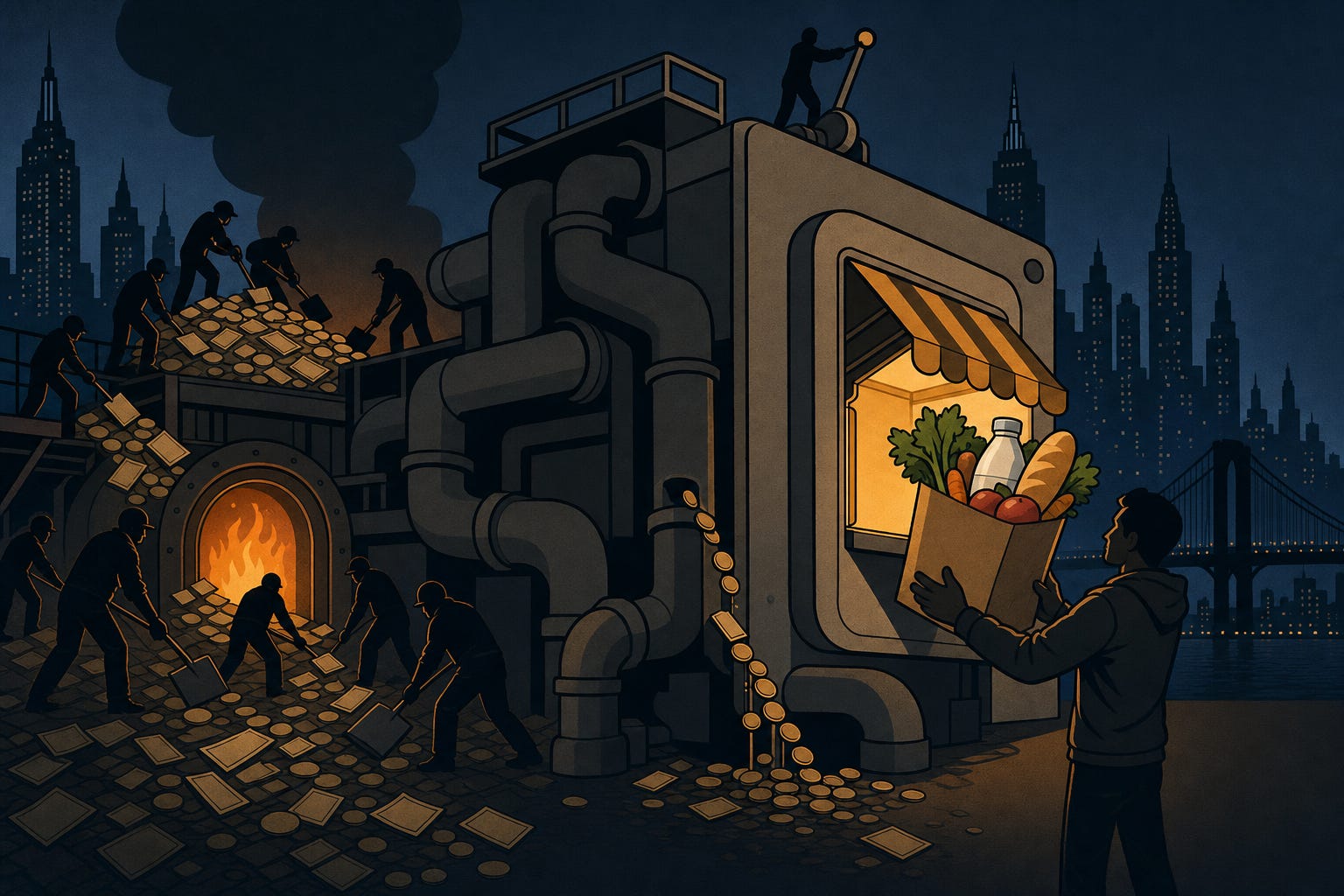
On Monday, Mayor Mamdani announced the details of his signature campaign promise: five city-owned grocery stores, one in each borough, funded with $70 million in capital costs just to build buildings, and recurring costs to fund staff and overhead.
A core basket of groceries — all fresh produce, meat, and seafood, plus about 20 categories of staples — will sell at a 30% discount, with prices locked in monthly.
The city covers rent, property taxes, and construction.
Private grocers run the day-to-day.
And the discount applies to everyone, at every income level.
Let me be upfront about why I’m writing about this.
In one sense, it’s a small story.
$70 million is a lot of money to you and me.
Relative to New York City’s $100+ billion budget, it’s tiny.
But in another sense, it’s crucially important.
Because it’s the perfect example of what’s wrong with socialism, and a tangible opportunity to make that clear.
And to show my cards: I am extremely concerned about the rise of socialism in America.
It’s much more likely that socialism doesn’t work in principle than that it just hasn’t worked in practice.
Because it violates basic economics the way a perpetual-motion machine violates basic physics.
Mamdani’s grocery store “experiment” shows exactly how. More on that word later.
The math
Grocery stores survive on 1-3% profit margins. Among the thinnest of any industry.
Mamdani’s plan mandates a 30% discount on the most expensive, most perishable categories in the store: produce, meat, seafood.
The city’s contribution — covering rent and property taxes — buys back maybe 10 of those 30 points.
If you live in New York, the other 20 come from you, through an ongoing taxpayer subsidy.
Which means the more groceries these stores sell, the more taxpayers pay.
These will be the only stores in New York where success makes the owner poorer.
You’re the owner.
We don’t have to speculate about where this leads, because the federal government already runs this exact model.
Military commissaries deliver roughly 24% savings for service members, and it takes about $1.4 billion in taxpayer funding every single year to sustain it.
The discount was never free.
It was billed to someone else.
So these stores don’t lower the price of groceries.
They move who pays, from the person at the register to everyone else.
Now, that isn’t a problem in principle.
We run several safety net programs in America: Welfare. Food stamps.
None of them are profitable. None of them are designed to be.
They exist to move money toward the people who need it most.
I’m fine with that.
The question is never whether we help.
The question is how efficiently the help arrives.
And this is one of the least efficient ways anyone has come up with.
Where the money actually goes
Start with $70 million to build the buildings.
Then recurring costs for rent. Property taxes. Staff.
Every one of those dollars is spent before a single dollar reaches a shopper as a discount.
The subsidy on the groceries is the only part that actually helps anyone. Everything else is overhead.
Now put a number on it.
The city projects the discount saves a household about $1,000 a year.
The buildings alone cost $70 million.
For the price of the construction alone, you could hand $1,000 to 70,000 households.
The East Harlem store by itself costs $30 million.
That’s $1,000 that could be given to 30,000 households, more than half the households in the neighborhood it’s being built in.
And that’s before rent. Before staff. Before a single discounted apple.
The other counterargument would be that the $70M+ is a capital expenditure — you spend a lot up front so that you get efficiency down the line.
The logic would be: the upfront cost of building infrastructure is high, but the high fixed costs are made up for with lower variable costs over time.
That logic is sound. It’s how every serious business thinks about investment.
But that’s not what’s happening here.
Mamdani is building a bunch of infrastructure that doesn’t need to be built to deliver groceries to people who already have access to groceries.
These buildings don’t lower the cost of a single item on the shelf. The discount runs entirely on subsidy, forever, whether the building exists or not.
Poor people don’t need more grocery stores.
They just need groceries to cost less, or more money to buy them.
And it costs time
This is not just an inefficient use of money, but also time.
Mamdani was elected because people want relief from the high cost of living ASAP.
The first store opens at the end of 2027. East Harlem waits until 2029.
So a family that can’t afford groceries this month gets nothing from this for 1.5-3 years.
A check clears in a week.
He is spending $70 million and several years building something people don’t need in order to eventually deliver something they could have had immediately.
Moreover — this is creating competition with privately owned grocery stores, which are operating on 1-3% margins, largely because of high costs.
Helping them would help the poor in a far more sustainable fashion.
See Through The Spin
Everything I just walked you through took me a couple of hours. The city’s own release. What the $70 million actually buys. When the doors even open.
It took me hours because I wanted to give you a deep dive and analysis.
But it doesn’t need to take you hours to get the key info if you use Ground News.
It’s been my favorite news app for two years, since well before they ever sponsored me, and Bias Comparison is a huge reason why.
It turns bias into data you can see instead of distortion you absorb.
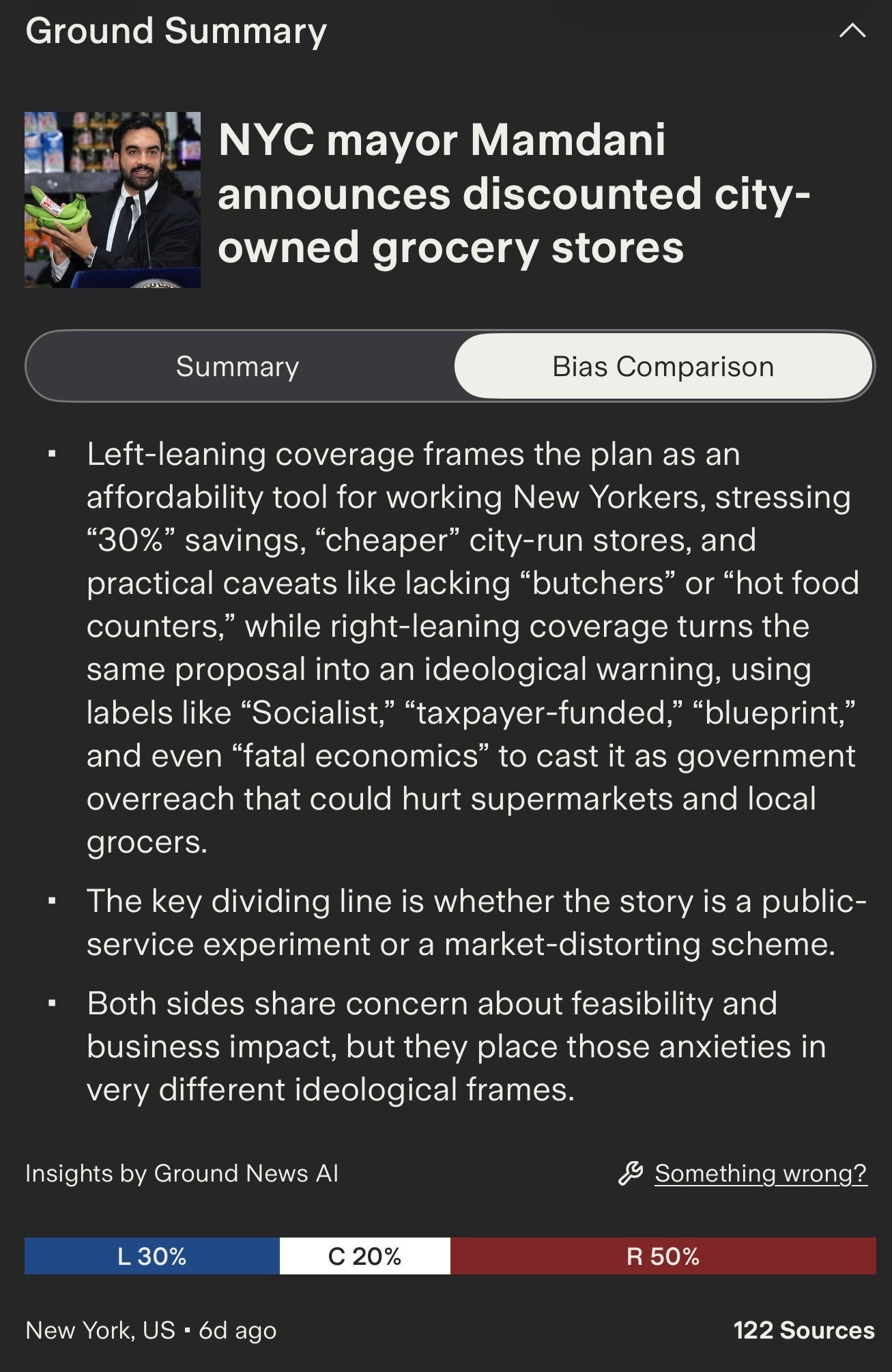
Look at this story. 122 sources. 50% right-leaning, 30% left, 20% center.
Right away that tells you something. This story is being covered more heavily on the right than the left, and the split follows a pattern you’ll see in almost every one of these fights.
The right is framing this as bad policy and incompetence.
They’re correct.
The left is framing it as helping the poor, and they keep stressing the savings.
They’re correct that we need to help the poor.
They don’t seem to understand that this is a terrible way to do it.
But the right is once again not taking the opportunity to solve it either.
They’re pointing at the failure.
They’re not offering anything better.
Being right about a bad plan is not the same as having a good one.
You can see all of that in one screen with Ground News, which helps you escape echo chambers.
When you can see how each side is spinning a story, you can also see what both of them are leaving out.
And usually that’s where the actual answer is.
You can get 40% off the Vantage plan at groundnews.com/kaizenx.
Signing up keeps you informed, and it directly supports the work I do here.
The best argument against me
There’s one serious objection here, and it deserves a straight answer.
A mayor can’t expand food stamps. SNAP is federal. And right now federal work requirements are pushing thousands of New Yorkers off their benefits. So when I say “just give people the money,” a defender can reasonably respond: he doesn’t have that lever. Grocery stores are a thing a mayor can actually build.
That’s the strongest version, and it’s still wrong.
New York City funds its own cash and voucher programs all the time. It does not need Washington’s permission to put money on a card.
If the city can find $70 million for construction, it can find $70 million for groceries, and the second one arrives this year instead of 2029.
The experiment
Whenever this plan gets challenged, the same word shows up in its defense.
“Experiment.”
“It’s an experiment. A test. Five stores. Let’s see what happens.”
An experiment requires genuine uncertainty.
You run one when you don’t know the answer.
You have a hypothesis, you design a test that could confirm or deny it, and you accept whatever comes back.
So what’s the hypothesis here?
That subsidized groceries will be cheaper than unsubsidized groceries?
Of course they will. Taxpayers are paying the difference. The result is guaranteed before the doors open.
It would be like me saying: I’m going to run an experiment where I knock over a glass of milk to see whether the milk falls out of the glass.
You already know the milk falls out of the glass.
All you’re doing is making a mess and calling it an experiment.
If prices come in lower, you take credit for a result you prepaid with public money.
If the whole thing collapses, well, it was only ever an experiment.
Heads, they win. Tails, you paid for it.
These stores will open. They’ll be busy. Prices will be lower. There will be a ribbon cutting and a press release with a number on it.
That’s not success.
The question was never whether you can sell groceries below cost.
Anyone can sell ten-dollar groceries for seven if someone else covers the three.
The question is whether this is the best use of the three.
It’s not. Not even close.
So why does this keep happening?
Not the politics of it. The thinking behind it.
Because this same mistake shows up in socialist policy after socialist policy, and once you can see the pattern, you can spot it coming a mile away.
That’s what I want to get into below: the specific blind spot that produces plans like this, why it’s so persuasive to young people — even the really smart ones — and what actually solving this problem would look like.
From here, you’ll learn:
How building my first business changed what I understood about where money actually comes from.
Why even brilliant people confuse prices with choices, wealth with theft, and redistribution with creation.
How zero-sum thinking turns “billionaire” into an accusation and makes socialist policies feel morally obvious.
The only three explanations I can build for a grocery plan that cannot work—and the explanation missing from the list.
What competent compassion would actually do to lower grocery bills and fix capitalism instead of replacing it.
