


This is part of my ongoing series on the Iran war. Read the full series here.

There’s been a lot of negativity about this war since the beginning.
And that’s understandable, because war is hell, the reasons for this war are abstract, and most people don’t see the benefits, they just see the cost.
But there’s been such committed negativity about war, Trump, and Israel that at this point, people are looking to confirm the worst rather than see the reality.
So let’s address each of these claims so you can decide for yourself where things are at.
Is $300B of American taxpayer money going to Iran?
The moment the memorandum was signed between Trump and Iran, commentators leapt on one particular passage, promising a $300 billion reconstruction fund for Iran.
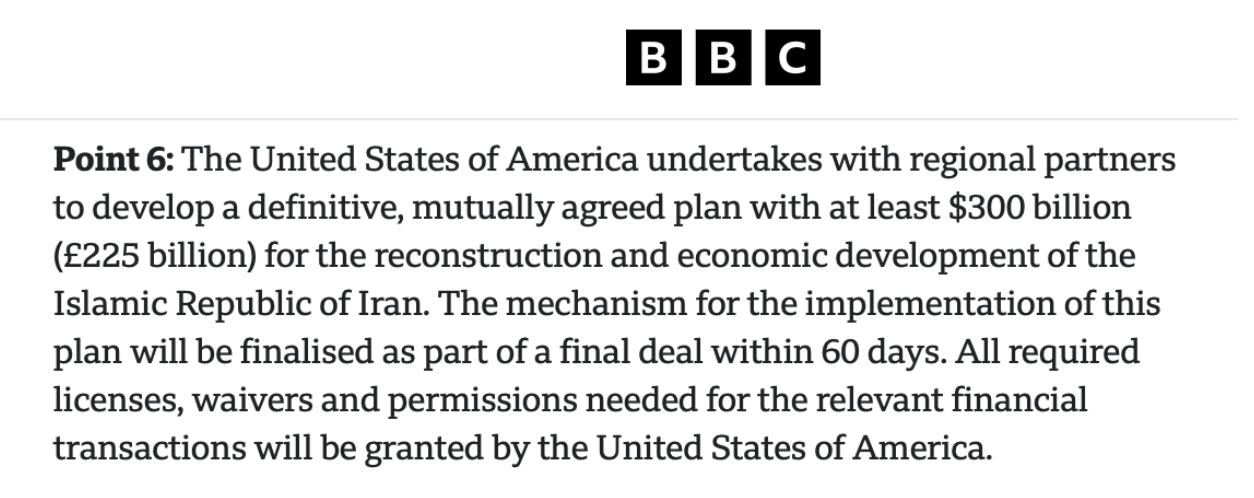
It’s easy to misread this as the U.S. committing to giving $300 billion of taxpayer money to Iran, especially with confirmation and negativity bias.
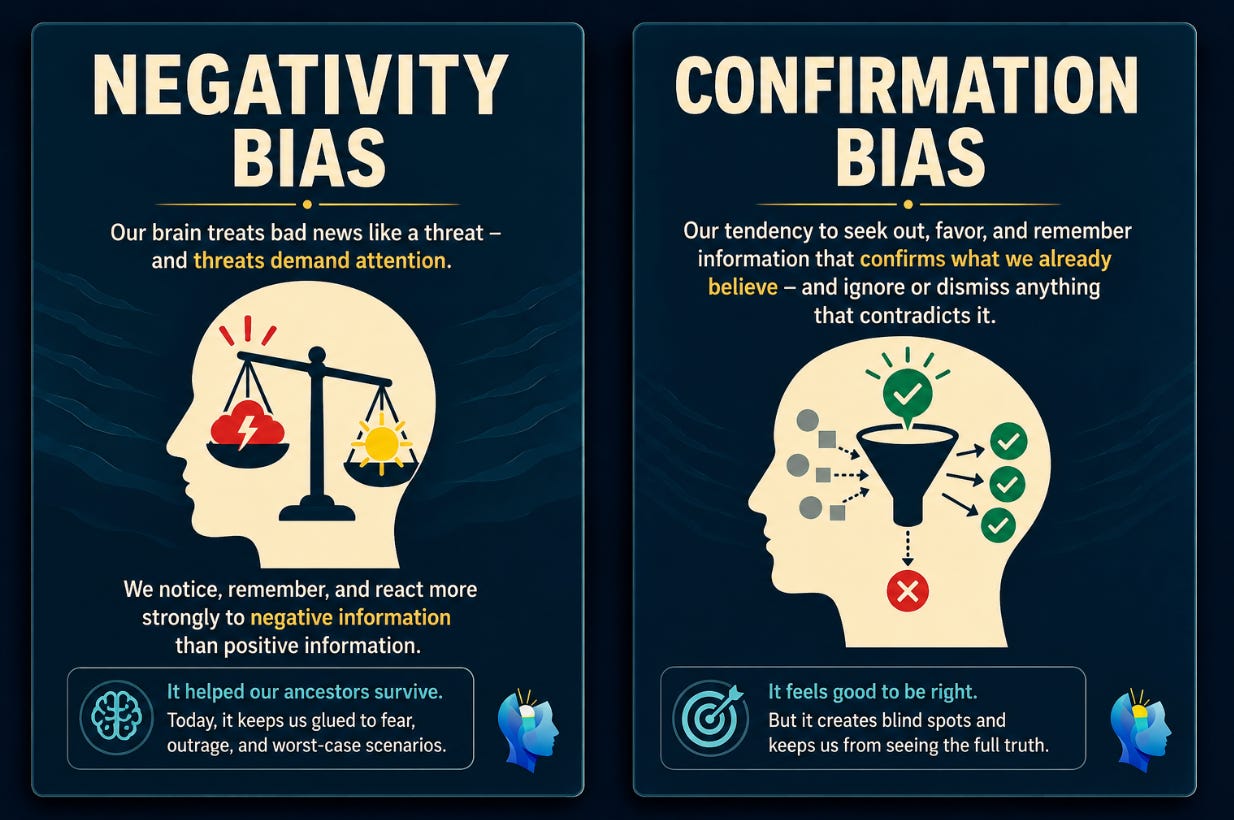
But that’s not what it says.
The truth is the text itself leaves flexibility and room for interpretation.
The key clauses here are:
“with regional partners”
“the mechanism for the implementation of this plan will be finalized”
“With regional partners” means that there is a spectrum of scenarios, ranging from the U.S. paying all $300 billion to regional partners paying all $300 billion.
The second clause means that which scenario is going to happen has not been locked in.
There’s a third line in that passage worth addressing, because critics jump straight on it: the part where the U.S. grants “all required licenses, waivers and permissions” for the transactions. That is not the U.S. writing a check. That is the U.S. clearing the legal path, lifting the sanctions walls it built so the money can legally move.
Clearing the road is not the same as paying the toll.
So the honest truth is: we do not know which scenario will happen.
But we do have a clue, and it comes from the Commander in Chief himself:
As well as Vice President JD Vance:
Reasonable minds can disagree over whether any money should go to Iran, how much money should go to them, and under what conditions.
But it’s not true that American taxpayer money is going to Iran. At least not yet.
The truth is that the stated intention is not to use American money, and the reality is that we won’t know whether that intention will be honored until the final deal is signed.
America lost the war
From the start, commentators forecast this war’s outcome with total certainty.
Given the inherent uncertainty of war, I don’t know how they were so certain — maybe they’re just smarter than me.
But there’s a sleight of hand associated with practically all of these predictions — they declared that America would lose without defining what losing actually means.
This is a microcosm of a broader problem with political discourse — people use terms without being precise about what they even mean.
Does “losing” mean:
The Islamic Republic stays in power?
Iran keeps any nuclear program at all?
Iran eventually builds a bomb?
Iran can still threaten America?
It’s easy to make predictions when you don’t identify what would make your prediction wrong.
Winning and losing are subjective, but the closest we can get to objectivity is understanding what the explicitly stated goals of the war were, and how America fared relative to those goals.
Fortunately, we have those readily at hand.
Despite the social media outrage-industrial complex’s insistence that the war is just about Israel, solely about Israel, and every other possible reason is a lie (more about that later), we do have clearly stated, albeit less salacious, goals from the Trump administration:
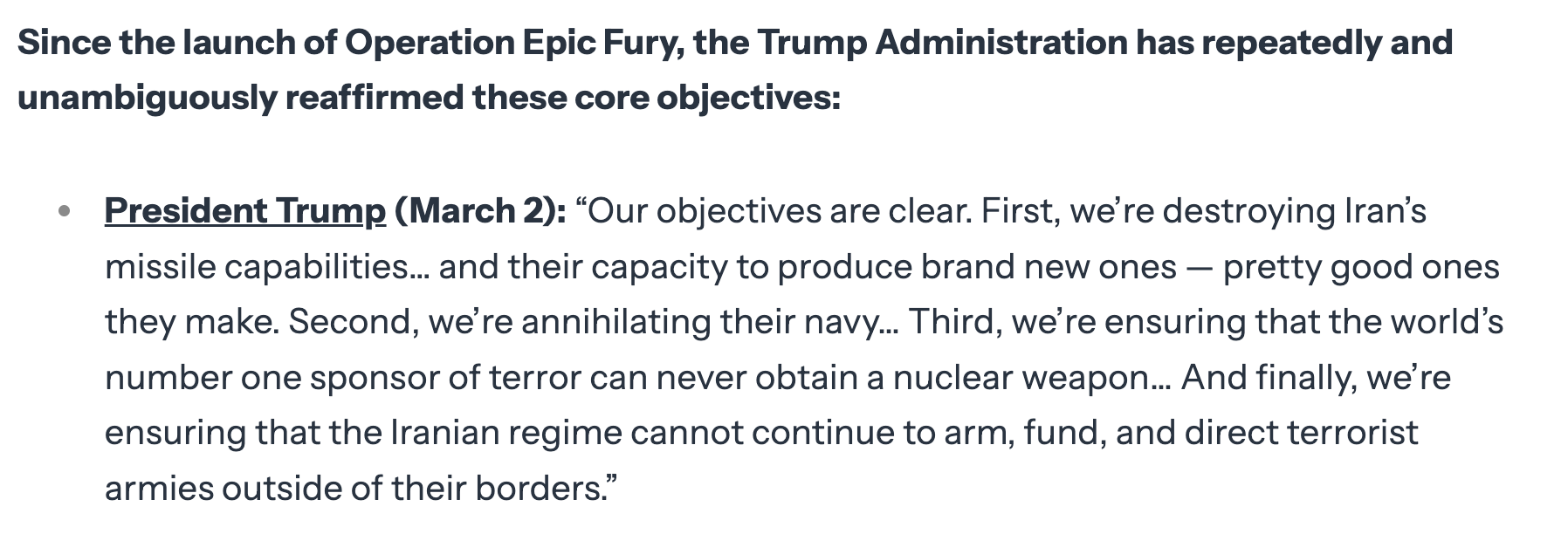
On March 2, Trump stated four goals:
Destroy Iran’s missiles
Annihilate their navy
Remove their support for terrorists like Hamas
Make sure they can never get a nuke
After the deal was signed, Trump positioned it as a triumph, partially because oil prices are going down, the Strait of Hormuz is open, and the fighting has ended.
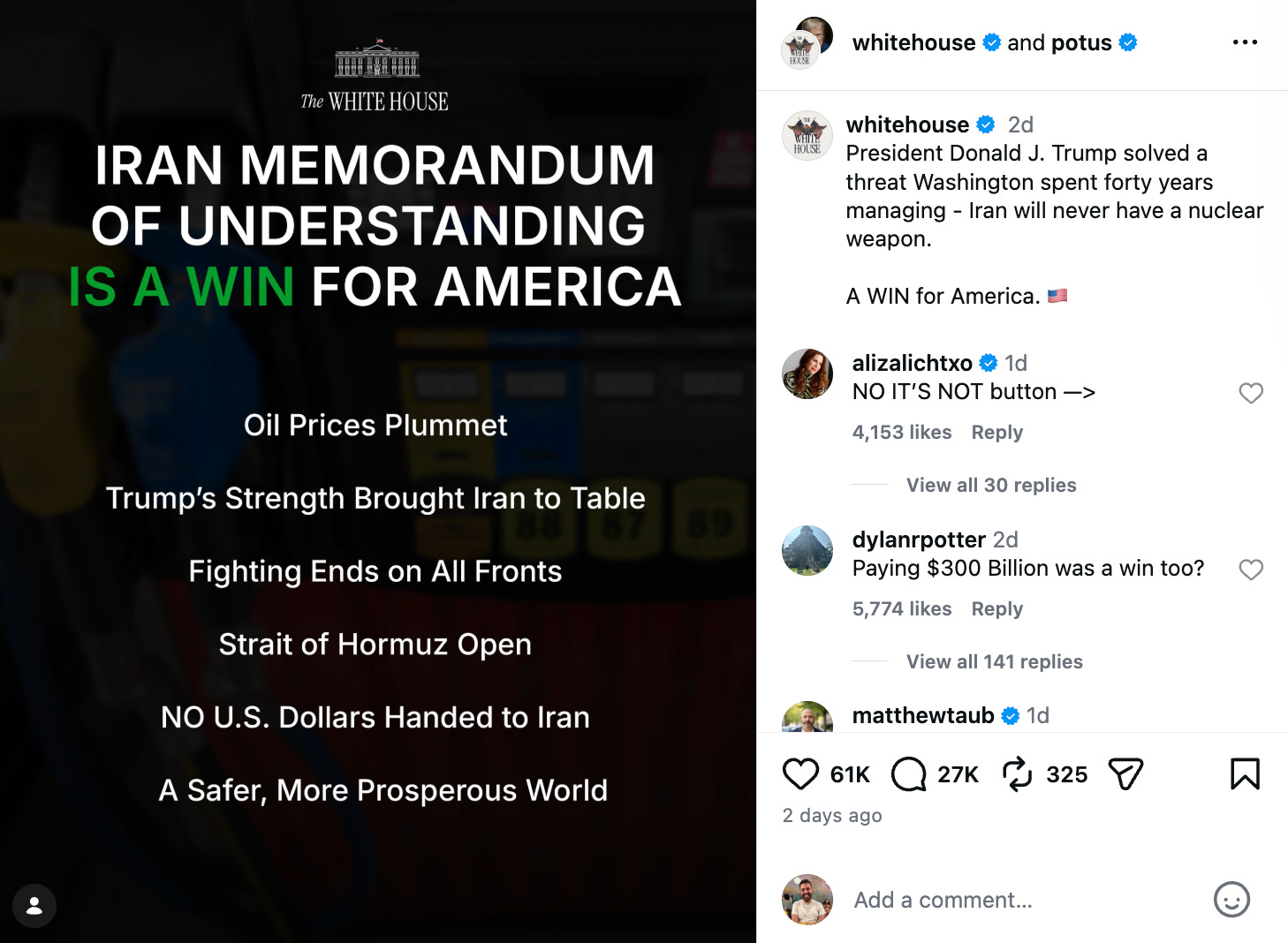
These are all good things, but of course, none of those were a problem before the war began, because the war is what caused oil prices to go up, the Strait to be closed, and the fighting to start.
So between Trump’s triumphalism and the mainstream media/social media’s rampant negativity lies the truth.
What the truth is, is difficult to ascertain through the fog of war for everyone, me included.
But let’s give it a shot.
Now, a quick caveat before I try to score any of this. The moment I hit publish, this article starts going out of date. The war is uncertain. It is also volatile. The facts move by the hour, and the spin moves faster than the facts.
I have spent this entire war hunting for a clean through-line, and social media often actually gets in the way.
It is so loud, so confident, and so contradictory that you can scroll for an hour and come away knowing less than when you started, a little dumber and a lot angrier.
So here is what I do.
I track these stories on Ground News.
It has been my favorite news app for two years, since well before they ever sponsored me, because it hands me the high-level picture without the hours of scrolling and without the mental pollution that comes with them.
The feature I lean on most is Bias Comparison. It lays the coverage side by side and shows you how the left is spinning a story right next to how the right is spinning it, so the bias turns into data you can see instead of distortion you absorb without noticing.
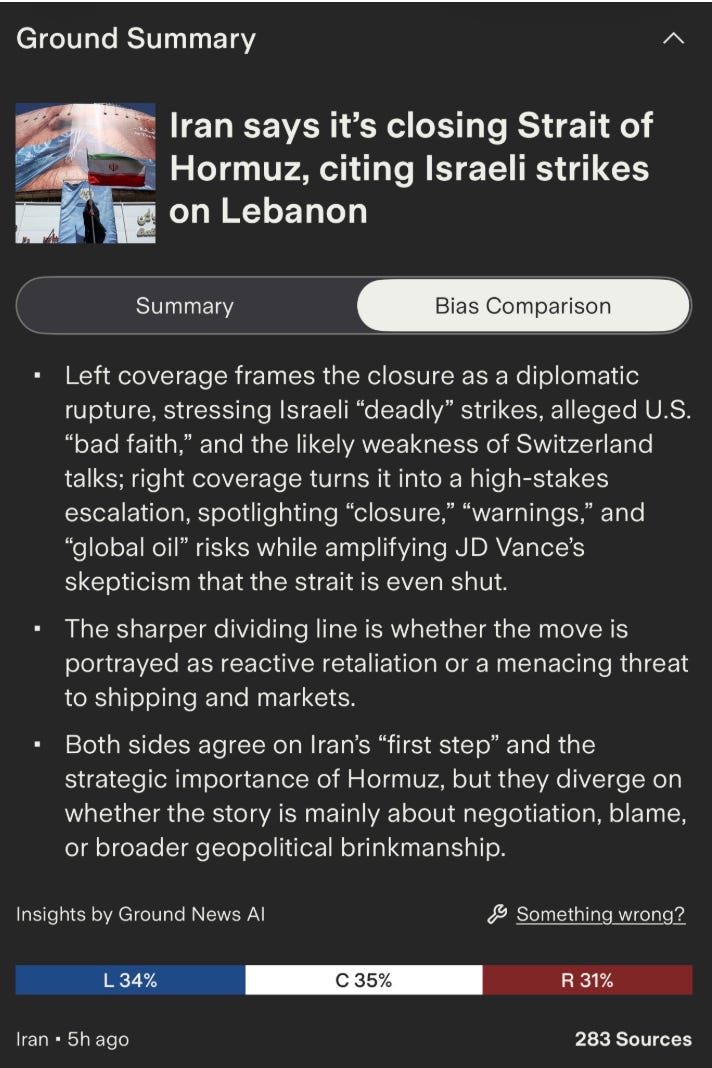
Here is a live one, on the Strait of Hormuz.
Look at the split. Read the left coverage and the story is that the West broke this. Israel’s strikes provoked Iran, Washington bargained in bad faith, and Iran is only reacting to being wronged. Read the right coverage and the story is that Iran is the danger. It is choking off the world’s oil, or maybe bluffing that the strait is even shut. Same closure. To one side, Iran is reacting to a wrong. To the other, Iran is the wrong. The facts barely move. The villain flips.
Same event.
Two different stories.
And as Ground News flags, the real fight underneath is whether this was reactive retaliation or a menacing threat to global shipping.
That split is the whole game I have been trying to show you in this piece. Triumphalism on one side, catastrophizing on the other, and a truth in the middle that you have to dig for.
Ground News is the shovel.
You can get Bias Comparison and everything else for 40% off the Vantage plan, their top tier, at groundnews.com/kaizenx.
Signing up keeps you informed, and it directly supports the work I do here.
How the U.S. fared against its four goals
Before scoring it, one honest caveat. Almost every damage figure below comes from the people who did the bombing. The U.S. and Israel claim more destruction. Iran claims less. Independent verification is thin, because Iran shut down the internet and cut off weapons inspectors. So treat these as ranges, not gospel.
Goal one: destroy the missiles and the production base.
This one splits in two, and the split is the story. The factories took a beating. CENTCOM said allied operations damaged or destroyed more than 85 percent of Iran’s ballistic missile, drone, and naval industrial base. [1] The existing arsenal is a different question, and the agencies fight about it. Israeli estimates put the losses at a third to half of the missiles and about half the launchers, while U.S. intelligence, cited by the New York Times in May, said Iran retained roughly 70 percent of its prewar stockpile. [1] Five weeks in, U.S. intelligence assessed the strikes had degraded only about half of Iran’s missiles and drones, with thousands of Shahed attack drones still in hand. [2] What is not in dispute is that the launch capability cratered. Iran’s fire rate collapsed by about 92 percent, and more than 60 percent of its launchers were knocked out. [3]
So Iran can barely build new missiles, but it likely still sits on a four-figure pile of old ones. One number is the workshop. The other is the warehouse.
Status: partially achieved. Production gutted, arsenal dented, launch capability wrecked, a residual force still standing.
Goal two: annihilate the navy.
This is the cleanest win of the four. Forty-three Iranian naval vessels were destroyed or damaged, [3] and the navy was folded into that same 85 percent industrial-base figure. Trump put it plainly in his April address: their navy is gone. [4] The honest asterisk: Iran’s threat in the Gulf was never a real fleet. It was mines, shore-based anti-ship missiles, fast boats, and drones. And Iran still managed to close the Strait of Hormuz on March 4, after the strikes had already started. The fleet was crushed. The sea-denial capability outlived it.
Status: largely achieved. The fleet is finished. The asymmetric Hormuz threat was degraded, not erased.
Goal three: end support for the proxies.
The axis was already gutted before this war began, which complicates the credit. Israel decapitated Hezbollah in late 2024, killing Hassan Nasrallah and most of its leadership, which in turn helped topple the pro-Iran Assad regime. [5] Hezbollah entered 2026 in terminal decline, and its failed intervention against Israel in March finished off any chance of recovery once Lebanon’s own government banned its military activities. [6] The broad verdict from analysts is that leaders across Iran’s network have been eliminated and the groups weakened. [7]
But the goal was removing Iran’s support, not just bloodying the proxies. Those are different things. The militias are wrecked, yet the deal does not bind Iran’s funding of them, and Iran fought to keep that lever. Battered network, intact patron.
Status: largely achieved on the battlefield, much of it before this specific war, and not locked in by the deal.
Goal four: make sure Iran can never get a nuke.
This is the most important goal for the U.S.
The machines got hit hard. The June 2025 strikes likely destroyed or disabled nearly 22,000 centrifuges across Natanz and Fordow, [8] and the head of the IAEA testified it is extremely unlikely any centrifuges survived at the three main sites. [9]
The fuel is the part that matters, and the fuel probably lived.
The IAEA estimates Iran holds about 184 kilograms of 20 percent enriched uranium and about 441 kilograms of 60 percent, and says that stockpile remains inside the country. [10]
That 441 kilograms, enriched further, is enough fissile material for something on the order of ten weapons. [11]
U.S. intelligence chief Tulsi Gabbard testified in March that Iran has not resumed enriching. [10]
And nobody can independently check. Inspectors have not been able to examine the bombed facilities. [10] Even the early U.S. read was more modest than the rhetoric. A preliminary Defense Intelligence Agency report said the strikes did significant damage but did not totally destroy the sites, [12] while Trump called them obliterated.
So the pathway was set back.
The bomb fuel was not eliminated, and its current state cannot be verified.
“Never get a nuke” is a promise that needs to be delivered during the 60-day negotiation period that started after the current deal was signed.
Status: leverage established, terms not finalized.
The bottom line. It looks like the war made meaningful progress on all four goals, but more work remains.
The navy is the clean win.
The proxies are mostly beaten, though they were already falling before this round.
The missile arsenal is half-done, with the agencies arguing over the other half.
And the nuclear guarantee, the thing this war was supposedly about, is the one still hanging on the deal.
Trump’s “we’ve done all of it” is triumphalism.
“We lost” is fantasy.
The reality is major damage, oversold by one side, denied by the other, and unfinished on the front that matters most.
Is America controlled by Israel?
In my earlier pieces on the Iran War, I examined the claim that the war in Iran is really about Israel.
I encourage you to read those if you want the full picture of where American and Israeli incentives align, where they split, and the arguments from people like Tucker Carlson that the war is literally just about Israel.
Rather than rehash all of it, consider these comments from our President and Vice President.
These are not the statements of men controlled by a foreign government. They are the statements of leaders managing a strategic partnership: aligned with an ally on the broad strokes, at odds on the particulars.
Adults who are largely on the same page, having a professional disagreement.
And Vance’s comment points to the opposite of what the “Israel controls us” crowd believes.
If anyone holds the leverage, it is America. We are the greatest superpower on earth.
Israel is a small country surrounded by enemies, and it needs our backing to do what it does.
The people shouting that we are controlled by Israel almost never say what “control” would even mean:
Do we do whatever Israel wants?
Do we act for their interests against our own?
Do we compromise, which is what every ally does in a healthy alliance?
They rarely define the term they are leaning the entire argument on.
And Trump’s friction with Israel is not new. He was openly frustrated when Israel and Iran kept fighting after Operation Midnight Hammer.
Here is the harder truth underneath all of it. For Israel, this is existential. For us, it is not. Iran sits on Israel’s doorstep, not across an ocean.
A nuclear Iran is a gun to Israel’s head. For America, Iran is a regional problem and a long-horizon threat. Serious, but not the same knife at the throat. And our interest in that region was never only Israel. It is the Abraham Accords. It is the Saudis. It is the Emiratis. It is oil. It is a neighborhood stable enough to actually do business in.
So why didn’t Trump just finish the job for Israel? Because this war is deeply unpopular at home, midterms are coming, and a hated war tanks the rest of a president’s agenda.
In short — because Israel does not control America — and America’s leader has different priorities.
And here is the proof Israel does not run us: we cut them out of the deal.
This was a direct agreement between the United States and Iran.
Israel was not a party to it.
If Israel ran Washington, the war would not have ended with their single biggest priority unmet, and they would not have been left standing outside the room.
Israel’s appetite is bigger than America’s stomach.
Do they have influence? Yes. Control? No.
There is a reasonable debate to have here: whether Israel’s influence over American foreign policy is worth what Israel gives America in return, and whether America should be operating in the Middle East at all.
What is not reasonable is starting from the premise that there are no America-first stakes in this war, or that Iran is not a threat to America and its interests.
Conclusion
So there you have it, measured against the four goals America set.
No, America has not lost this war.
But it has not won it either.
It has made substantial progress, and it is now in the middle of a process meant to lock that progress in.
In pure geopolitical terms, the ledger right now reads positive.
Which is exactly why nobody is happy.
Israel and the neocons are angry that America stopped short.
Iran is angry that Israel is still operating in Lebanon and that America backed the war at all.
As the old saying goes, when everybody leaves the table unhappy, the deal was probably fair.
But fair is not the same as finished. It is premature to call this a win, because the biggest piece, Iran’s nuclear status, has not actually been locked in. That happens in the 60-day negotiation period, or it doesn’t.
But there’s another question to assess: are we even better off than we were before Trump tore up Obama’s deal in the first place?
Because the situation we are landing in looks an awful lot like the one we left.
That is what I want to get into below.
From here, you’ll learn:
The Sunset Clause Danger: The hidden flaw in the new framework’s timeline that could accidentally hand Iran a permanent path to a bomb.
The Stockpile Audit: What is happening right now to Iran’s 441-kilogram cache of highly enriched uranium behind the current inspection blackout.
The Leverage Equation: The single structural difference between Trump’s force and Obama’s hope that completely alters how this deal functions.
