



Last week, CBS News asked Americans what “socialism” means.
Socialism is defined and distinguished by the collective or government ownership of the means of production.
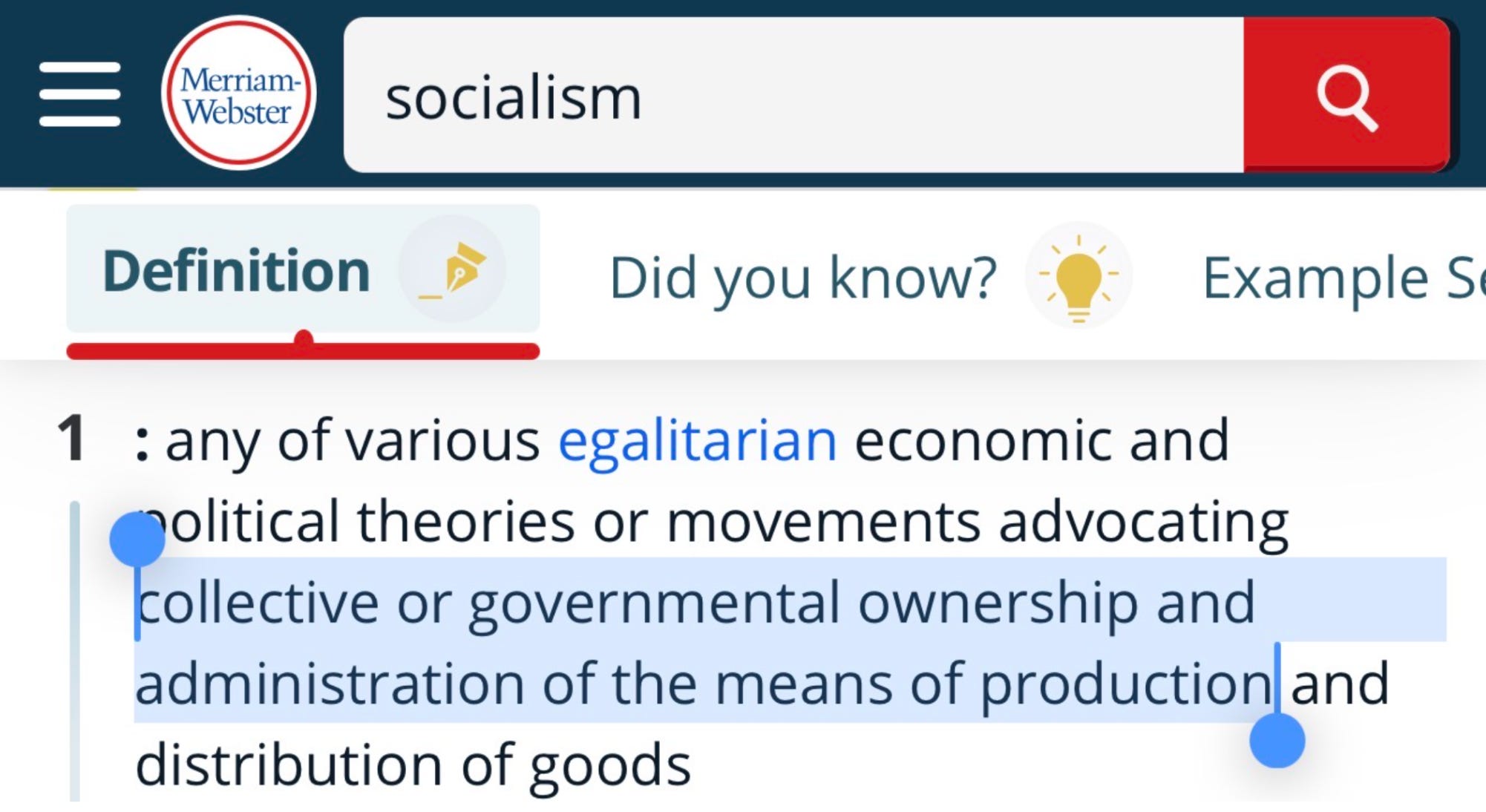
In the poll, 29% named some form of government control, government ownership, or collective ownership of production.
That’s the distinction and definition. Which means 7 in 10 Americans don’t know it.
12% said they didn’t know. 4% thought it had something to do with being sociable.
Republicans: 41%. Independents: 29%. Democrats: 23%.
It’s not a rosy picture. No group had a majority of people providing the right definition.
But Democrats want socialism the most, and understand what it is the least.
So the group most likely to like socialism is the group least likely to know what it is.
Here’s what Democrats said instead:
19% said government or public services.
15% said equality and fairness.
13% said the common good, or helping people.
None of those are what define and distinguish socialism from other mainstream political and economic theories.
Every one of them is an outcome somebody hopes socialism will produce.
AKA they’re describing what they want, not what the word means.
And they want it badly. 58% of Democrats view socialism positively. Only 32% say that about capitalism.
Then CBS asked those same people a question with no label attached: should the U.S. government own stock in private American companies?
7% of Democrats said good idea.
63% said bad idea.
Government owning shares is the mildest version of socialist ownership there is. Not control. Not operation. Not seizure. Just stock.
The people who like socialism most rejected it 9 to 1.
Now to be fair, you could argue those are two different things. Owning a slice of a private company is a sovereign wealth fund. Owning the company outright is socialism. Someone could reject the first and still want the second.
But that would mean they oppose the mild version and support the extreme one. Possible, but unlikely.
The simpler explanation is that most people who like socialism don’t know what it is.
So when you argue with someone about socialism, you’re usually not arguing with a socialist.
You’re arguing with what they want socialism to achieve.
That’s the foundation of why these conversations break down. When people who like socialism hear someone attacking socialism, they hear an attack on equality, fairness, the common good, helping people, and government services.
This helps illuminate why this conversation fails so often.
The term isn’t defined properly.
You can’t disagree with a word nobody defined.
You can only take turns being angry at different things.
The second problem is that the conversation gets abstract almost immediately. It becomes about philosophies rather than what people practically want.
So one person is arguing against what socialist countries have produced — poverty, ruin, and the erosion of freedom.
Meanwhile the person across the table is thinking about unaffordable housing, insufficient healthcare, and student debt.
On the last Clear Thinker Academy call I asked for a volunteer to play a belligerent socialist so I could demonstrate another way of having this conversation.
Here’s the clip.
And here’s the framework.
Step one: ask them to define it.
“When you say socialism, what do you mean by that?” Nine times out of ten you’ll hear: healthcare people can afford, housing people can afford, childcare, education.
This is a valuable opportunity to first understand what they think socialism is and what they want it to accomplish.
Step two: agree with the goals.
“I want people to have healthcare and housing they can afford too.”
That’s how you establish that you’re not competing — you’re collaborating.
Not identifying where there is shared alignment is how conversations become adversarial, and if you ever feel like the other person thinks you’re a bad person for disagreeing, establishing common ground will help dramatically.
Step three: offer the actual definition.
Now that you’ve established what they think socialism is, and how you support what they want it to achieve, you can say something like this.
“Can I share what socialism technically means based on the dictionary definition? It’s about who owns the farms, factories, grocery stores, and companies that produce everything. Socialism moves that ownership from entrepreneurs and businesses to centralized control — usually the government. The question it answers is who owns production, rather than which services people receive.”
If you just keep going without pointing to the dictionary definition of socialism, you’ll be arguing over the value of healthcare, housing, childcare, and education. By introducing the definition after letting them express what they really want (better healthcare/housing/etc.), you can ground the definition in facts without immediately rejecting their definition.
It’s an emotionally intelligent way of correcting a misunderstanding by gently guiding them toward the truth, rather than confronting them with it out of the gate.
Step four: If they bring up Nordic countries — Finland, Denmark, Norway, or Sweden.
“The countries you’re pointing to are capitalist with strong safety nets, funded by taxing private wealth creation. Their own leaders insist on this. So what you might want is better capitalism, and that, we can build.”
Here’s a useful fact you can cite. In 2015, after Bernie Sanders held Denmark up as a socialist model, Denmark’s prime minister flew to Harvard’s Kennedy School and said this:
“I know that some people in the U.S. associate the Nordic model with some sort of socialism. Therefore, I would like to make one thing clear. Denmark is far from a socialist planned economy. Denmark is a market economy.”

Look at where these countries actually sit. In Denmark, 22% of GDP is produced by the government. That’s a big public sector, and it’s nothing close to socialism, because the farms, factories, and companies stay in private hands.
They might also bring up China. Today about 25% of China’s GDP comes from state-owned enterprises, and China’s own government leaders say private firms produce more than 60% of it. That’s the World Bank’s estimate and Beijing’s own number, not mine.
When China had actual socialism, with roughly 100% of the economy owned by the government, 15 to 55 million people starved under the Great Leap Forward. You can read more about that here.
Step five: Show the failures of socialism.
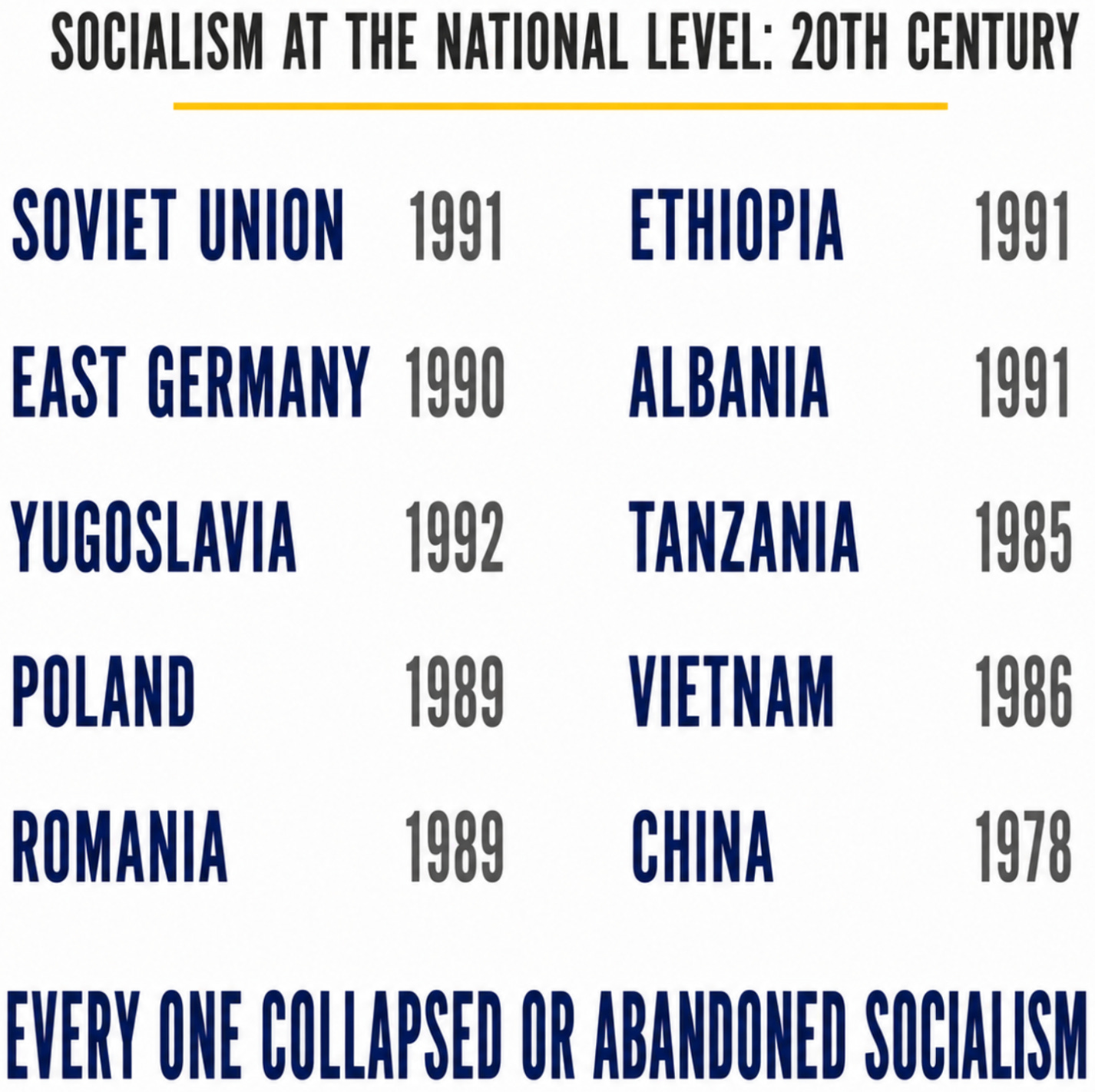
There are myriad examples of failed experiments in socialism.
There’s also Cuba and Venezuela in the 21st century.
Now that you’ve listened to their desires, offered a definition, and shown that what people think is socialism is not, they will be more willing to hear about how it’s failed every time it has been tried.
Present it as data to consider, rather than as a gotcha.
Step six: offer an alternative.
“Here’s what I think would fix the thing you’re describing: get corporate money out of lawmaking, make it legal to build housing again, force price transparency in healthcare. Same goals you named. I think we can do it within capitalism, which is flawed but functional, rather than socialism, which has never been functional.”
Nobody trades a bad answer for no answer.
If your entire contribution is that their idea won’t work, they’ll keep it, because at least it points at their problem.
The person across from you isn’t your enemy. They’re looking at the same broken housing market you are and reaching for the only word anybody handed them.
Give them a better one.
That’s the method. Try it and watch your conversations transform from deathmatches to dialogues.
But knowing how to have the conversation only gets you halfway. You also need to know what to say when they push back, and they will.
Below the paywall, five more analyses, the specific objections you’ll hear, and how to answer each one:
The one question to ask instead of rebutting “that wasn’t real socialism” — and the reframe that makes corruption a design feature rather than bad luck
China and Venezuela — the year one country reversed course, the number of people it moved out of poverty, and the number who have left the other
The billionaire tax argument you should concede immediately — what conceding buys you, and the single move that turns an ideological fight into a negotiable number
Denmark’s top tax rate applied to American incomes — the salary threshold that ends the “just tax the rich” version of the conversation
“Healthcare is a human right” — why agreeing is the strongest opening, the three countries that deliver universal coverage through private insurers, and the spending figures showing we’re not short on money
