


This is Part 2 of a two-part letter. Part 1 was the short-form video: the compressed version of the argument. This is the full version, with much more detail, including answers to the common questions about October 7: why some towns waited six hours for help, why a livestreamed attack still caught Israel flat-footed, and how a terrorist group drew blood against one of the most advanced militaries on earth.

(Clipped for brevity. Full episode here.)
Ah, so now Tucker Carlson is using a dead man’s words to justify his theories about Israel killing Israelis?
OK Fine. Then include this too.
And this one.
Yes, Charlie Kirk wondered if there was a stand-down order that allowed Hamas to commit October 7.
No, he did not accuse Israel of intentionally allowing October 7.
That’s why he said, in the clip Tucker himself showed: “I’m not willing to go so far as to say Netanyahu knew”.
Tucker Carlson is putting words in Charlie Kirk’s mouth.
Now - how could Charlie wonder if there was a stand-down order, but also think it’s insane to accuse Israel of a false flag?
Because he had the courage to ask questions and the discipline to not assume answers.
So if it’s not a conspiracy, what’s another explanation?
Perhaps, in the vacuum of information 5 days after October 7, he was suspicious that something had been allowed.
But he explicitly said he is not making that accusation - presumably because he was open to alternative explanations.
For example - maybe October 7 happened because:
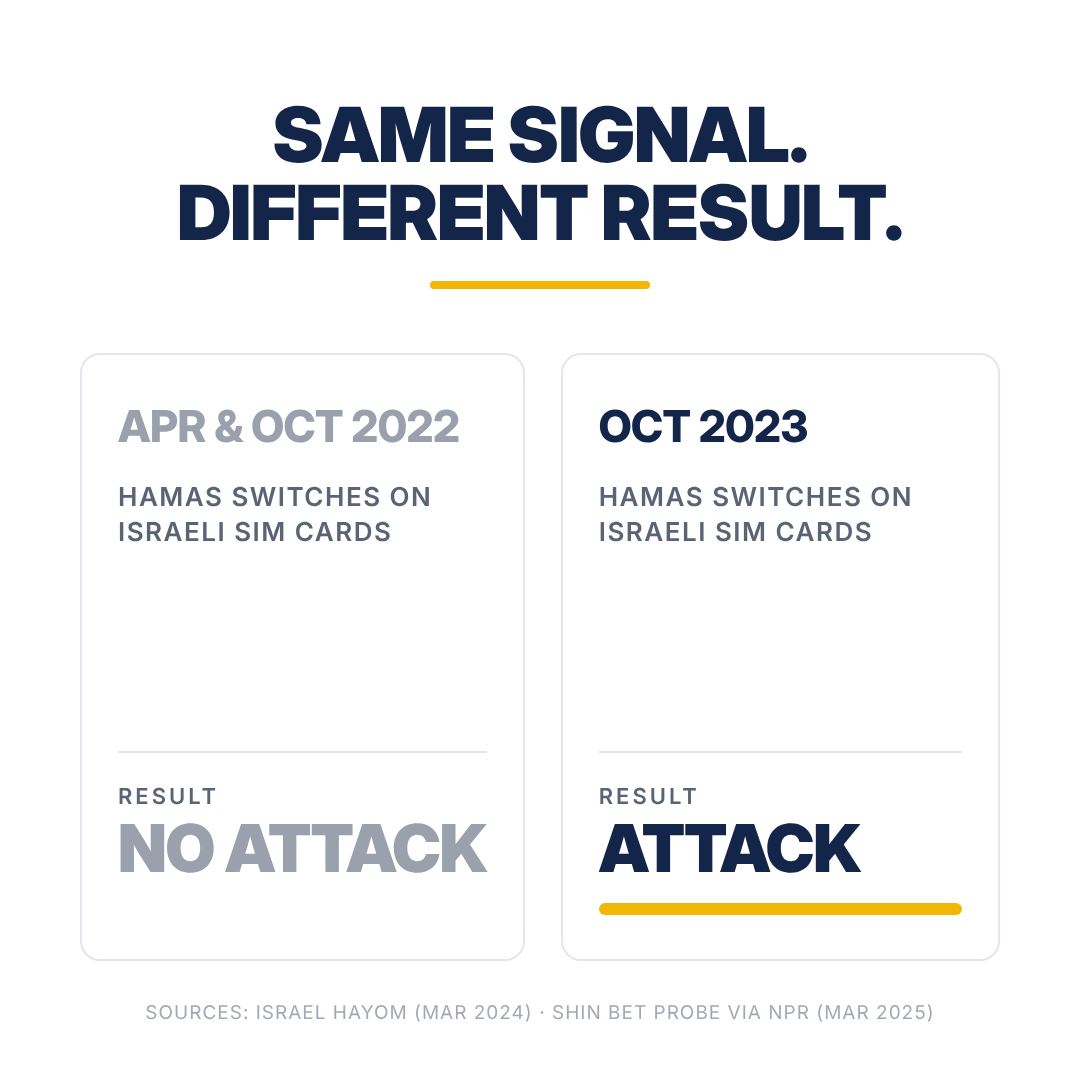
In April 2022, Hamas sent the same phone signals they did on October 7 2023, but it didn’t lead to an attack in 2022, so the Israelis thought it wouldn’t in 2023.
Maybe that’s because before October 7, Hamas hadn’t attacked for two years.
And maybe Israel assumed that Hamas was choosing to actually govern instead of attack, because Hamas asked for and received thousands of permits for Gazans to work in Israel.
So maybe with that context, in the hours before October 7, when Israel saw signals that Hamas was up to something, they decided to stand down because they thought it was another false alarm.
Maybe they decided to stand down because if they raised a real alarm, then Hamas would know how Israel was surveilling their phones.
And maybe Hamas planned it that way. A Hamas source told Reuters the group spent two years acting like it didn’t want a fight, so Israel would believe it.
So maybe - just maybe - after decades of trying, Hamas managed to score a major blow against one of the most advanced militaries on the planet.
Because of mistakes and incompetence, not malevolence.
So that’s the high-level explanation. We don’t need to believe it, but it’s important that we at least know it.
OK, so why did some communities wait six hours for help?
Some towns waited six hours for help. Others got it in minutes.
Perhaps that’s because:
Hamas specifically planned to attack on a holiday, Simchat Torah, where 50% of the country is off because it’s like Christmas for them.
That was also a Saturday, which is the Jewish Sabbath.
Hamas specifically attacked the headquarters that coordinates the response, delaying the response. The first thing they did was use drones to knock out the cameras and communications systems.
Ok, but Hamas’ attack was being livestreamed. Why didn’t Israel send reinforcements sooner?
Because there’s a difference between knowing an attack is happening, and knowing where to send whom.
A livestream is information that a town is under attack. It doesn’t tell you which of the 20-plus towns are under attack, how many fighters are in each, which roads are held, where your own soldiers are, or which bases still exist.
On a normal day, the Gaza Division at Re’im (the military base that was attacked) builds that picture from the cameras, sensors, and radios along the fence and turns it into orders.
Hamas blinded the sensors first and overran the division within hours.
The IDF’s own probe found the General Staff knew of roughly 40% of the infiltrations by 7:30 a.m. - about an hour after the attack began.
So IDF leadership knew there was a battle. But it didn’t have a clear picture of the battlefield.
Two other things the livestream argument misses:
The response began immediately. The attack started at 6:29 AM. Fighting started within minutes at the fence, at police stations, and in kibbutz security teams. Helicopters were in the air by around 7. The first units sent toward the border ran into Hamas on the roads and some died getting there. To say there was “No response for six hours” is false. “Some towns waited six hours” is true, and the reason is the second point.
Five thousand fighters at fifteen breaches is more than Israel was prepared for. Israel’s whole plan for the Gaza border assumed Hamas was only capable of a small raid. It was a holiday and Shabbat, and much of the force was on leave. The reinforcements that would have made a difference were located hours away.
So the livestream revealed that Israel was under attack.
It didn’t tell Israel where to fight, who to send, and how many to send, because Hamas first destroyed the system that supplies that information.
Being aware and coordinating are two different jobs, and Hamas crippled Israel’s ability to do the latter on purpose.
But I don’t think most people who entertain the theory that Israel intentionally allowed October 7 to happen know these technical details. I think they have a deeper, more basic, intuitive question:
How did a rag-tag terrorist organization draw blood against one of the most advanced militaries on the planet?
The same way the Islamic Republic of Iran kept the Strait of Hormuz shut for months against the United States.
The same way that in June 2025, Ukraine hid cheap drones in truck containers, drove them deep inside Russia, and launched them at airbases, hitting a big part of Russia’s strategic bomber fleet from the ground.
Asymmetrical warfare.
It’s been observed in military strategy (as well as cybersecurity) that the attacker holds fundamental advantages in cost, timing, and effort compared to the defender.
That is how:
Thousands of dollars of drones can sometimes beat billions of dollars of military equipment.
Thousands of rag tag guerrillas can sometimes beat tens of thousands of trained soldiers.
This is why terrorist organizations - who embed themselves in civilian populations, attack civilians, and don’t abide by the rules of war, sometimes succeed.
Moreover - it is easier to attack than defend, and over a long enough time frame if you stay on offense, you will get past the defense.
And Hamas now says the quiet years were the setup.
A Hamas source told Reuters the group spent two years building the image of an organization that didn’t want a fight.
Israel’s army even had the attack plan, codenamed Jericho Wall, more than a year in advance, and decided Hamas couldn’t pull it off.
Shin Bet’s own probe later concluded the attack was preventable.
None of that is secret. It’s in Israel’s own investigations.
So is it possible that Netanyahu intentionally allowed an attack?
From here, you’ll learn:
My answer to the question above. It’s probably not the one you expect.
The exact moment Tucker rewrote Charlie’s words, and the two clips he left out.
The four-step move behind “just asking questions,” and how to catch it in real time.
What blaming Israel has been worth to the people doing it.
Who really runs the world, and why the answer is more unsettling than any conspiracy.
