



Last week, between Wednesday and Friday, somewhere between 50,000 and 60,000 people forced their way into Ceuta — Spain’s territory on the North African coast, bordered by Morocco.
Ceuta has 84,000 residents.
Proportionally, that’s like 240 million people entering the United States. In three days.
They came around the border fence, swimming past the breakwater in wetsuits and on inflatables.
It was the largest mass crossing in the territory’s history, and the largest single surge of irregular arrivals ever recorded on EU soil.
At least 72 people died trying.
And within days, it was essentially over.
Spain deployed the military, installed a floating barrier, and returned almost everyone to Morocco — some expelled under a 1992 agreement between the two countries, and many walking back on their own once they discovered there was no food, no shelter, and no future waiting for them.
By Saturday, Spain’s interior minister said the situation was practically back to normal.
By next month, the invasion itself will be a footnote. The feed will have moved on, and this crisis will just be another news cycle that came and went.
So why write about it?
Because I’m not writing about what happened at Ceuta.
I’m writing about what Ceuta surfaced: the quality of thinking about immigration in the West is abysmal.
Not just the quality of the policies — the thinking.
And I can tell you exactly how it got this bad.
For a decade, the West ran a censorship regime on this topic.
Not just through laws — through social annihilation.
Say you want to be selective about who enters your country — racist.
Say you care whether newcomers share your values — xenophobe.
Suggest there should be a limit, any limit at all — far-right.
Is racism real? Of course.
And the racism of a few has been used to shut down the concerns of the many.
Because the accusations didn’t eliminate racism.
They eliminated honesty.
And when honest conversation ceases, two things replace it:
The first is avoidance presented as complexity: “Well, it’s complicated. There are systemic factors.”
The second is shutdown: “We’re not having this discussion because you are a bad person, or have bad intentions, or lack empathy.”
A decade of that, and the West has forgotten how to talk about immigration at all.
A fundamentally simple question — who should enter your country, and on what terms — became untouchable.
And as we all know from our personal lives — when you avoid problems, they compound.
That’s why immigration is now a legitimate problem in America.
And a full-blown crisis in Europe.
So this essay uses Ceuta as an anchor for the conversation we need to have.
Immigration is one of the simpler policy questions a country faces.
We already know the right answer.
We practice it every day at our own front doors.
We just need permission to say it out loud, and the skill to speak about it gracefully.
Humans Are Hardware. Culture Is Software.
Permission is one thing. You also need a way to actually have the conversation.
When a censorship regime punishes everyone who raises a concern, the only people left willing to talk are the ones with nothing to lose: the angriest, the most resentful, and sometimes the outright racist.
The unreasonable, extreme minority of voices become the mascots for the reasonable, moderate majority.
Because the reasonable, moderate majority decides to stay quiet — both for fear of being canceled, and for fear of being associated with extreme voices.
But extreme voices dominating a conversation doesn’t mean no honest, reasonable, compassionate version of it exists.
There is a way to talk about immigration that never demonizes an individual and is still honest about demographics and compatibility.
Here’s the framework, from the full piece I published last week:
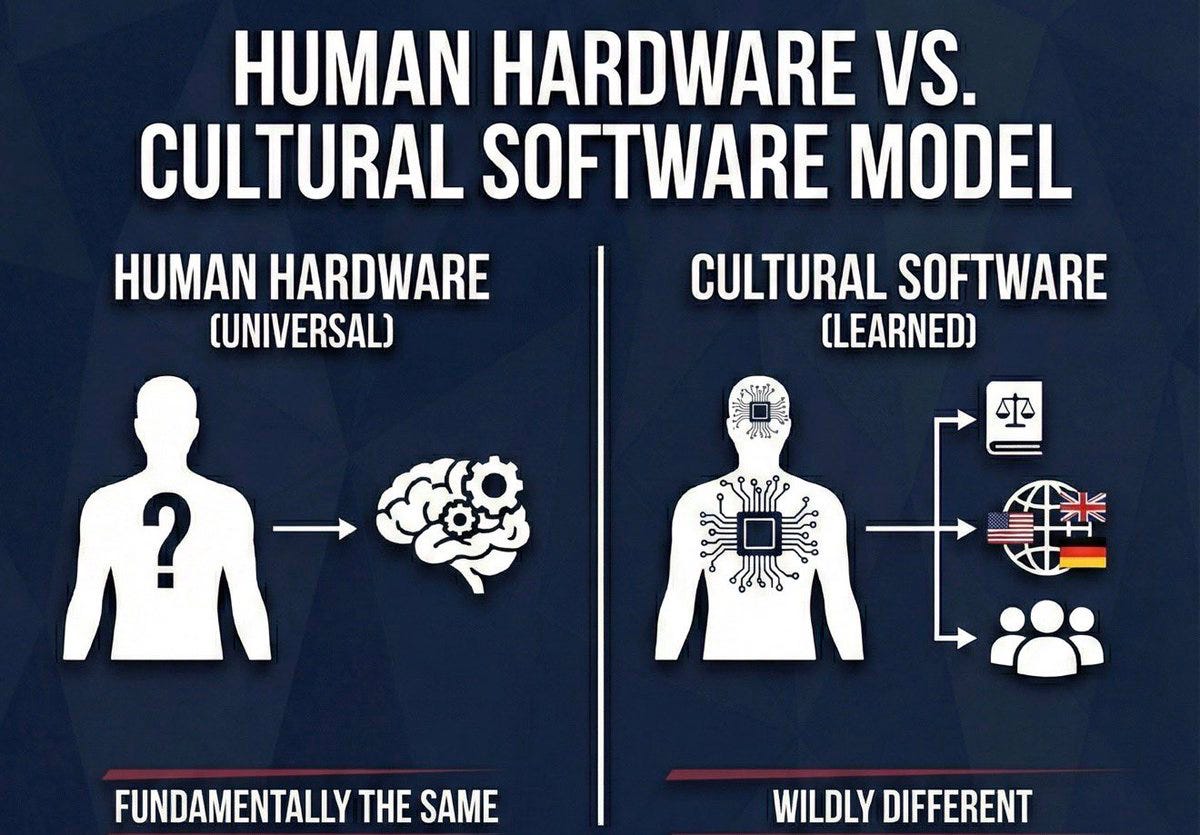
Humans are hardware. Our biology. There are variations between individuals, but they are relatively small. Fundamentally we’re all running the same machine. Nobody is a better or worse human by birth.
Culture is software. The beliefs, norms, and behavioral expectations a population runs on. And software varies far more than hardware.
Some software is highly compatible. Like Google Sheets and Microsoft Excel.
Some has major compatibility issues — try getting Adobe Photoshop and Excel to work together.
That’s not a judgment about which system is “better.”
It’s a statement about integration: try to get two programs with low compatibility to work together without doing the integration work, and you get crashes, no matter how good each program is on its own.
Why does this matter? Because right now, an honest conversation about immigration requires an hour of preamble. You have to:
Prove you’re not a racist
Prove you’re empathetic
Prove you care about the less fortunate
Checkpoint after checkpoint, always on the defensive — before you’re permitted to say anything true.
The hardware vs software framework ends the preamble.
It’s not about anyone being a better or worse person — same hardware.
It’s about software being more or less compatible, and how much unintegrated software a system can absorb at once.
Say it that way, and you can be honest while being tactful.
Knowing the framework isn’t the hard part. Using it in front of your sister-in-law is.
The social risk is high.
People are losing friendships over this.
Losing family.
Watching their own kids look at them like they’ve become something ugly.
So they go quiet — and we end up with the two worst possible extremes at once: in real life, nobody says anything true, and online, everybody says it in the worst possible way.
That’s what Clear Thinker Academy exists to fix.
It’s not just about thinking clearly on these topics. It’s about communicating calmly and clearly under pressure — saying what you actually believe, honestly and without cruelty, without torching the relationships that matter to you.
Now let’s apply the framework to Ceuta.
The Filter
Reuters interviewed one of the men who made it in — a young Moroccan who climbed a wall, crossed the sand, and swam 200 meters around the border.
He has fundamentally the same hardware as you and me, and is responding to the incentives in front of him.
If he manages to break into Ceuta and stay there, he stands to gain:
Food, housing, and support paid for by Spanish citizens
Easier access to the rest of Spain and Europe
Asylum status
Eventually, full legal residency — as Spain demonstrated in January, when it launched an amnesty that drew over a million applications
Given the same situation, we’d probably take those odds too.
Because wanting a better life is universal.
It’s the same thing wanted by the millions of people waiting in line every year to enter Western countries legally.
So if everyone has the same desire, but a country can’t absorb infinite people — how should that country decide who gets in?
By assessing whether the applicant is a net positive for the current inhabitants.
Imagine you’re designing the perfect legal immigration system from scratch.
You get to choose who enters your country.
Would you choose the people whose first act on your soil is breaking your law?
Would you choose based on who can climb a fence or outswim a coast guard?
Would you choose a crowd that is, by every image and account, overwhelmingly young men — no families, no vetting, no paperwork, no idea who anyone is?
Of course not. Nobody would.
Open borders, or policies that indiscriminately admit people based on specious asylum claims, select for exactly the traits no sane country selects for, and filter out exactly the people every sane country wants — the patient, the qualified, the ones respecting your rules from day one.
Last week I argued that immigration policy should screen for four things:
Similarity. How close is the incoming culture to the host culture — language, religion, shared history?
Screening. Who arrives, and how carefully are they chosen? Their skills, their reasons for leaving, and whether anyone checked for fit at all.
Concentration. Where do they settle — dispersed through the society, or packed into parallel enclaves?
Pace. How fast is the change happening, relative to the society’s capacity to absorb it?
The Ceuta invasion obviously fails all four, visibly.
But Western immigration policy has been failing all four, invisibly, for years.
We’ve been merging code without checking for compatibility.
It’s About More Than Just Crime
Now, the argument everyone fixates on: crime.
The left has a favorite statistic here: in America, illegal immigrants — largely from Central and South America — commit crimes at lower rates than the native-born.
It’s true.
It’s also not the point.
Crime is one item on a long list. Introducing a new population without the consent of the governed erodes trust, creates compatibility issues, and breeds resentment between groups.
Fixate on the crime rate and you’ve agreed to argue a narrow part of the problem.
But fine — say crime is the only thing that matters.
Even then, the crime rate isn’t the only thing that matters.
Admit a million people illegally, and if 10,000 of them commit crimes, that’s 10,000 crimes that would not have happened.
The issue is not that the illegal immigrant population is more crime-prone than the native population — it’s that they were never supposed to be admitted in the first place.
They were admitted through an illegal process without the consent of the governed.
Every one of those victims is the cost of a process that got skipped.
A low crime rate doesn’t undo that.
And an influx of illegal immigrants who aren’t crime-prone in one place doesn’t tell you anything about the next one.
Because when you let people in unchecked, you don’t know what you’re getting. You get whoever shows up. It’s roulette.
Maybe you draw a population that commits less crime than your natives.
America largely did, with Latin America.
Maybe you draw one that commits more crime.
France did — and I spent last week’s essay documenting the results.
Maybe you draw tens of thousands of military-age men with no records, no families, and nothing to lose.
Maybe you draw the guy who chases a reporter down the street with a knife.
Obviously, not all immigrants are the same.
Many are just responding rationally to irrational incentives set by Western governments.
Many are hardworking and not seeking welfare payments.
Some will even provide more economic value than natives.
Without rigorous vetting, you don’t get to choose which ones you get.
You’ve handed the decision to chance.
It’s like leaving the front door to your home open.
Maybe the person who walks in becomes your best friend.
Maybe they clean your apartment and leave.
Maybe they trash the place and take the valuables.
Maybe they refuse to leave and demand you fund their life — they’re just trying to have a better life, after all.
Maybe they start imposing their house rules instead of honoring yours.
You don’t know. That’s the problem.
Not that every stranger is dangerous — but an open door means you find out after they’re inside.
Which is why nobody runs their home this way.
You don’t let someone in just because they want in.
You assess whether they’re safe.
You assess what value they’re bringing.
You assess whether they’ll respect the place.
Every person on earth practices this at their own front door.
And we should be doing it at the doors to our civilizations.
The Invitation
Now the question the coverage keeps dancing around: why did 60,000 people decide, in the same week, that the invasion would work?
Definitely because Spain created the incentive structure. Possibly because Morocco’s government exploited it.
Incentive one: the court ruling. On July 8, Spain’s Supreme Court ruled that migrants intercepted at sea cannot be summarily returned.
The ruling doesn’t apply to land entries — but that nuance was lost.
Spain’s interior minister says trafficking networks spread misleading interpretations of the ruling to vulnerable people: the door is open—go now. Seventy-two people died — at least some of them acting on legal advice from criminals exploiting illegal immigrants.
Incentive two: the amnesty. In January, Prime Minister Pedro Sánchez launched a mass regularization program for migrants living in Spain illegally.
More than a million people applied.
When a country periodically converts illegal presence into legal status, illegal entry becomes a way of entering a waiting room for legal status.
Amnesty becomes an advertisement.
Incentive three: Morocco. Ceuta has been Spanish since 1580, and Morocco has claimed it since independence in 1956.
In 2021, after a diplomatic dispute, Moroccan border forces stood aside and let roughly 8,000 to 12,000 people cross in two days.
Spain’s defense minister called it “blackmail” at the time.
This time, a veteran Spanish journalist who covers the region observed that Moroccan security forces appeared to be doing the same thing they did in 2021.
Notice what Morocco’s government understands that Europe pretends not to: migration is leverage.
Morocco’s government doesn’t believe the “all immigration is good” platitude — it weaponizes its own poor precisely because it knows Europe experiences mass arrival as a crisis.
The gate opens when Morocco’s government wants concessions, and closes when it gets them.
People respond to incentives. Migrants do. Smugglers do. Governments do.
Rational policy is built on rational incentives.
Western Civilization Is Worth Protecting
I was traveling through Europe when the invasion happened, and spent a week of those travels in Madrid.
Something happens when you walk through a city like that.
Stone walkways worn smooth by five centuries of feet.
Buildings older than my entire country, still standing, still beautiful, still used.
Walking those streets, I felt elevated as a human being — inspired by what humans can build when they build across generations.
Then I remembered Washington, D.C., in January 2025, when I was there for the inauguration. Our capital.
The seat of American power. And large stretches of it feel like a place nobody loves.
It is much, much easier to destroy than to create.
It took centuries to build Madrid into what it is now.
Two thousand years to build Paris and London.
One generation of bad decisions to destroy them.
A civilization is not a landmass with an economy attached.
It’s an inheritance — and the most natural instinct in the world is to protect what you love.
Guarding the door is love of the thing behind it — the inheritance that makes people swim oceans to reach it in the first place.
A civilization that won’t guard its door will eventually have nothing behind the door worth reaching.
Love your civilization enough to decide who enters it.
Because love is not just about empathy.
It’s also about boundaries.
That’s the case for guarding the door.
But you’re not going to win this argument by loving your civilization. You’re going to win it by answering the specific things people say.
And the Ceuta invasion surfaced every misguided argument used to justify unchecked immigration and open borders in the Western immigration debate at once — about colonialism, climate change, jobs immigrants fill, etc.
Nine of them, all with real emotional appeal, all of which fall apart the moment you think about them.
Here they are, and here’s how to answer each one.
From here, you’ll learn:
Why “they just want a better life” can be true without answering who a country should admit.
How turning asylum into a backdoor hurts the genuine refugees the system exists to protect.
Why climate, labor shortages, and “diversity is a strength” all fail as defenses of unvetted immigration.
What America’s immigration history, Ceuta’s legal status, and the record of former colonies actually show.
The one population missing from all nine arguments—and how censorship manufactured the backlash it was supposed to prevent.
