


Note: This article was written before the recent migrant invasion into Spain.
I’m writing this from Madrid.
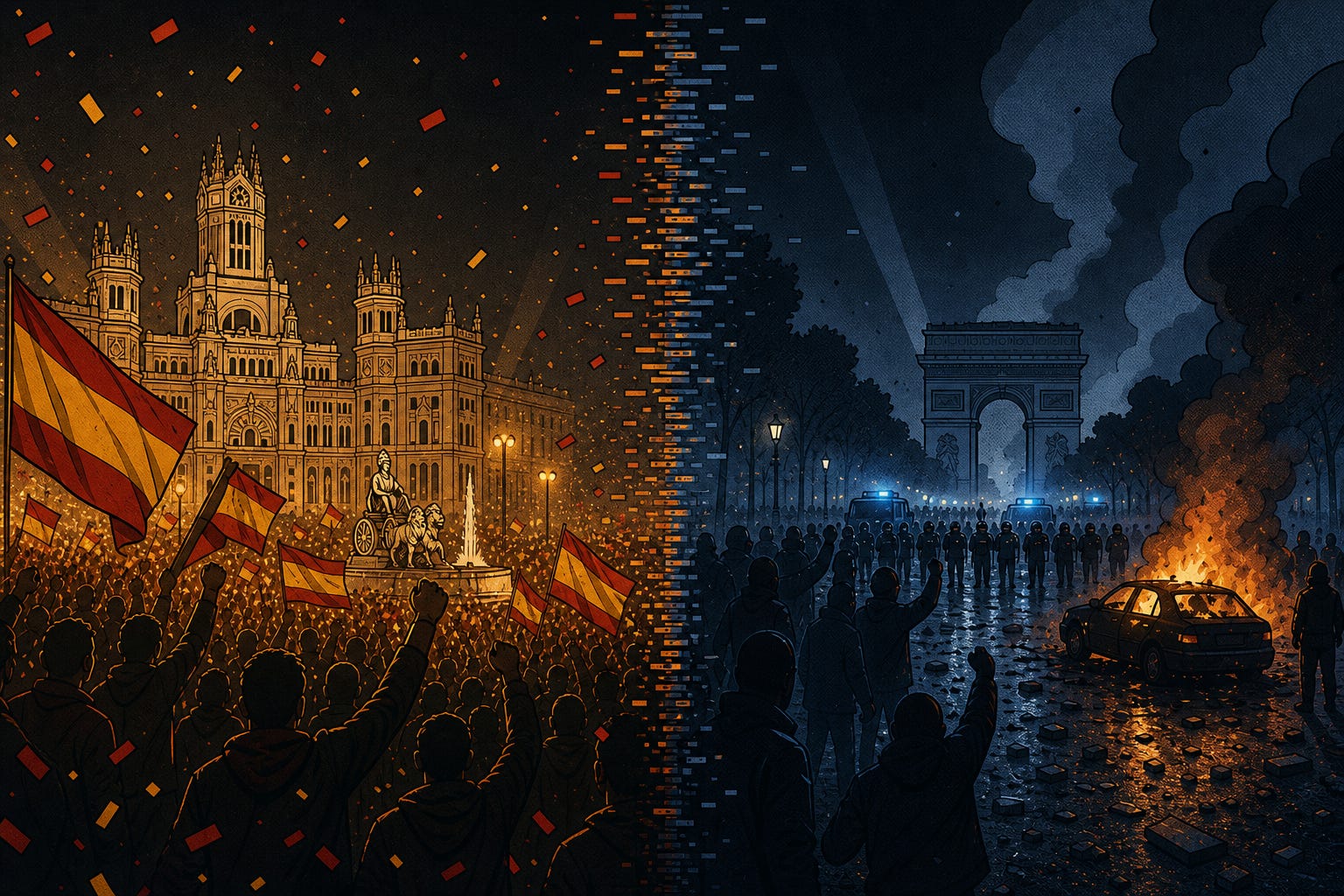
A week and a half ago, on July 19, I was here when Spain won the World Cup, defeating Argentina.
I’d never seen anything like it, and perhaps never will again.
An estimated nearly two million people parading the streets, dripping in their country’s red and gold.
Spaniards spontaneously erupting into anthems they all somehow knew.
And this continued for 24 hours.
I saw everything one would hope to see when a country wins a major sporting event — happiness, camaraderie, revelry.
What I did not see: Riots. Burned cars. Looted stores.
The official tally for the celebration: seven arrests — out of two million.
The Spanish government’s own summary of the night: no serious incidents.
Two Cities, Two Nights
You don’t need to go far in space or time to witness a similar event with an opposite reaction.
A few hundred miles away and a few weeks prior, on May 30, 2026, Paris Saint-Germain won the Champions League — soccer’s most elite club competition — for the second year in a row.
The result was bedlam.

890 arrests nationwide.
219 people injured. 178 of them were police and security forces.
One death.
Cars torched. Stores looted.
A crowd tried to storm a police station in one of the wealthiest neighborhoods in Paris.
And the French government saw it all coming. They deployed thousands of officers in advance.
Because it happened the year before.
PSG also won in 2025.
That night: 559 arrests. 264 vehicles burned. More than 190 injured. Two dead.
Two cities. Similar achievements. Wildly different nights.
This Didn’t Use To Happen
Some might argue the difference is that the Champions League is about clubs and the World Cup is about countries.
The timeline says otherwise.
1998: France wins the World Cup. More than a million people flood the Champs-Élysées. The night is peaceful, unifying, legendary — marred by one tragedy, when a panicked driver plowed into the crowd and injured 80 people. An accident, not a riot.
2006: France merely reaches the final. Two dead, 189+ arrested in Paris, cars torched.
2018: France wins again. 292 detained across the country. 45 police officers injured. A luxury store on the Champs-Élysées looted. Tear gas and water cannon.
2025 and 2026: PSG wins back to back. You just saw those numbers. They’re the worst on this list, by far, and they land two years running.
Paris is not fundamentally more chaotic than Madrid. In 1998, Paris partied the way Madrid just did — peacefully.
The difference is not that the French are violent and the Spaniards are peaceful.
The difference is immigration.
But probably not in the way you think.
Immigration and the R-Word
The trouble with talking about immigration is that it’s littered with landmines — race, culture, comparison.
Say the wrong thing and you’re a racist or a xenophobe.
So most people just avoid it. Which resolves nothing.
That leaves the field to two groups: the unusually brave, and the actually racist. The first is rare. The second gets treated as the face of everyone with concerns, most of whom stay quiet.
As a black person whose parents are immigrants, I have a built-in defense against those accusations.
It’s a superpower in this discourse — one that shouldn’t exist, because arguments should stand on what’s said, not who says it. But here we are.
I get called a race traitor and panderer to white people instead — but those don’t shut a conversation down the same way.
So let me use the superpower to help provide you a framework for thinking and talking about this.
Here’s a way to think about immigration, race, and culture that helps avoid conversational triggers.
Technical readers, forgive the oversimplification. It’s just an analogy.
Humans Are Hardware. Culture Is Software.
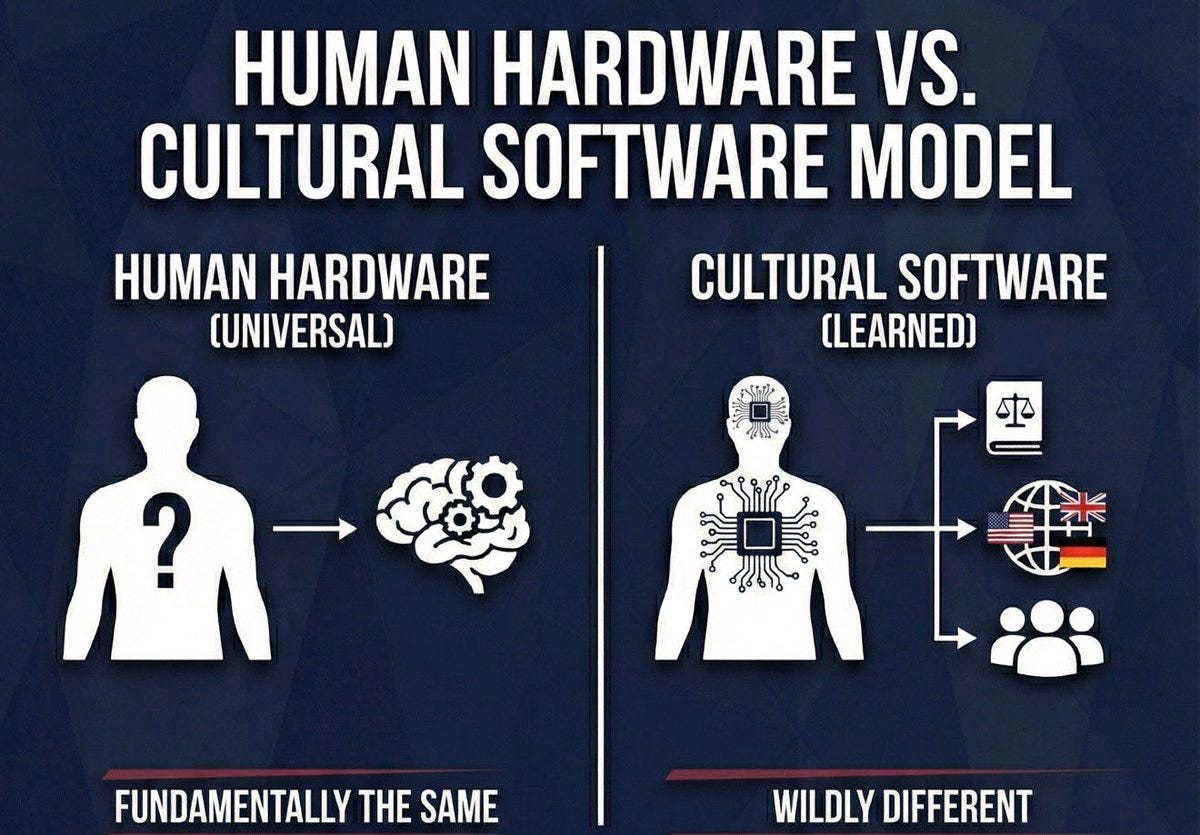
Think of people as having two parts: hardware and software.
Our hardware is physical. It’s our biology. Humans have fundamentally the same hardware — the variance between individuals and populations is small.
We run on different keyboards and monitors, but the differences between a Mac keyboard and a PC keyboard don’t start wars.
Humans are hardware. But we run software.
Culture is software — the beliefs, norms, and behavioral expectations a population commits to.
And it varies massively. And when the variance is sufficiently large, it can lead to war.
Some software is compatible: Photoshop and Premiere run together seamlessly. Some isn’t: a program built for Mac won’t run on Windows without an intensive code rewrite.
The good news is someone’s hardware is nearly impossible to change, but software can be rewritten — and almost any hardware can run almost any software.
Western democracies run software built on individual rights, universal principles, and the rule of law.
Many developing countries run software built on tribe, honor, custom, and heritage.
That’s fine. Every culture is optimized for different things, at different stages of its development.
But mix that software in one country without doing the integration work, and you get compatibility issues.
Not because the newcomers are worse people — same hardware, and anyone can install new software.
But installation is work.
Push too much new code too fast without checking compatibility, and you get bugs.
Sometimes the merged culture ends up better.
Sometimes it just breaks — people who share little with the country around them, and were never brought into it, don’t hold together with it.
Like rioting and burning cars during what should be a celebration.
Why Madrid Partied and Paris Burned
The issue is not the size of the immigrant population.
Because Madrid actually has a higher share of foreign-born residents than Paris.
30.5% of Madrid’s residents were born abroad, as of January 2026.
In Paris, it’s about 25%.
If raw numbers caused the riots, Madrid should have burned first.
It didn’t.
The size of the foreign-born population explains almost nothing here. Composition and assimilation explain almost everything.
This becomes clear across 4 axes:
Similarity. How close is the incoming culture to the host culture — language, religion, shared values? This is the one that decides whether integration is even achievable. The wider the gap, the harder people are to integrate. And integration is what produces cohesion — the shared sense that we live under the same rules and belong to the same place. High similarity, cohesion comes cheap. High dissimilarity, it may never come at all.
Screening. Who arrives, and how carefully are they chosen? Their skills, their reasons for leaving, and whether anyone checked for fit at all.
Concentration. Where do they settle — dispersed through the society, or packed into parallel enclaves?
Pace. How fast is the change happening, relative to the society’s capacity to absorb it?
Now run Spain and France through those axes.
Spain’s foreign-born population is roughly half Latin American. Colombians, Venezuelans, Peruvians, Ecuadorians — people who arrive already speaking the language, already Christian like Spain, already steeped in five centuries of shared history.
The software is nearly identical. Installation is fast.
France is the inverse. The Paris region’s largest immigrant origin countries are Algeria, Morocco, and Tunisia, alongside large populations from Mali, Senegal, and Côte d’Ivoire.
Different language.
Different religion — Islam.
Different norms about law, speech, and the role of faith in public life.
Low similarity, at scale.
And the scale runs one direction. France is roughly 10% Muslim. Spain is about half that. In the Paris region the concentration is higher still, while Spain’s mix is shaped far more by Latin America.
One thing before I go further — on Islam, since it’s a part of the immigration discussion.
None of this is a judgment on Islam as a religion, or on Muslims as individuals.
There are Muslim societies so desirable that people leave wealthy Christian countries for them — like Abu Dhabi and Dubai.
There are Muslim empires that rivaled their Christian contemporaries — like the Ottomans.
I am not interested in analyzing which religion is “better.”
And this is not a claim that Muslims, in principle, are the problem.
Every religion can be read in ways compatible or incompatible with a free society.
There are Christians who read the Bible to justify slavery or stoning gay people — a tiny fringe, but a real one.
There are millions of Muslims whose software is fully compatible with the West, and who live it every day.
I know many on the right believe Islam is fundamentally incompatible with the West.
But the key question for determining immigration policy is not whether Islam is compatible in the abstract — it’s whether the specific people arriving are running compatible software, and how you make sure of that regardless of what religion is on the box.
But it’s also true that in many of the countries sending immigrants to the West, Muslims interpret Islam in a way that is not compatible with the West.
That’s a large gap in similarity. And a large gap, left unclosed and concentrated, is what erodes cohesion — which is the ground disorder grows from.
I’ll expand upon this when we get to Islam directly.
First, the other big factor besides religion.
France added concentration.
Paris’s immigrants are packed into the banlieues — the low-income housing estates ringing the city. Seine-Saint-Denis, the department just north of Paris, is the poorest in mainland France.
So you have immigrants with: Low similarity. Low screening. High concentration. High pace.
That’s how you get dysfunctional software.
“But the Rioters Are French”
Most of the young men burning cars in Paris were born in France. They’re second-generation — the sons of immigrants.
Which actually makes immigration more of a concern.
Bugs in software don’t disappear by themselves. When they aren’t fixed in an earlier version, they show up in later versions — and sometimes they’re harder to track and fix.
France imported millions of people, concentrated them in estates outside its cities, demanded little in terms of assimilation — and is now two generations into the compatibility crisis.
Today, 41% of the Paris region is either an immigrant or the child of one.
And the fact that it’s the sons, not just the fathers, is the tell.
First-generation poverty fades.
Discrimination alone would hit every immigrant group.
But this pattern holds into a generation born in France, which means something is being passed down that neither poverty nor prejudice explains on its own.
That something is culture.
And this is where it shows. These young men share almost nothing with France — not the language fully, not the values, not a stake in the place.
It’s the absence of anything holding them to the country they were born in.
That’s a compatibility issue that causes bugs.
You can watch the bugs accumulate in the event record. The 2005 banlieue riots. The 2023 riots after the police shooting of Nahel Merzouk. The cars that burn across France every single New Year’s Eve.
And apparently, every time Paris wins something.
None of this requires believing anything ugly about any individual. Again — same hardware.
It requires believing something obvious about policy: cultures don’t integrate themselves.
If you aren’t intentional about what culture you allow in, how much of it you allow in, and how you’re going to integrate it — you get software no one wants to use.
The mayor of Paris said it plainly after this year’s riots: the vast majority of Parisians celebrated with joy, unity, and respect.
He’s right.
A minority of individuals burned the city, as the result of an immigration policy that made that minority larger, year after year, without ever assimilating it.
The Choice
So the pattern is clear.
The harder question is which specific incompatibilities keep causing the crashes.
Which brings us to Islam and its compatibility with the West — perhaps the most treacherous conversational minefield there is.
From here, you’ll learn:
Why compatibility, not superiority, is the real question, and where certain interpretations of Islam collide with liberal democracy.
What the data on blasphemy, apostasy, and sharia actually show, and what they do not prove about individual Muslims.
Why screening the software instead of the label produces a radically different approach to immigration.
The strongest case against this argument: poverty, exclusion, and the long history of immigrants once considered impossible to assimilate.
The four questions every immigration system should answer, and why preserving a civilization requires integrating newcomers on purpose.
