


If you watched my video, you saw what happened a few weeks ago outside Gracie Mansion in New York City.
A right-wing influencer brought a cooked pig during Ramadan to antagonize the city’s first Muslim mayor.
Counter-protesters showed up to call them Nazis.
And then two young men inspired by ISIS threw homemade bombs into the crowd.
That situation captures, in miniature, everything that’s broken about how the West talks about Islam.
At the extreme, the Right is cruel - they provoke in ways that alienate the very people they need.
At the extreme, the Left is crazy - they confuse priorities in ways that blind them to the threats to everyone.
And actual extremists exploit the chaos.
I want to go deeper on this than I did in the video. But I also want to be clear about what this essay is and isn’t.
This is not about whether Islam is fundamentally a religion of war or peace. I’m not a religious scholar and I’m not going to pretend to be.
This is not about the cultural question whether Western and Islamic values are better, whether immigration is too high, whether the character of American or British society is being changed for better or worse.
Those are real discussions that deserve their own treatment.
I’m sidestepping them here on purpose.
What this essay is about is something much simpler. Something we should all be able to agree on:
Political violence is completely unacceptable in Western democracies. And there is a significant contingent of radicals who interpret Islam in a way that advocates for turning Western countries into religious states, and condones violence against civilians.
That contingent is larger than most Westerners realize. And we can’t seem to talk about it honestly.
That’s what I want to address.
The Concern That Gets Buried in Noise
The right has concerns about Islam. Some of those concerns are legitimate.
Some are legitimate concerns expressed in bigoted ways, which is maybe the worst combination because it discredits the concern itself.
The left has concerns too — about Islamophobia, about the demonization of an entire faith community, about vulnerable people being targeted for their religion. Those concerns are also legitimate.
But here’s what happens: the left’s concern about bigotry and the right’s concern about Islam crash into each other so violently that neither side can see clearly.
The left is so focused on protecting Muslims from bigotry that they miss the extremists exploiting their protection.
The right is so focused on the threat of Islam that they antagonize the peaceful majority who are their best allies against that very threat.
And what gets buried in all that noise is the thing that actually matters most: people are being killed.
In the last six months, ISIS-inspired attackers have struck in New Orleans, Austin, Bondi Beach, and outside the mayor’s mansion in New York. Nine of the ten deadliest terrorist organizations in the world are Islamist. This is not a fringe phenomenon. And we can’t address it if we can’t even name it.
Islamism Is Not Fringe
Here’s what I need people to understand: the concern about radical Islam is not about a handful of extremists hiding in caves. Islamism — the political project of imposing religious governance — is a substantial movement within the global Muslim community.
An analysis of forty years of parliamentary elections in Muslim-majority countries found that Islamist parties carried a median of about 15% of the vote. Some estimates put the true proportion of Islamists worldwide at closer to 20%.
But the vote share is actually the less alarming number.
The Pew Research Center — the gold standard for this kind of data — surveyed over 38,000 Muslims across 39 countries.
They found that in the Middle East and North Africa, 74% of Muslims favor making sharia the official law of the land. In South Asia, 84%. In Southeast Asia, 77%. A January 2025 Pew update confirmed this pattern holds: roughly nine in ten Muslims in Bangladesh, Indonesia, and Malaysia favor a legal system in which Muslims are bound by Islamic law.
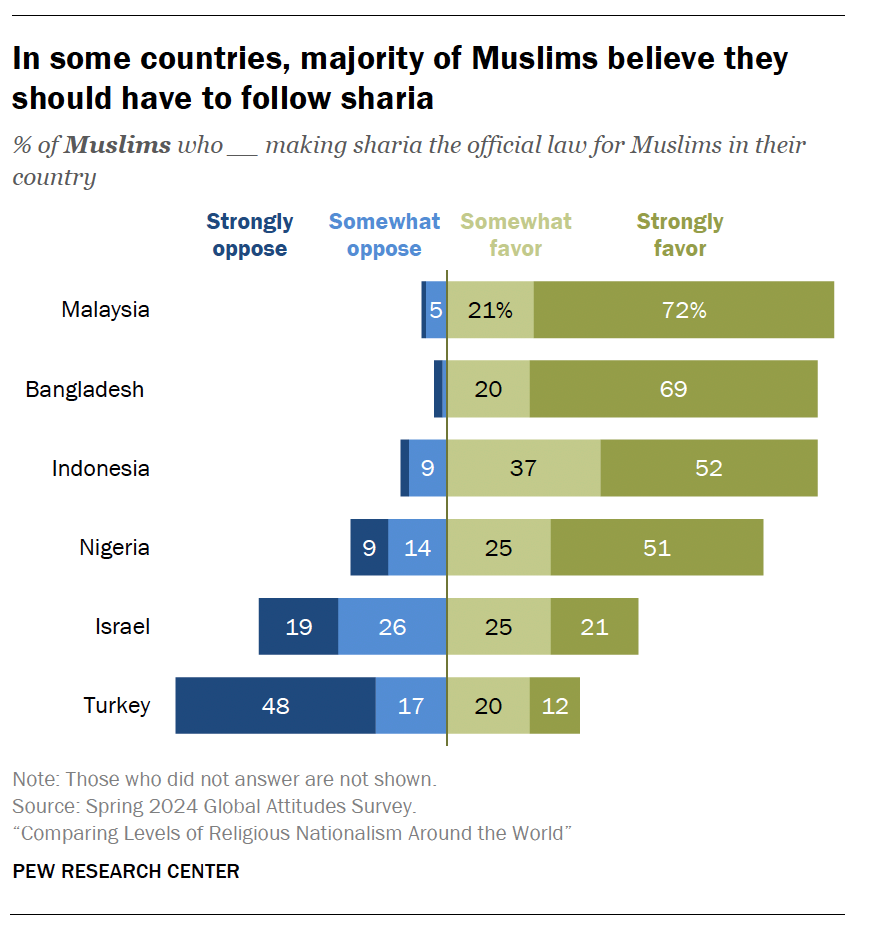
Now, “sharia” means different things to different people. Some interpret it as personal moral guidance.
But when you look at poll results on the specific implementations — killing adulterers, cutting off the hands of thieves, executing people who leave Islam — the support is much higher than most Westerners would expect or find tolerable.
Compare this to any other major religion. Christian nationalism exists in America, but it polls in the single digits as a political movement. There is no equivalent movement within Judaism, Hinduism, or Buddhism that commands anywhere near this level of support for religious governance.
What’s Happening Across the Pond
If you want to understand why reasonable people are concerned — look at Britain.
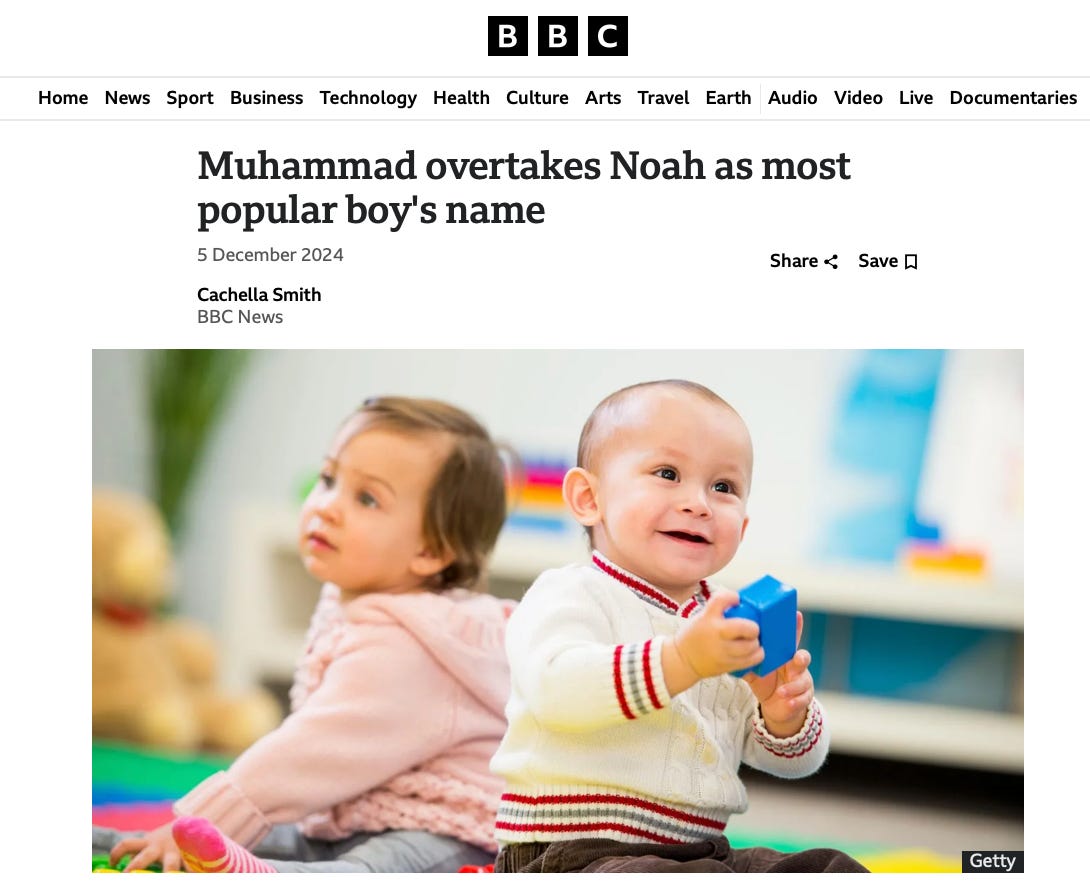
The most common baby name in England is now Muhammad.
That fact alone isn’t a problem. But it signals a demographic shift that is happening fast, and what’s coming with that shift is what concerns people.
In Britain, a 2006 study found that 30% of British Muslims wanted to live under sharia law. 28% wanted Britain to become an Islamic state. And 31% of younger British Muslims endorsed or excused the July 7 London bombings that killed 52 people — compared with just 14% of those over 45.
The generational trend is going the wrong direction. The problem is getting worse among exactly the people who will shape the future.
Maajid Nawaz — a former Islamist who founded the counter-extremism organization Quilliam — puts it bluntly.
He says Britain has become “a net exporter of Islamism and jihadism.”
His former Islamist group didn’t exist in Pakistan until it was exported there from Britain.
When a Muslim reformer based in London is telling you this, maybe the West should listen.
Global Islam and American Islam Are Not the Same
Now — this is important, and it’s not something I’m saying to be diplomatic. It’s something I’m saying because it’s true and it’s strategically essential.
The global Muslim community and the American Muslim community are not the same thing.
The roughly four million Muslims in America are self-selecting into a system that is fundamentally incompatible with sharia law. They chose to live in a country with separation of church and state. A country with equal rights for men and women. A country where you can leave your religion without being killed for it. The vast majority of American Muslims are peaceful, productive Americans.
When you have four million members of a religious group and you’re concerned about extremists within that broader religious community, it makes sense to form an alliance with the people who are in good standing — so they can help identify and ostracize the people who are not. You don’t win this fight by alienating your best allies.
The concern — and it’s a legitimate one — is about what happens at scale. People look across the Atlantic at England and they see what a larger demographic shift has produced. That concern is understandable. But the solution is not to treat the four million who are already here as the enemy. The solution is to work with them against the actual enemy.
So we have a real problem. Islamism is not fringe. The data is clear. The trend among young Muslims in the West is going the wrong direction. Islamist ideas are contaminating Western universities.
But we also have four million American Muslims who chose this system and are our best allies against the very threat we’re worried about.
So how are we screwing this up?
Both sides are making the problem worse in ways that are almost tragically predictable.
And to be clear — these failures are not equal. Bringing a pig to a protest is ugly. Failing to identify and confront an ideology that is killing people is dangerous.
The left’s blind spot is the more consequential failure at present.
But as in every relationship - it’s important for both sides to have self-awareness, even if they’re concerned the other side is the bigger problem.
The left is doing something specific that makes us all less safe. The right is doing something specific that makes the shared problem solving difficult.
And until both sides can see their own blind spots, we’re going to keep having the same unproductive conversation while people die.
Now let’s talk about what those blind spots are, and how to reveal them.
