


This is part of my ongoing series on the Iran war. Read the full series here.
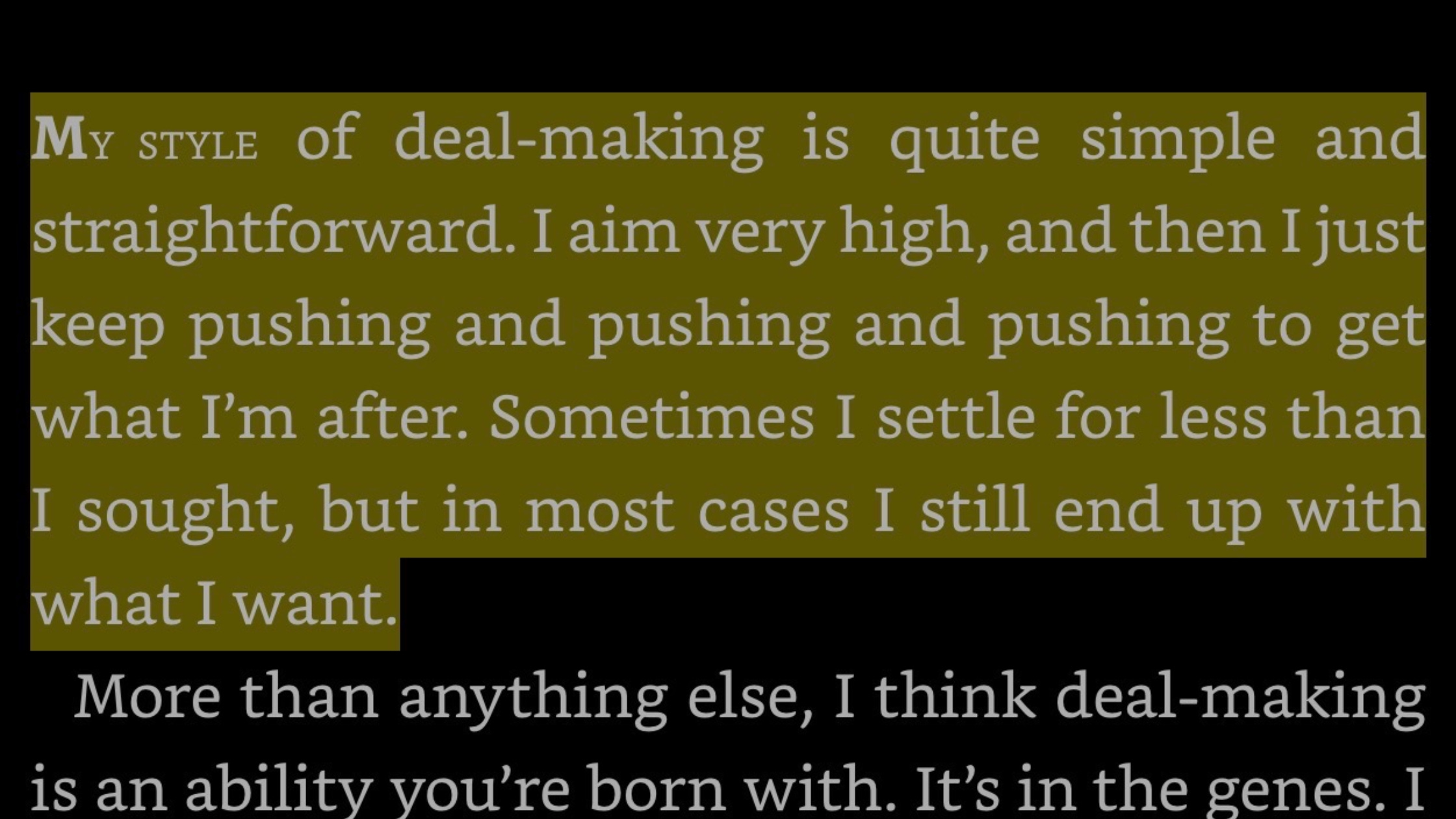
That’s from Chapter 2 of The Art of the Deal, published in 1987.
39 years later, Trump posted on Truth Social that “a whole civilization will die tonight” if Iran didn’t reopen the Strait of Hormuz.
Today, it looks like things are de-escalating.
So maybe it worked. And that’s the problem - because it probably did work, and that makes it harder to talk about why it was still wrong to say.
I’m about 60% through The Art of the Deal right now, and what struck me most is how little has changed. The playbook is identical to what he’s running today - 39 years later. I’ll share more quotes that reveal the pattern later in this piece. But first, let’s talk about what that pattern looks like when it’s applied to war.
In today’s letter, you’ll learn:
Why the “unhinged” maximalist approach to foreign policy actually produces real results.
The critical difference between hard power and soft power, and why one is rapidly eroding.
The four levels of war, and how current rhetoric dangerously blurs the lines between them.
The exact 6 strategies from The Art of the Deal that are being used to dictate the Iran war.
High stakes
You can see the same approach everywhere in this administration:
With Greenland - he threatened to take it. Got concessions on mining rights and military access.
With tariffs - he threatened catastrophic rates. Got trade concessions from multiple countries.
With the deportation agenda - he used maximalist rhetoric. Deportations hit record highs.
With Iran - he threatened to wipe out a civilization. Got what appears to be progress toward a ceasefire.
This approach produces results. Trump’s critics would have you believe it never works. That’s dishonest. It often works. He gets concessions that more conventional approaches failed to achieve.
But “does it work?” is only half the question. The other half is: what does it cost?
Soft power
There’s a concept in international relations called soft power. It was coined by Joseph Nye at Harvard in 1990, and the simplest way to understand it is this: hard power is the ability to force people to do what you want. Soft power is the ability to make people want what you want.
America’s greatest strategic achievement of the 20th century was what came after World War II.
The Marshall Plan rebuilt a devastated Europe. The United States spent the equivalent of over $150 billion in today’s dollars to reconstruct the economies of countries that had just been at war with each other. The result was a Europe that wanted to be aligned with America. NATO wasn’t imposed at gunpoint. European nations joined voluntarily because the U.S. had demonstrated that it was a partner worth having.
As Nye put it: “The Berlin Wall didn’t go down under a barrage of artillery. It went down under hammers and bulldozers wielded by people whose minds had been affected by American ideas.”
PEPFAR - the President’s Emergency Plan for AIDS Relief, launched under George W. Bush - saved an estimated 25 million lives in Africa. It cost a fraction of a single military operation and generated enormous goodwill across an entire continent.
This is what soft power does: it makes the world want to work with you, invest in you, align with you, and follow your lead. And it compounds over decades.
It’s also eroding.
Pew Global surveys from 2025 show sharp declines in how favorably the world views the United States, with the steepest drops among America’s historically closest partners. Across 24 countries, only 34% of adults expressed confidence in the U.S. president to do the right thing regarding world affairs.
At home, the erosion is even sharper. In 2003, 60% of young Americans said they were “extremely proud” to be American. By 2023, that number had collapsed to 18%. A 2025 Harvard Youth Poll found that 29% of young Americans - nearly one in three - said they were explicitly “embarrassed” to be American.
This decline preceded Trump. It started with Iraq, accelerated through the War on Terror, and deepened through a decade of partisan dysfunction. But rhetoric like “a whole civilization will die tonight” accelerates it further.
And the cost compounds. Every time American rhetoric sounds indistinguishable from the language of the regimes we’re fighting, three things happen:
Extremists abroad use it as recruitment material. You can guarantee that Islamist propagandists are already circulating Trump’s quote to tell young men that America wants to destroy Muslim civilization. This is exactly how Al-Qaeda and ISIS built their recruitment pipelines after Abu Ghraib.
Extremists at home - on both the far left and far right - use it as evidence that America has no moral standing. That narrative erodes the domestic cohesion that makes sustained military operations possible in a democracy.
And allies distance themselves. When you threaten to destroy civilizations on social media, allies calculate the reputational cost of being associated with you.
Think of it like starting a company with a friend. You’re wealthier, more experienced, and you need the partnership less than they do. So you use your leverage to negotiate 70-30 in your favor instead of 50-50. You keep extracting concessions because you can. Short term, you win every negotiation.
Then one day there’s a hostile takeover attempt, and you need your partner’s vote against the board. But your partner, who’s been quietly building resentment for years, doesn’t have your back. The board votes you off. You had the leverage. You used it. And when you needed loyalty, you discovered that leverage and loyalty are different currencies.
The bill for hard power used without soft power doesn’t come due immediately. It might not come due before Trump’s presidency ends and his legacy is secured. But it does come due. It always comes due. Eventually, when you need the goodwill of others, they remember how power was used by you.
The real threat
Let me be clear about something, because this conversation only works if we’re honest about the baseline.
The Islamic Republic of Iran has 440 kilograms of uranium enriched to 60% purity. There is no peaceful use for 60% enriched uranium. None. Civilian energy needs 3-5%. Research reactors use 20%. The jump from 60% to weapons-grade 90% takes weeks.
At minimum, this regime has been exploiting nuclear ambiguity to extract concessions from the world for over two decades. At worst, they are sincerely pursuing a nuclear weapon.
Either way, it’s unacceptable. And the United States is doing what the international community failed to do: stopping it.
So when I critique Trump’s rhetoric, I want to be extremely clear that I’m not confused about who the enemy is. This is a regime that has killed tens of thousands of its own people for protesting. That has arrested over 30,000 women since 2022 for not covering their heads. That, in response to Trump’s threat yesterday, told its own civilians - including women and young people - to form human chains around power plants. They told their own people to stand in front of buildings that might get bombed.
That is who we’re dealing with. And the threat is real.
Which is precisely why clarity about standards matters.
Four levels
To think clearly about proportionality, it helps to distinguish between four levels at which a country can be engaged in war.
Level one: leadership. This is what we did in Venezuela - a targeted operation to capture Maduro. Minimal broader damage. Surgical.
Level two: the military. This is what Trump’s four stated objectives in Iran target - missiles, navy, proxy networks, nuclear infrastructure. Soldiers accept the risk of being targeted when they serve. War at this level operates within a framework that most of the world accepts as legitimate.
Level three: civilian infrastructure. Power plants, gas fields, desalination plants, pharmaceutical facilities, bridges. When you target these, you’re degrading the systems that keep 90 million people alive. The argument is usually “dual use” - the military also relies on this infrastructure. Sometimes that’s true. But “dual use” can justify bombing virtually anything in a modern economy, which is why it requires extreme discipline to apply honestly.
Level four: civilians themselves. Intentionally killing non-combatants. This is what terrorists do. This is what the Islamic Republic does when it fires missiles at residential buildings in Israel and uses its own people as human shields.
When Trump says “a whole civilization will die tonight,” he’s using language that blurs the lines between levels two, three, and four. People who defend the statement say he obviously didn’t mean level four. Maybe. But “obviously” is doing a lot of work in that sentence.
How sure are you that he wouldn’t follow through?
30% sure? 50%? 90%? 100%?
We don’t know what any leader would do if pushed to the absolute extreme. Most of us don’t know Trump - certainly not intimately. We should be skeptical of our own certainty about the inner workings of any person’s mind, especially under the pressures of war.
Win well
I want Trump to succeed. I want this operation to achieve its objectives. I want the Iranian people to be free. I want the nuclear threat eliminated.
But the quality of a win matters. There are wins with small costs and wins with enormous costs, and the cost isn’t always measured in dollars or casualties. Sometimes it’s measured in how the world sees you afterward, and whether your own people still believe in what you stand for.
Obama and Clinton didn’t just threaten to bomb civilian infrastructure - they actually did it. We should hold Trump’s actions to the same standard we hold theirs. And by that standard, his actions in this war have been more disciplined than his words.
But words set standards. And the world is watching what standards America sets.
If the Islamic Republic’s conduct is a ten on the scale of moral failure, Trump’s statement is a two. But a two still matters. Because the thing that separates the good guys from the bad guys is the limits we place on our own power.
So celebrate the ceasefire. Root for the operation to succeed. Acknowledge that Trump’s pressure tactics get results that diplomacy alone hasn’t achieved.
And hold the line that “a whole civilization will die tonight” is language that costs us something - even when it works. Especially when it works. Because the wins that feel free in the moment are often the ones you pay for later.
Eventually, when you need the power of others, they remember how power was used by you.
For paid subscribers, I wanted to do something different. I am breaking down 6 direct passages from The Art of the Deal that map flawlessly to this week’s geopolitical chaos.
