


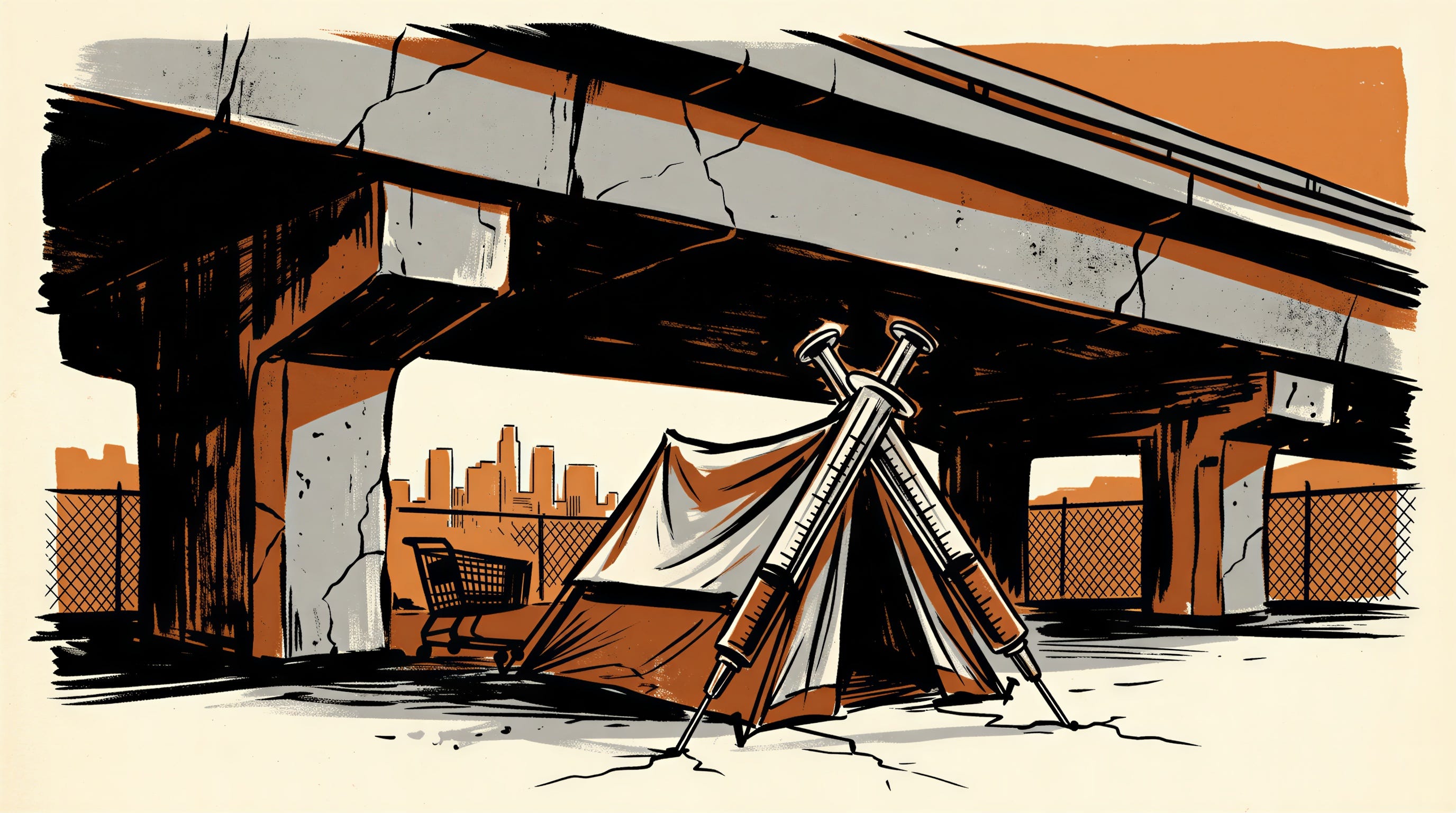
I’ve lived in LA for close to 12 years.
Seeing homeless drug addicts acting erratically in public is normal.
Smelling the stench of homeless encampments is common.
Having to cross the street because I see a homeless person behaving strangely is routine.
Getting threatened by homeless people has happened to me.
And I suspect I’m not the exception.
And yet, when the universal unpleasantness of these experiences is mentioned to other Angelenos, people get uncomfortable.
It’s more comfortable to have conversations about the words we’re told to call homeless people - “unhoused,” “homefree” - than it is to talk about the actions.
Because the moment a conversation starts about action, there’s a background risk that the conversation stops being viewed as a good-faith discussion on how to solve homelessness - which is obviously both awful for the homeless and unpleasant for everyone else.
Instead, the smallest misstep - the wrong word, the wrong tone, the wrong “energy” - and now the conversation becomes about whether you’re a good person. Whether you lack empathy. Whether you lack compassion.
It’s a rhetorical game of don’t step on the lava.
That’s why if you say something obviously true: like if you are endlessly permissive of someone’s behavior, they will not change it - it attracts retaliation.
To recognize that if you ceaselessly talk about compassion but avoid consequences, you will recreate the circumstances - you get called cruel.
It is true that we should have a heart for the worst off. But we should also have a brain.
The basic common-sense truths everyone intuitively knows have been suppressed by a decade of this rhetorical game:
People respond to incentives, both positive and negative
Being around homelessness is unpleasant for everyone involved, including the homeless - many homeless people have a drug problem and are uncomfortable at best, dangerous at worst to be around
Public spaces are cultivated for public use, not for individual claim
A civilization that doesn’t respect itself can’t expect its members to respect it
These are obvious. They were obvious to every previous generation of Angelenos. They’re obvious to anyone who walks down Hollywood Boulevard.
Logic without empathy is cruelty. But empathy without logic is lunacy.
Right now LA is suffering far more from the latter than the former.
I said something similar on a show last year:
Pratt’s Plan
Pratt recently announced a 5-step plan:
Stop giving drug users needles and tools to use drugs
Use California’s new SB 43 law (which Pratt credited Democrats for passing) to compel treatment for severely addicted people
End the body-brokering racket where NGOs profit off out-of-state addicts trafficked into LA
Bring in federal law enforcement against the cartels operating openly on our streets
Build a dedicated treatment campus instead of expecting residential neighborhoods to absorb the crisis
The predictable reaction has already arrived. Pratt is being attacked as heartless. His plan is being called “criminalizing homelessness.” Activists are framing him as a MAGA Republican with no compassion for the unhoused.
It would be too easy to say it’s because of Spencer’s provocative speaking style. Or because he’s white, wealthy, and privileged. Or because he’s “MAGA-coded.”
All of that falls apart when you realize one thing.
Moderate Democrats with the exact same policies get the exact same criticism.
The Mahan Test Case
Matt Mahan is the mayor of San Jose. He’s running for Governor of California as a Democrat. He’s the only mayor in California who has actually reduced street homelessness - by roughly one-third.
His approach is functionally similar to what Pratt is proposing. Shelter is offered. After three refusals in 18 months, there are consequences - typically referral to a behavioral health court. He pairs accountability with massive expansion of interim shelter capacity. He uses SB 43 - California’s own law signed by Newsom in 2023 - to compel treatment for people too lost in addiction to make the decision themselves.
Mahan’s philosophy in his own words: “compassion paired with accountability.”
For this, Mahan has been called heartless. His policies have been called “criminalizing homelessness.” Activists protested him at San Jose City Hall holding signs that read “Jail the billionaires, not the unhoused.” He’s been accused of being “punitive, immoral and ineffective.”
Those first two labels are opinions. The last one is untrue.
One of Mahan’s loudest critics is Alex Lee, a sitting California State Assemblymember and the chair of the California Legislative Progressive Caucus. Lee ran for office as a proud, self-identified member of the Democratic Socialists of America. He is, on paper, Mahan’s political ally.
Lee’s response to Mahan’s results-based approach wasn’t a counter-proposal. It wasn’t data. It was an insult:
“It’s clear that he’s having a public mask-off for the true conservative that he is.”
Lee called Mahan a “MAGA fellow traveler.”
When the same attack lands on a Democrat with proven results that lands on a Republican with a campaign promise, the attack is ideological.
Not logical.
What Compassion Actually Looks Like
Look at what a decade of “compassion” has built. Six to seven homeless Angelenos dying every day. $24 billion spent at the state level on homelessness in five years, and the State Auditor told us we don’t know if any of it worked.
This is what we call compassion. It is institutionalized neglect dressed up in compassionate language.
If someone you loved was on the street, addicted to fentanyl, defecating in public, harassing strangers for money - you’d grab him. You’d get him to rehab. You’d demand he get sober before he came home. You’d do it because you love him.
Shallow empathy is about words. True compassion requires action.
That’s what Mahan is doing. That’s what Pratt is proposing. And that’s what the DSA-aligned activist class calls cruelty.
What’s In The Paid Section
I’ve laid out the surface story: the attacks on Pratt come from the same coalition attacking Democrats like Mahan. The attacks aren’t substantive - they’re ideological.
But naming the problem is only half the battle. The harder half is knowing what to actually say the next time someone tries to shut down an honest conversation about homelessness - or anything else.
In the paid section, I lay out a field guide:
The six most common rhetorical moves used to shut down honest conversation in America right now
What each one is actually trying to do
And what to say when it happens, in your own voice, without yielding or escalating
These are general-purpose tools. The examples I use are about homelessness because it’s fresh on the page, but you’ll recognize every move from a dozen other conversations. Once you can name the tactic, you can walk through it.
How to Walk Through the Lava: 6 Tactics That Shut Down Honest Conversation, And How to Handle Each One
The “don’t step on the lava” game I described above isn’t unique to homelessness. It shows up in every politically charged conversation in America right now - immigration, education, drug policy, crime, gender, race, foreign policy. The specific topics change. The rhetorical moves don’t.
What follows is a field guide. Six of the most common moves used to shut down honest conversation, what each one is actually doing, and what to say when you encounter it. I’ll use homelessness as the running example because it’s fresh on the page, but every one of these applies anywhere.
