


Tomorrow is America’s 250th birthday. It’s Clear Thinker’s 2nd. 5 days, 5 articles. Become an annual member at 30% off forever - for the first 500 subs. Join here.

This week, Mayor Zohran Mamdani posted this:
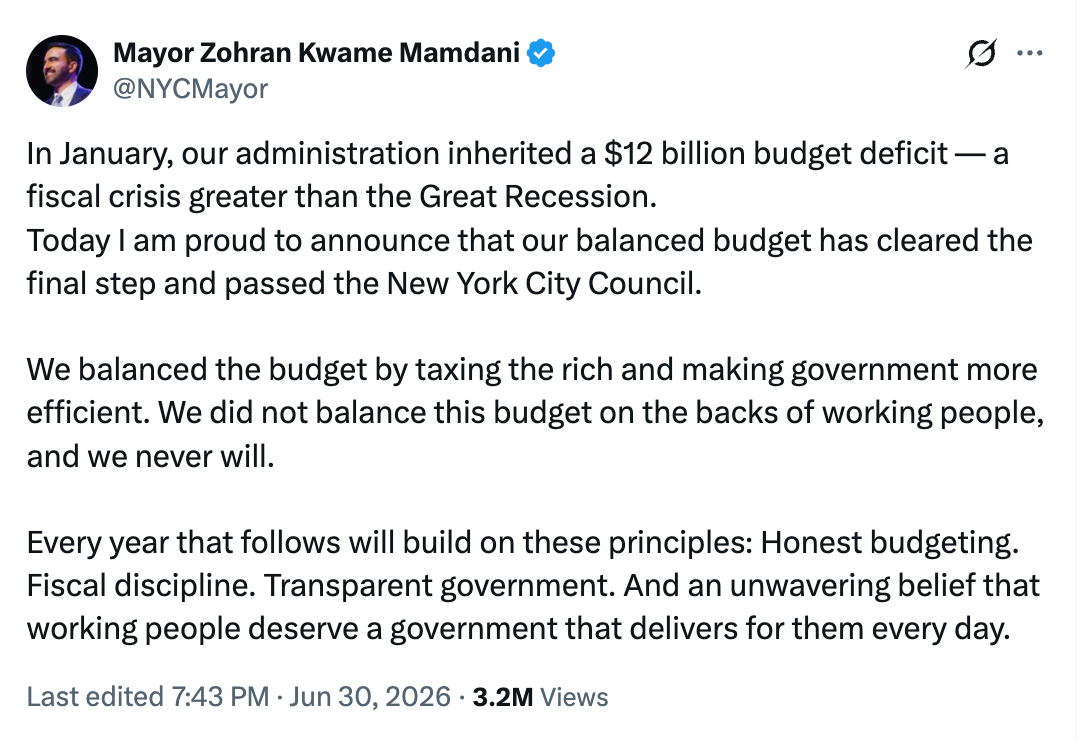
In May, he posted something similar, and said of the achievement, “Call it Democratic Socialism.”
There’s only one problem.
Socialism delivered very little of this win.
Much more of it was capitalism, and taking money from future taxpayers and people outside of New York City.
Now, before we get into that, I want to make it clear why I’m writing this piece.
I’m not interested in demonizing Zohran. I’m not here to expose him as a nefarious liar.
I know that some believe him to be a wolf in sheep’s clothing: a secret jihadi communist with a TikTok-ready smile who hates America and is using taqiyya to intentionally lie about his true intentions as he seeks to usher in Sharia law.
I am not one of those people.
If you are, I’m not going to spend this piece convincing you otherwise.
I’m just telling you where I stand for transparency’s sake.
Either way, positive or negative claims about what’s going on inside his brain are subjective, impossible to prove, and a waste of time to debate.
So I’d rather focus on what we can be objective about, which is policy.
In fact, I like the guy.
I think he’s cool.
As someone who resonates with clear communication, I respect his competency in that domain.
Politics aside, I think we could even be friends.
And from the looks of it, I’m not the only one who feels that way.

I’ve also listened to long-form interviews with him. He has a strong understanding of the problems New Yorkers face, and it’s obvious why they elected him.
Similar to Trump, he is in touch with the pain of the people, and knows how to speak to that.
I don’t think he’s bad.
I think socialism is.
So that’s the spirit in which I’m writing this piece. To resist bad ideas.
I’ve written several pieces about the rise of socialism in America.
There are also serious problems that we need to address in our current version of capitalism.
There’s too much money in politics.
Too much corporate influence over policy.
Billions of dollars are speaking louder than millions of people.
But I’m of the belief that socialism is not the solution.
And I don’t want to see socialists ride the coattails of capitalism and call the wins socialism.
That’s what Zohran is doing. And that’s why I’m writing this piece.
Socialism Is the Last Reason the Budget Was Balanced
Zohran Mamdani inherited a budget crisis not of his making.
$12 billion is a lot of money for a city budget deficit.
It’s larger than the gap New York faced during the Great Recession.
He closed it without raising property taxes, without cutting services, without draining the city’s reserves.
That’s a genuinely difficult political and technical achievement.
And it was not an achievement that came primarily from socialism.
In fact, socialism is last on the list of reasons for that achievement.
Here’s how he actually balanced the budget.
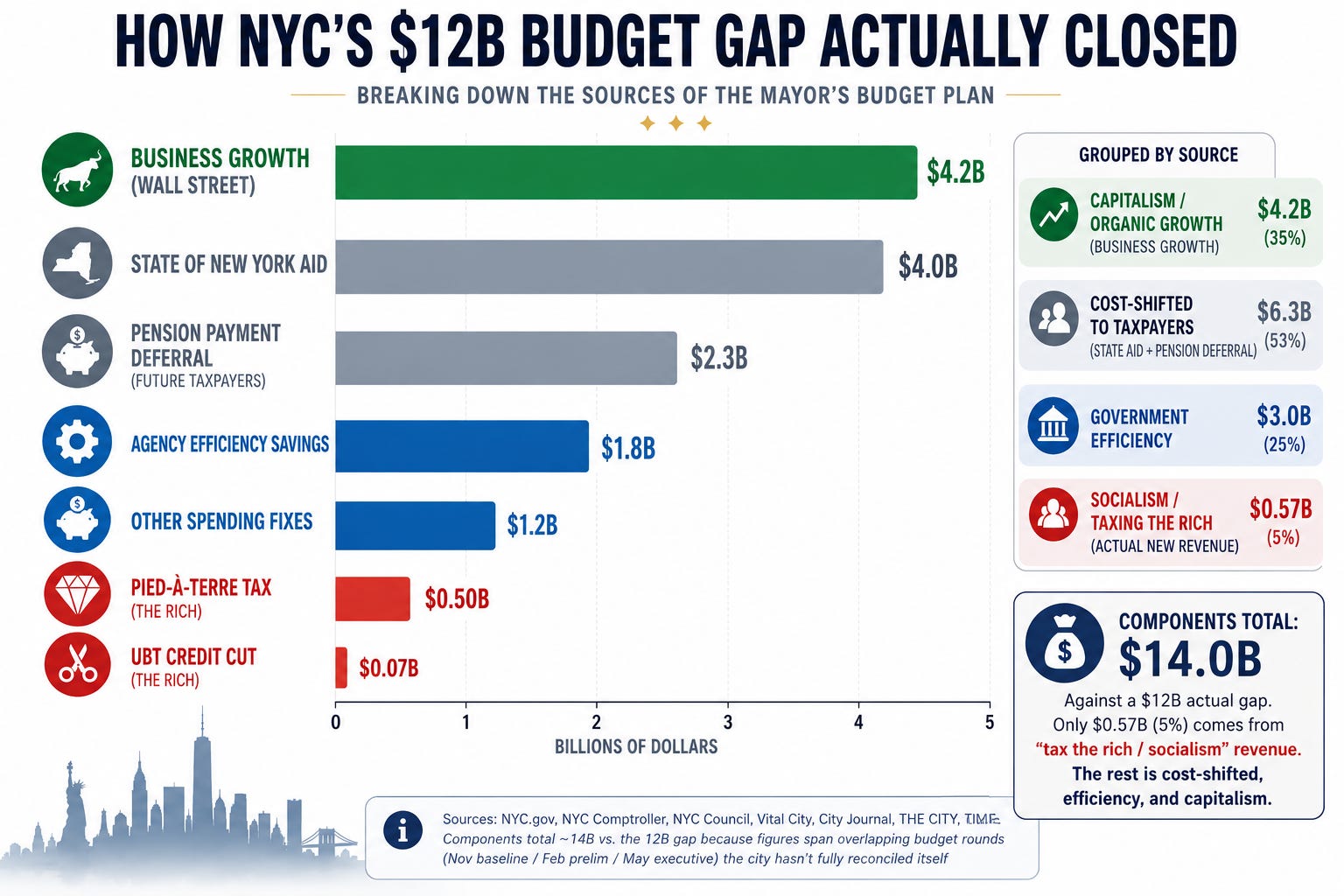
Most of the money, 53%, comes from two moves:
A bailout from New York State to New York City. The majority of that money is from taxpayers who don’t live in New York City, bailing out those who do.
Future taxpayers paying more for pensions, in exchange for present taxpayers paying less. This is money moved from one group of working-class people to another group of working-class people.
The second biggest pot of money, 35%, comes from projecting that in 2027, Wall Street will continue to have strong economic growth.
Ironically, he is projecting that Trump, the man he has vehemently opposed, is going to continue to oversee a booming stock market that helps balance his budget.
Perhaps even more ironically, Mamdani made a more optimistic projection of Wall Street’s growth in February than his predecessor, Eric Adams, did in November.
Capitalists are creating the growth, while socialists call the benefit of that growth socialism.
The third pot, 25%, comes from government efficiency.
Great job, Mamdani.
We should all celebrate that, regardless of whether it came from left or right, capitalist or socialist.
And finally, weighing in at 5%, is the savings from socialism: taxing the rich.
So 35% of this gap was closed by capitalism, and 5% by socialism.
Much of the 53% came from moving the burden onto taxpayers outside New York City, and taxpayers who haven’t been born yet.
(These pieces add up to a bit more than the $12 billion, because the city reached zero through a mix of overlapping measures rather than one clean stack. The proportions tell the story.)
He said, “We didn’t close the gap on the backs of working people.”
But state taxpayers are working people.
Future taxpayers are working people.
He didn’t take the gap off the backs of working people.
He moved it onto different backs.
Does this sound like a win for socialism to you?
Now, to some, this might seem like nitpicking. So let’s zoom out and discuss why it’s important.
The issue is not that socialists and communists are bad at describing problems. On the contrary, they are some of the best.
They truly attract gifted communicators who move the masses.
The problem is they don’t solve those problems.
There is not a single socialist country on planet Earth that the average American would want to live in.
No, Nordic countries are not socialist. As I’ve mentioned elsewhere, and as the former Danish Prime Minister has said, they have capitalist economies with strong social safety nets.
No, not even China is socialist. Its model is characterized as “state capitalism” or “authoritarian capitalism.”
Socialism requires state ownership of the means of production.
The countries where that is actually the case, not in name but in practice, are North Korea, Venezuela, and Cuba.
The problem with socialism has never been that it can’t identify problems. It’s that it can’t implement solutions.
And here’s the deeper issue. The worldview isn’t responsive to reality. It’s unfalsifiable. Every time it fails, the failure gets explained away.
“It wasn’t real socialism.”
“The timing was wrong.”
“We just haven’t tried the enlightened version yet, the one no civilization before us was virtuous enough to pull off.”
The solution is always kept one more try out of reach, so the ideology never has to account for its own track record.
The concerns it raises are often real.
Wealth is concentrating.
Politics is captured.
Working people are hurting.
Those are true things worth taking seriously.
But the framework built on top of them — the language of power structures and class abstractions, so boundless and poorly defined that it’s easy to sound intelligent without demonstrating results — keeps the actual solution perpetually out of reach.
It’s been said that the mark of intelligence is speaking simply. Socialism doesn’t speak simply. It uses a bunch of terms that mean something different to everyone, and creates the appearance of clarity.
It is not a constructive ideology that values the growth and abundance that capitalism creates.
It doesn’t value capitalism, warts and all.
It says capitalism is all warts.
We’ve scaled humanity to over 8 billion people not through redistribution, but through growth, innovation, technology, and markets.
Every single human being alive today lives in more abundance than their ancestors did 100 years ago.
For the first time in human history, more people are dying from too much food than too little.
To be clear, we have serious problems. Many of them come from the corruption of markets, and the concentration of wealth that follows when business and politics commingle.
That is something we need to solve.
But we should not overcorrect from a flawed but working model to a model that has never worked at all.
We have real problems to address as a civilization.
And the best contribution of the socialists is that they’ve held all our feet to the fire so that we look at them.
But socialism isn’t the solution.
Better capitalism is.
But there’s a reason why socialism is so appealing. And no, it’s not because people are lazy and want free stuff.
In the next section, I’ll show you what the Socialist Messaging Strategy is, and why it’s so effective.
From here, you’ll learn:
The pyramid model that explains how modern political messaging captures the top floors while destroying the foundation.
A close look at the test to analyze what happens to safe streets and local jobs when a city honors labels over public service results.
The playbook behind disordered priorities and how to quickly spot when an ideology is coasting on growth it didn’t create.
The Socialist Messaging Strategy
The socialist messaging strategy is incredibly effective at focusing on things that are genuinely important — racial equality, class exploitation, concentration of power — without putting them in proper relation to other priorities like economic growth and safety.
Here’s the way to understand it.
