


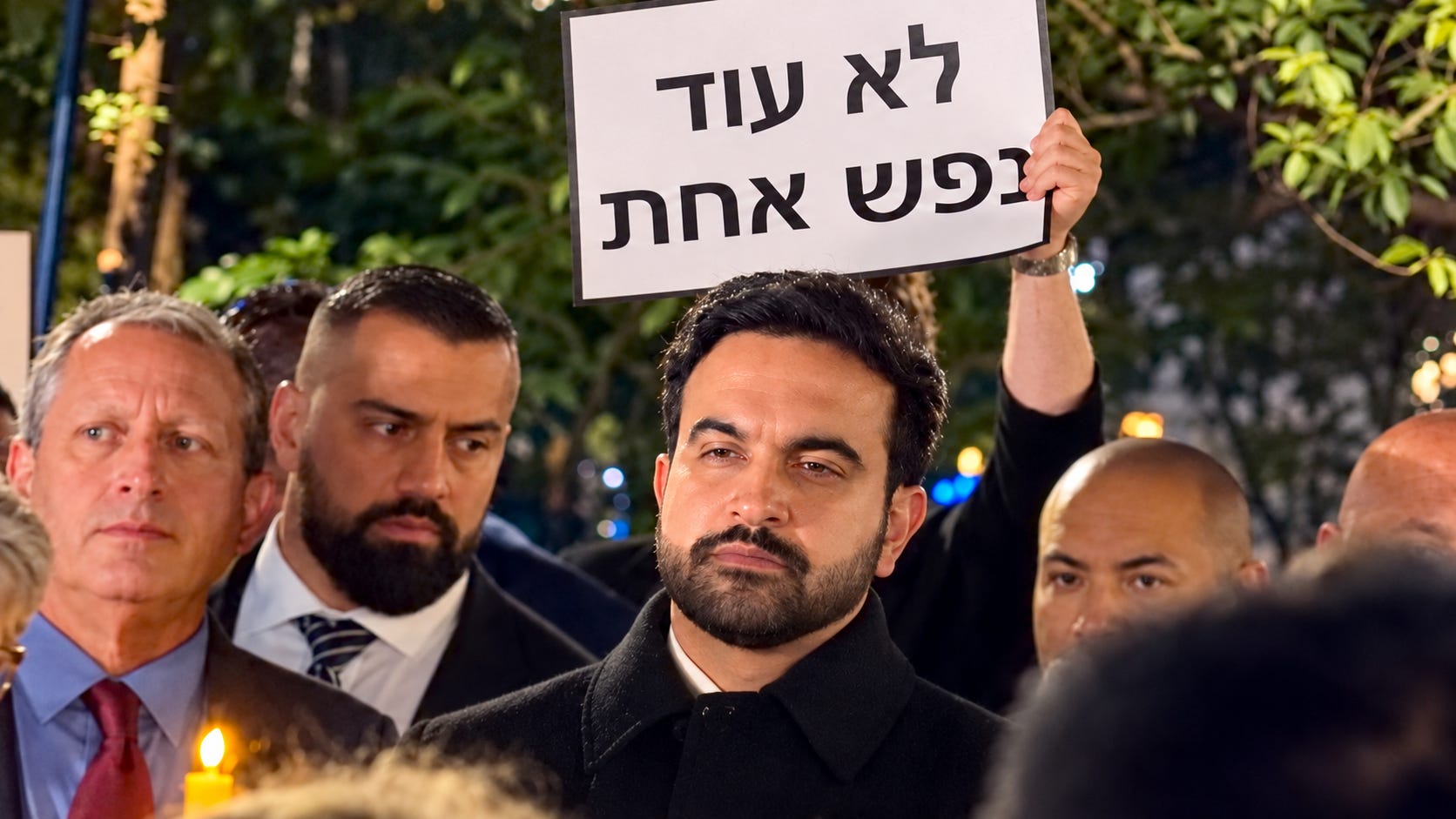
Yesterday was October 7, 2026.
It was the third anniversary of Hamas’ October 7 attack on Israel.
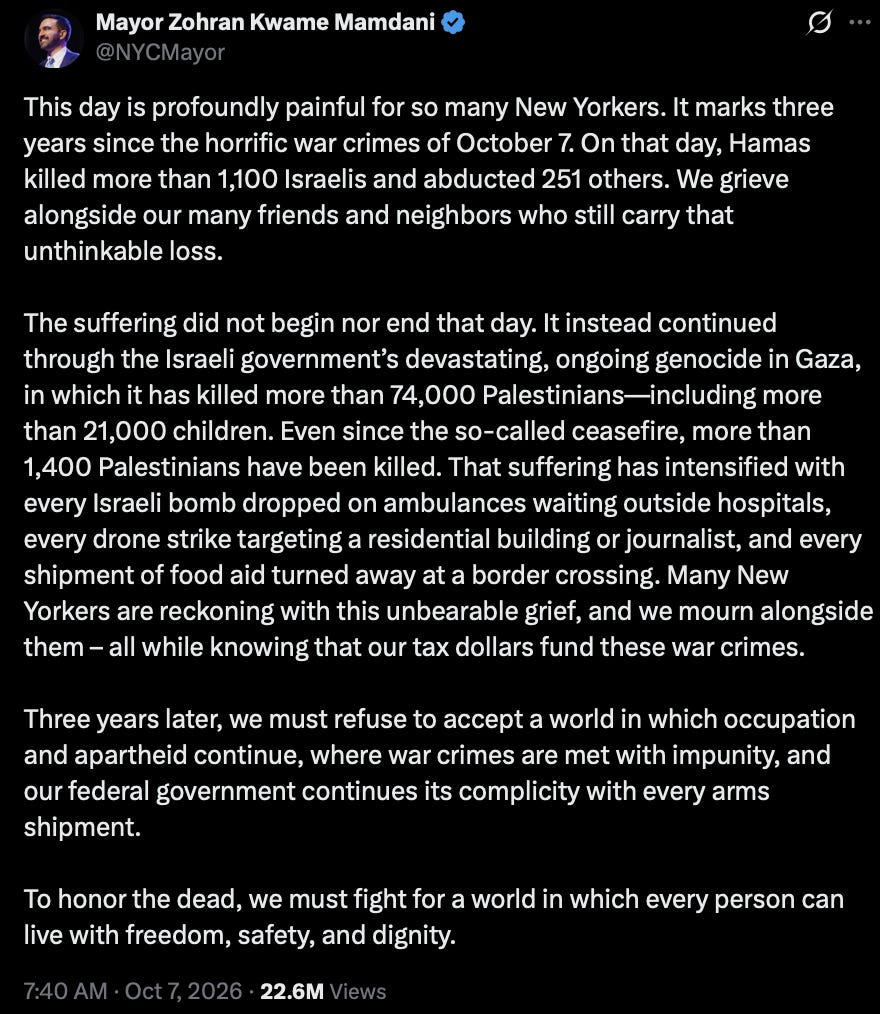
Zohran Mamdani gave a statement.
This was the response from a significant portion of his own supporters:
They’re calling Zohran Mamdani a traitor.
This is how you know that much of the Free Palestine movement is extremists who are more interested in sides than solutions.
They’ll even eat their own.
There’s no level of nuance or responsibility on the Palestinian side that is ever permissible to them.
Everything needs to be entirely Israel’s fault all the time.
To see the problem, look at what he said.
Three camps
Various factions reacted to this in different ways.
The first camp viewed this as a fair, even-handed, moderate statement in which he acknowledged the wrongs on both sides of this conflict.
The second camp interpreted this as a deceptive and even anti-Semitic post with clever wording. We’ll call this “Pro-Israel” for simplicity.
The third camp is the one in that video - let’s call them “Free Palestine.”
What do they mean, anti-Semitic?
Let’s start with the second camp first - because once you understand them, it makes the third camp look even more irrational.
I’ve been educating myself on anti-Semitism recently.
As part of that, I listened to a conversation between Haviv Rettig Gur and Ruth Wisse, a former Harvard professor.
She pointed out something interesting that I’ve started to realize myself: when people hear the word anti-Semitism, the colloquial interpretation is hatred against Jews.
Actually, there’s a different way of thinking about anti-Semitism: viewing Jews as the central, responsible party in all issues.
Antisemitism is a theory of blame. Hatred is optional.
It’s treating Jews as the root of society’s problems, whether it’s saying that Jews are the reason we have too much immigration (a popular statement on the far right), that Jews control the media (a popular sentiment even in mainstream circles now), or that Jews control finance.
The way it manifests in the Israel-Palestine conflict is not necessarily as actual hatred of Jews (though there is some of that), but as viewing Israel and Israel’s actions as the fundamental problem in the conflict.
It’s not necessarily that someone is going around hating Jews in their life, similar to the overt racism that historically some white people harbored against black people and that would lead to outright lynchings.
It’s a different idea: it’s a unifying theory of the world that implicates Jews as the source of its problems.
I think this is a very useful way to look at things, because it helps you understand, even if you don’t agree with it, why Jewish people view critiques of the state of Israel as anti-Semitic in nature.
It’s not necessarily that they’re saying there is outright hatred toward Jews, although that clearly is an issue, given what we see: two Israeli embassy staffers shot dead outside the Capital Jewish Museum in D.C., the recent attempted terror attack in Michigan, and the Bondi Beach massacre.
This is happening all over the world, which is actually pretty akin to the lynchings that black people experienced.
It’s something deeper: a mental model that seems to always find a way to trace every issue back to Jews.
It’s a lens - a filter for looking through the world.
What the Pro-Israel camp saw.
The concern from this crowd is about a few things:
Asymmetry in attention: Zohran devoted 50 words to condemning Hamas’s attack, but 164 words to condemning Israel’s counterattack.
Asymmetry in the language used: Zohran named 1,100 “Israelis” but did not mention the composition of those Israelis, who were predominantly civilians, including women, children, and babies. Zohran specifically called out 21,000 children being killed by Israel.
Asymmetry in intent: Zohran used words for Israel’s actions that describe intent, like genocide and apartheid. He used no such words for Hamas.
I would argue that for Hamas, you can be much more certain about intent than you can for Israel’s government.
Hamas went house to house through the peaceful communes killing families, and when they found a music festival, they raped, killed, and slaughtered attendees.
There’s also the fact that Zohran chose to bring up Israel’s actions on the anniversary of October 7.
To understand why this is a deliberate choice with important consequences, imagine if, on September 11, Zohran brought up Al Qaeda’s attack on 9/11 and then brought up, in the same breath, the subsequent devastation that the U.S. brought upon Iraq (which many people now agree was unnecessary and disproportionate).
It’s this deliberate choice that leads many people to reasonably conclude that Zohran’s post was anti-Semitic - again in the sense that it treats Jewish power, influence, and culpability as central and fundamental to key issues.
One could reasonably argue that Israel is not targeting civilians; they are targeting militants and killing civilians in the process.
Ironically, the genocide claim, as I discussed in a recent piece [LINK], turns on the interpretation of intent.
I would argue that, regardless of your feelings about who’s in the wrong, it’s pretty obvious that Hamas is much more genocidal in intent - they just lack the power Israel does.
Genocide, according to the UN definition, requires trying to destroy a group as a whole or in part.
It’s very clear that that’s what Hamas was doing: they were targeting Jews because they were Jews.
Even if you don’t want to call what Hamas did genocidal, there’s a very easy term readily at hand: a terror attack.
This is exactly what a terror attack is: intentionally targeting civilians, not as collateral damage, but as the goal.
I agree with the pro-Israel camp that Zohran’s statement was clearly biased.
I’ll also say that he at least is trying to provide some semblance of accounting on both sides.
I just don’t think it’s particularly thorough accounting.
What the statement leaves out
The biggest omission is not even the genocide claim. It’s what Hamas is doing to the Palestinian people: building tunnels and, in their own words, using people as human shields.
That’s a necessary fact to reckon with because it introduces a tremendously important question.
If Hamas was not:
Embedding tunnels under schools
Telling people to stand on roofs
Telling civilians to ignore evacuation orders
Using children to transport weapons, according to recent IDF footage
Would Israel be killing civilians at the rate they are, or would Israel exclusively be killing military targets?
As I mentioned in my previous piece, a normal army uses soldiers to block bullets from civilians.
Hamas uses civilians to block bullets from soldiers.
For a normal army, killing civilians is what happens in the process of hitting the military.
For Hamas, killing civilians is the process.
I personally think this is the single biggest blind spot for the West: they don’t understand radical Islam organizations like Hamas, or the Islamic Republic, which controls Iran’s government.
This is not even like Russia fighting Ukraine.
This is a completely different actor with a completely different calculus from what a normal government or army does, and still, despite 9/11, people don’t seem to understand this about radical Islamists.
Charlie Kirk pointed this out too:
That blind spot creates an asymmetry.
Whatever misgivings people might have about the influence of Jews in Western society, we have a very clear idea of what the influence of radical Islam is in Western society.
It’s been made clear not through abstract theories about influence and power, but through blatant incidents of terrorism throughout the West, ranging from 9/11 to constant terror attacks in Paris, Germany, and other Western bastions.
Yet the zeitgeist is more suspicious of Jews than of radical Islam, despite this difference in the tangible track record of attacks on the West.
To be explicit about it, on this particular point, I’m quite sympathetic to the Israeli cause - they are fighting radical Islamists - which are far less aligned with Western values than Jews.
Is Zohran being deceptive?
It’s a different claim entirely to say that this is evidence that Zohran is being intentionally deceptive.
There are two plausible explanations here:
Zohran is secretly an Islamist who is soft-peddling Islamism, and it’s a Trojan horse for Islamism in the West. He’s carefully calculating everything so he stays within the window of acceptable political rhetoric while still trafficking anti-Semitic ideas.
He’s like most politicians: well-intentioned, with his own biases. He has a side he agrees with more than another. He’s trying to be charitable to the other side, but at the end of the day, he has his convictions. He’s also trying to play to his political base, which got him elected and is a huge part of his power: the pro-Palestine movement and the Democratic Socialists who overlap with it.
I’m honestly not certain.
As I’ve said in other pieces, I think Zohran is a generational political talent, charismatic, and I find his personality attractive.
He’s also certainly capable of deception.
I genuinely find it hard to discern his intentions, and try to avoid mindreading as a rule.
Mindreading doesn’t convince anyone who doesn’t already agree with you, and I generally find it more useful to focus on actions over states of mind - which are usually unknowable.
So look at actions.
There are also statements like this, where Zohran exclusively implicates Hamas without implicating Israel:
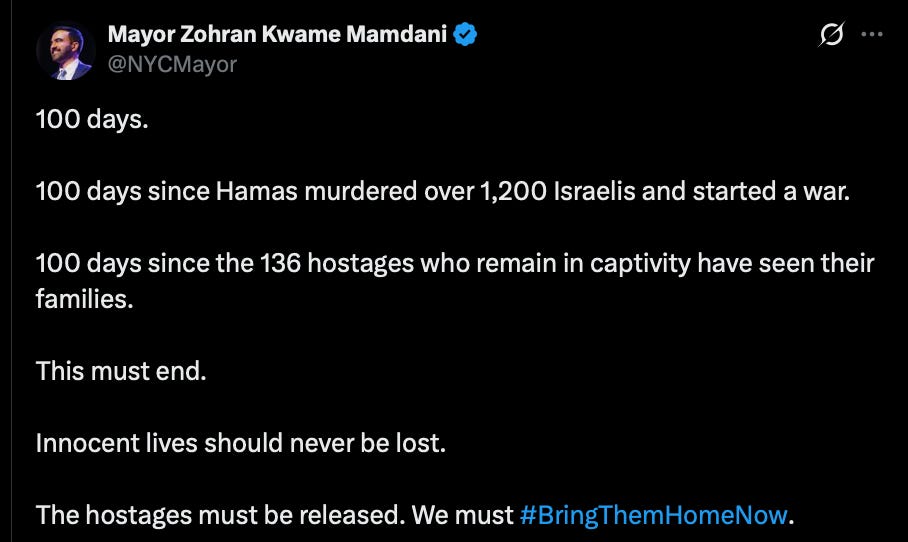
Maybe this is all part of the grand deception, or maybe it’s not, but I want you to factor this into your analysis, wherever you are on Zohran Mamdani.
We don’t know what Israel would do in a counterfactual where Hamas wasn’t using their people as human shields.
Would they be bombing entire residential neighborhoods?
I don’t think so, but we don’t know.
We certainly know, however, that Hamas is doing all these things and making it essentially unavoidable for Israel to attack Hamas without simultaneously wreaking devastation upon the civilians Hamas hides behind.
So if Zohran is sincere, the standard is simple: it is a responsibility of all, especially leaders like him, to clearly call out what Hamas is doing to its own people.
A quick note before we get to the third camp.
People tell me they like how I break down issues like this one.
Separating what someone said from what they meant.
Judging actions when intentions are unknowable.
Holding two explanations at once without picking a team.
That’s a skill. You can learn it.
I designed the Clear Thinker Course to teach it, because it’s so easy to be confused and overwhelmed by the information landscape.
The course uses principles of logic, philosophy, and psychology, modernized for the way information reaches you now.
You’ll learn the 10 cognitive biases and logical fallacies the media uses to manipulate your thinking, a framework for catching them as they happen, and exercises to sharpen your pattern recognition.
Here’s the link where you can get the course yourself.
The Free Palestine cancellation
Now go back to the people in that video.
A statement that leans against Israel, on the anniversary of the worst massacre of Jews since the Holocaust, got him called a traitor.
It doesn’t matter that Hamas builds tunnels under schools.
It doesn’t matter that a Hamas MP said on Hamas TV, verbatim, “we have formed human shields of the women, the children, the elderly, and the mujahideen.”
It doesn’t matter that Hamas dresses like civilians, making them difficult to distinguish from actual civilians.
It doesn’t matter that Hamas has engineered a situation in which there is effectively no way for Israel to eliminate Hamas without killing large numbers of civilians.
No, these people are not interested in solutions.
They are obsessed with sides.
In their view - 100% of the responsibility is the Israelis and 0% is the Palestinians.
That’s the definition from earlier.
One party carries all the blame.
Israel.
Even a 1% deviation makes you a traitor.
Extremism is becoming the norm
This inability to accept any nuance at all is a sign of extremist thinking, and scarily, extremism is starting to become the norm.
We see it on a macro scale with movements like this constantly justifying every single thing Hamas does and either ignoring or being completely unaware of the way they behave.
We see it in France, where, in response to grievances about teacher shortages and run-down buildings, students are burning down schools, which, of course, is self-defeating.
We see it with an unsettling number of people saying that the killing of the United Healthcare CEO is justified.
We see it with people saying that the killing of Charlie Kirk is justified - or even celebrating it.
We saw it with the anti-ICE protests in LA as people burned cars in the street.
It’s ideological extremism, and it springs from a far-left ideology that is so certain in its righteousness that any tactic used to prosecute its goal is justified, even if it’s killing your fellow citizen or supporting an organization that uses its citizens as cannon fodder.
I’ll admit there’s an instinct for me to say, “Well, there are issues on the right as well.”
Of course there are.
In fact, when it comes to the attitude toward Israel and Jews, the far right and the far left are almost indistinguishable from one another.
Both seem to be adopting this form of anti-Semitism that views Jews as central to America’s problems, the world’s problems, and/or even their personal problems.
But saying I think they’re equal would be dishonest.
I don’t think, at this particular moment in history, far-right extremism and far-left extremism are equally a problem.
Extremism of any kind is almost always a problem. You’re seeing this with the Free Palestine movement: it shuts down critical thought and the nuance needed to actually make productive changes that last.
The deeper problem here is extremism.
It is manifesting itself most potently in the far left at this particular political moment, and I think it’s the enemy.
It’s the enemy of the West, the enemy of independent thought, and something we need to take seriously.
The thing with this extremism is that, if it’s unchecked, it doesn’t stop.
It begets more extremism.
And this alliance has been tried before.
The rest of this letter is for paid subscribers: what happened the last time the far left marched with Islamists, and why I keep meeting young British men who’ve fled to Colombia. Becoming a paid subscriber is the best way to support this work.
