


This video is also available on YouTube.
Jason Arday should not be dead.
He’s dead because he didn’t tell the truth.
And universities didn’t look for the truth.
And his peers didn’t ask for the truth.
Some of the attention on Jason was racist. The majority was not.
And focusing on a minority of racists to dismiss the majority of people who are rational is making us all irrational.
People avoided the truth, and it caused a tragedy.

Jason was a Cambridge University professor of sociology.
In March 2023 he was made Professor of Sociology of Education - one of the most prestigious positions in his field.
The 37-year-old was the youngest black professor in Cambridge’s history.
And he had an extraordinary story.
Jason said he was diagnosed with autism and global developmental delay at three years old.
He said he couldn’t speak until he was 11, communicating in sign language.
He said he couldn’t read or write until he was 18.
And then he became a Cambridge professor.
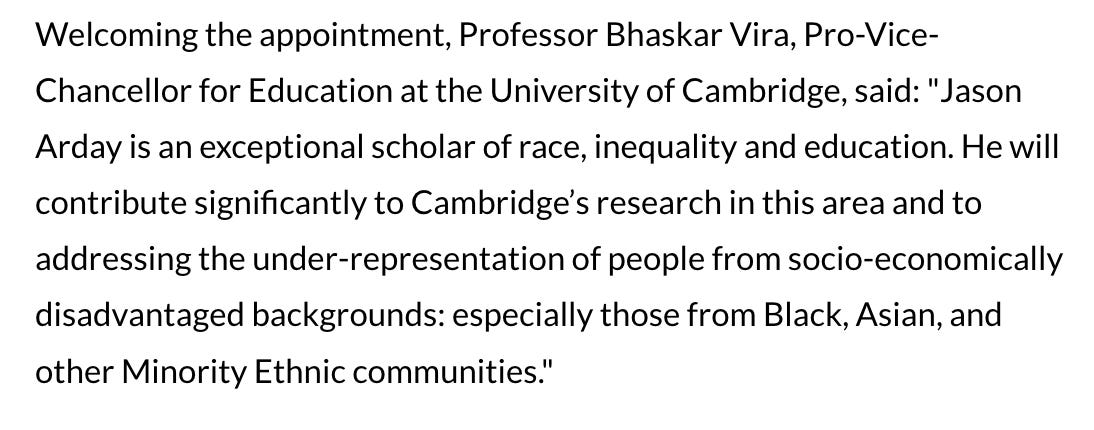
Cambridge put that story in the press release announcing his appointment.
They called him “an exceptional scholar of race, inequality and education.”
The story went global. BBC. CNN. The Guardian.
There was more.
Jason said he ran 600 miles in six days.
He said he raised £5.5 million for over 70 charities.
He said he held visiting professorships at Ohio State, Glasgow, and Nelson Mandela University.
He said he had a book with Palgrave Macmillan.
Jason published his first peer-reviewed paper in 2018.
He became a full professor in 2021.
In three years.
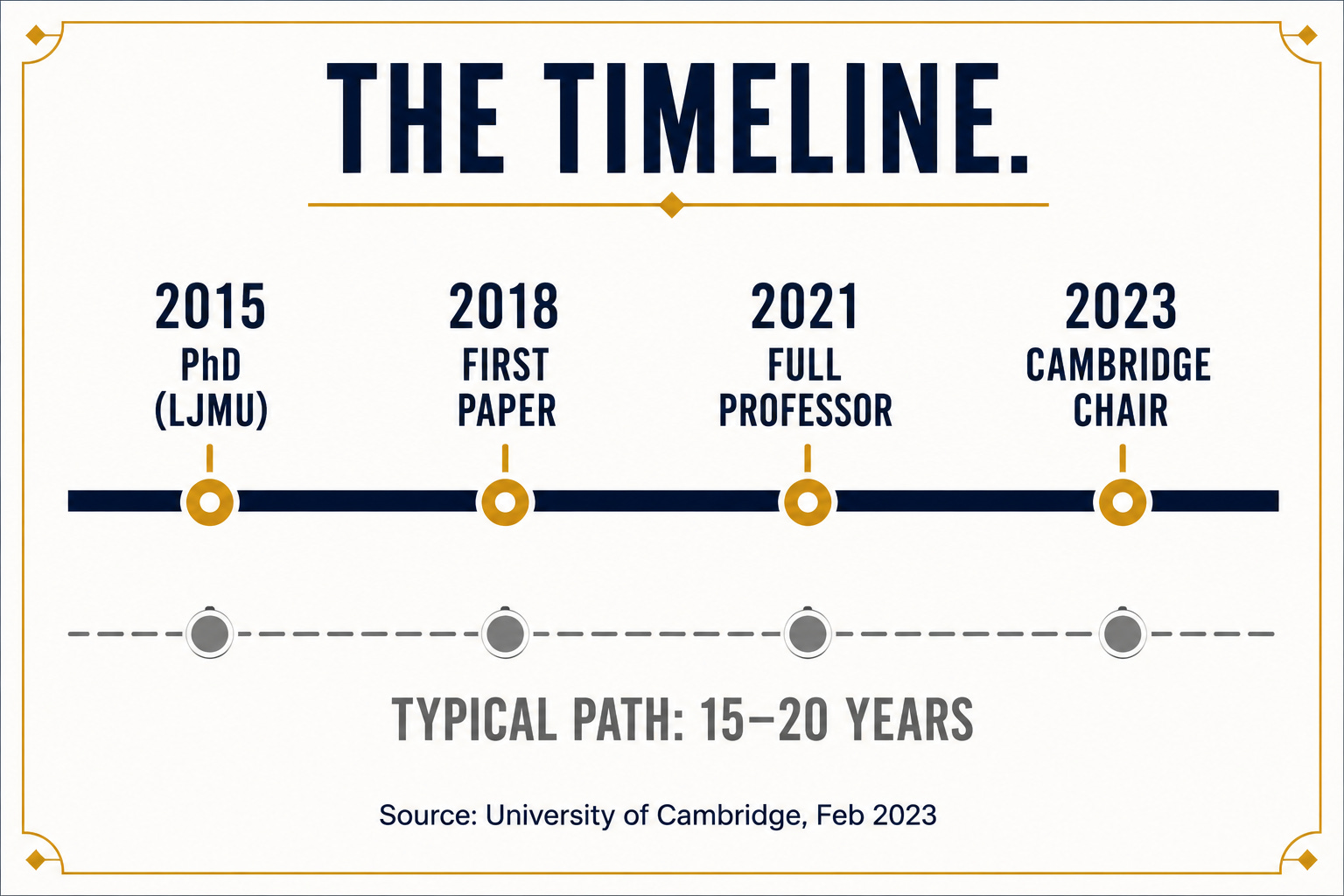
The normal path takes fifteen to twenty.
And his scholarly record was thin. Around 30 published works.
It looked like a mid-career lecturer’s record, not a Cambridge chair.
Somebody noticed.
In 2023, a sociologist named Martyn Hammersley wrote to Cambridge with evidence that Jason’s work was plagiarized.
Cambridge’s integrity office wrote back and said the alleged plagiarism happened before Jason arrived, so it wasn’t their remit.
Fair enough, that is in their rulebook.
But they had the option to recommend an alternative course of action.
It looks like they didn’t.
Instead of looking into the accusations, the head of the Faculty of Education wrote that Jason had spoken movingly about his experiences of racism and about health issues.
And that he had the department’s full support.
Nobody looked.
Two years went by.
The university where Jason was a PhD student, LJMU, investigated the claim.
They acknowledged citation failures, but called them honest and reasonable errors.
They said the overlap was well within the academic standards of the time.
And they blamed his supervision.
Then, in July 2026, an academic named Nathan Cofnas published the plagiarism evidence publicly.
Cofnas is a self-described race realist. Some people consider him a racist and dismissed Nathan’s evidence on that basis.
Cambridge called the criticism from people raising concerns “a vile campaign to undermine his credibility.”
A letter of solidarity with Jason got 13,000 signatures.
But now that the evidence was public, publications started to dig.
The Telegraph is considered right-leaning. The Guardian is left.
And the Guardian originally celebrated Jason’s achievement in 2023.
The Telegraph’s analysis found 188 matching sentences.
The Guardian investigated Jason’s biography and discovered:
The professorships Jason claimed to have? Fake.
The book he claimed to publish? Fake.
The charity numbers? Fake.
Ohio State, Glasgow, and Nelson Mandela University all said he never held the visiting professorships.
Palgrave said they took a proposal and never published the book.
One children’s hospice said he’d raised £10,800, not millions.
After questioning, Jason’s 600 miles in six days became 600 miles in twelve days.
When the Guardian asked him about the missing evidence, Jason said:
“To be honest with you, I thought you’d just believe me. Why would I lie?”
Then on August 5th, Cambridge opened an investigation into his qualifications and honorary appointments.
Jason resigned hours later.
Nine days later, he was found dead in south London.
We don’t know how.
But it seems likely that he killed himself.
It seems impossible to have a rational conversation about race-based policies in education and college admissions or hiring.
So to help, here’s an analogy.
The NBA is roughly 78% black and 19% white.
But the U.S. is 13% black and 57% white.
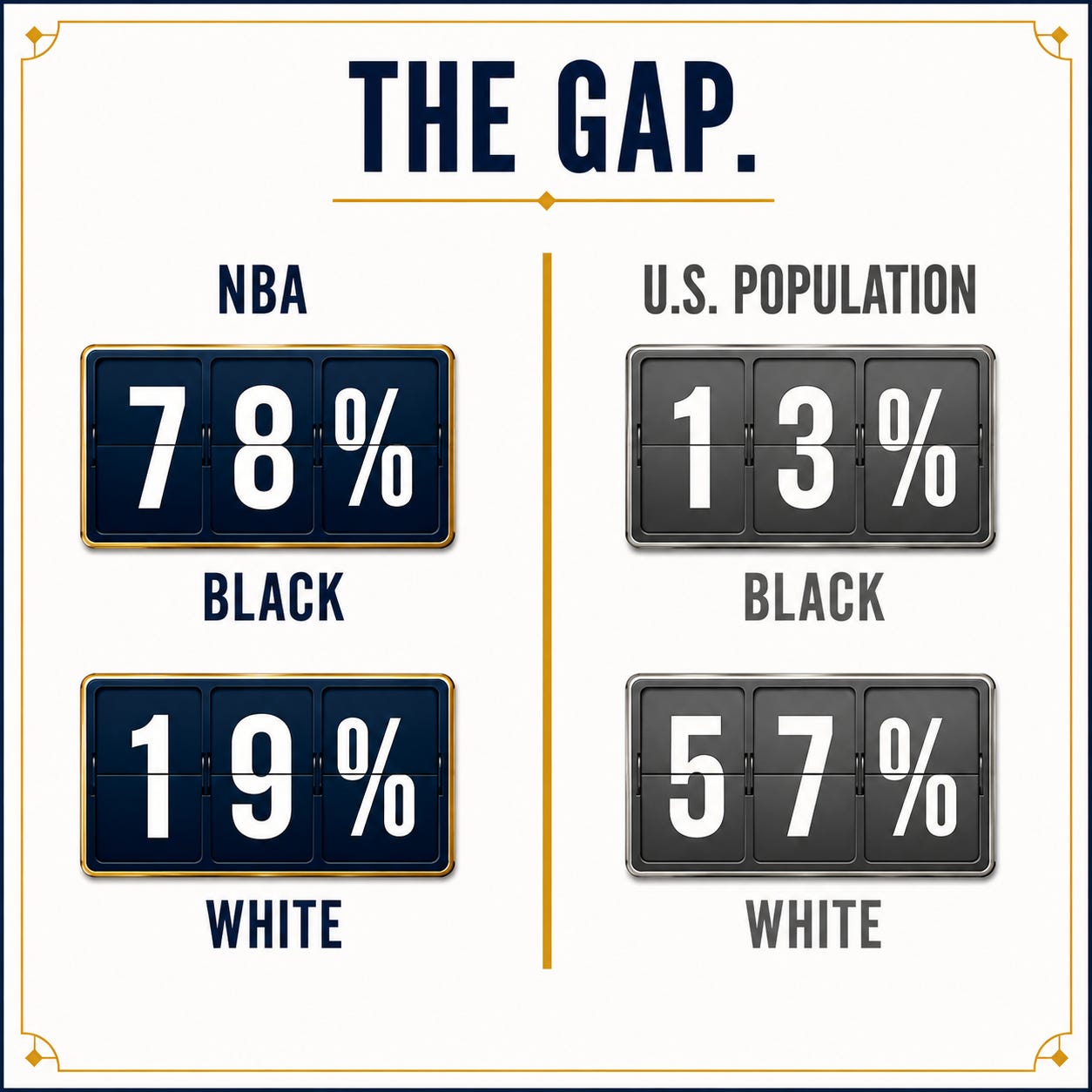
So the NBA is not representative of the diversity of the United States. Not even close.
Now imagine the NBA looks at that data and concludes its system is broken, and must be fixed.
Imagine supporters of this decision say these gaps in racial achievement are explained by discrimination.
The NBA must be discriminating against white people.
So alongside points, assists, and rebounds, they start weighing abstract, subjective factors that are not performance-based - like lived experience and hardship.
Next year, the number of white players increases in the NBA by 50%.
The NBA immediately comes out with a statement and says “This record rise in the number of white players is a credit to their hard work and ability. We have not lowered entry standards.”
One day, a new player gets signed to the Lakers.
His name is Bob.
Bob’s white.
Bob’s STATS are mid.
Bob’s STORY is amazing.
He says he played college ball at Duke, Michigan, UConn - elite basketball schools.
He says he couldn’t even walk until 11.
He says he ran 600 miles in six days.
That he raised millions for charity.
Nobody checks - despite the fact that these are easy to check.
After all, he’s a minority, he needs protecting.
In fact, people who bring up doubts are called racist.
Now, on the court, other players notice that Bob isn’t very good.
They wonder - how did he make it to the league?
But black players don’t say anything publicly - they don’t want to be called racist.
White players don’t say anything - they don’t want to feed the racists.
Years go by.
And then another player, Nick, says Bob is lying.
Nick publishes evidence.
People say Nick is a racist.
Maybe they’re right.
But Bob is still lying.
Bob lied about his story, lied about his achievements, and lied about where he played.
The story goes viral.
Fueling that virality are 3 groups of critics.
Group A: Are actual racists who hate white people.
Group B: Is bigger. They don’t hate white people. They hate double standards. Because humans abhor an imbalance.
Group C: Is the biggest. They’re people who regularly watch basketball, who quietly suspected not all white players were the best, but didn’t have proof.
Now Bob’s defenders say all the critics are just group A - racists.
But B and C didn’t care about race.
They just care about the sport.
They just wanted to watch basketball played by the best.
Not those who are just good enough - the best.
Before the NBA said they need to be more diverse, and before the 50% increase in white players, groups B and C never doubted whether a white player was the best.
Because the NBA never gave them a reason to.
All the system selected for was performance.
But the NBA changed the system.
So fans rationally responded to the changed system.
Fans didn’t want to spend time thinking about whether a white player was the best.
They just wanted to watch the best players ball.
But now, every time they watched a game, of course they wondered if a white player was truly the best.
And now, even the white players who were there before the NBA’s racial equity initiative are getting questioned.
Because when you make race a factor in a system, people are going to wonder if race is a factor.
Even if the intentions were good.
Even if you say the bar wasn’t lowered.
Even if you’re trying to correct for the effect of past oppression.
Now - this hypothetical isn’t so hypothetical.
In 2018, Cambridge said it wanted more black students.

Their words: “committed to doing more to encourage young black students to aspire to the top grades to apply.”
And they’d just increased funding for Target Oxbridge - which Cambridge describes as “a programme which helps black students secure places.”
Within a year, black admissions jumped 50%. Cambridge credited the campaign.
And here’s Cambridge’s senior pro-vice-chancellor, Professor Graham Virgo, in 2021:
“Since the Stormzy Scholarships were announced in 2018 we have seen a significant increase in the number of Black students applying to study here and being admitted.”
Applying AND being admitted. Cambridge’s words, not mine.
And here’s what Virgo said about that 50% rise back in October 2019:
“This record rise in the number of black students is a credit to their hard work and ability. We have not lowered entry standards.”
That’s the same statement I put in the NBA story.
Because I didn’t write it. Cambridge did.
Now remember - admissions are competitive.
So if one demographic becomes more represented, another gets less represented.
But you don’t need to lower the bar for more black students to get in.
You either need a sudden influx of black students who are outperforming their peers but for some reason weren’t applying.
Which is possible.
Or, you pick black students who are underperforming their peers, but still clearing the bar.
Because meeting the bar is not the same as being the best.
Now here’s Cambridge’s own math, from Cambridge’s own website.
In 2017, Cambridge admitted 58 black students.
That was a third of all black students in the entire country who got the grades Cambridge requires.
Two years later, they admitted 91.
So where did the sudden influx come from?
Now, when you see a 50% increase in black students at Cambridge.
And endless initiatives aimed at increasing representation.
And endless slogans about diversity being a strength.
And you go from a system that had 1 priority, performance, to two priorities - that AND diversity.
Of course people are going to think that both admissions and hiring are no longer a pure meritocracy.
Of course they’re going to wonder if a black person who got in under the new system would have gotten in under the old system.
Of course there’s going to be a big reaction when one black person turns out to have told multiple major lies.
And you know who suffers?
The black people who are the best.
Not just met the bar - the best.
Because now, there’s an asterisk on their achievement.
Now, a suspicion that would have been irrational under a merit-based system, becomes rational under the new system.
And in Jason Arday’s case - black academics had private concerns about his competence.
To quote Afua Hirsch from The Guardian:
“The fact is that many of Arday’s black peers in academic sociology have been voicing concerns about him for a while. He seemed, to them, to have come out of nowhere. His performance at high-profile academic events did not match the credentials that were being touted... They did not voice them publicly because we all know that whatever the truth or the outcome, he would be unlikely to be treated fairly and we would all be damaged in the process.”
A valid concern.
Because when you’re in a high-profile position as a public person - you won’t be treated fairly all the time.
There are racists.
The media is biased.
People can be mean.
People have misinformation.
People have scores to settle.
And despite ALL OF THAT - WE MUST TELL THE TRUTH.
Because as much as we want to control reality by lying about it, reality cannot be controlled.
And given enough time, lies do backfire, as do double standards.
The black academics were right.
Everyone was damaged.
Not because black people can’t be the best.
But because this particular black person wasn’t the best, and he lied about it.
And he rose up in a system whose design creates reasonable doubt about whether the black people in elite positions are there because they are black, or the best.
Jason lied.
And everyone covered for him.
And in a well-intentioned attempt to protect him, and protect black people, they hurt both.
You know - I graduated from Harvard.
I’m grateful for that.
I’m also grateful for the black Americans and civil rights advocates who made that possible - because there has been genuine oppression and discrimination that they fought to overcome.
I’d also like to believe I would have been admitted under any system, merit-based, or merit plus race.
But you know what? I’ll never know.
It will always be an asterisk until proven otherwise.
I could yell at people who doubt me.
I could call them racist.
But the fact remains - in a system that makes race a factor, it’s reasonable for people to wonder when race was a factor.
And you know what - maybe you think it’s worth it.
Maybe you think we need these new race-conscious systems, to make up for old racially oppressive systems.
Perhaps that’s true.
But let’s just be honest about the downside.
Jason Arday was given a job he didn’t deserve, because he lied.
Cambridge avoided scrutinizing him, because he was black.
Cambridge attacked those who asked questions, because he was black.
Other black professors didn’t raise their private concerns publicly, because he was black.
This was all so avoidable.
Jason could have told the truth.
Jason’s employers could have looked for the truth.
Jason’s peers could have too.
And this could have all happened years ago, quietly.
Before Jason flew so close to the sun on waxen wings.
Before he fell from a height so great the crash killed him.
But for years, people decided the truth was not the most important thing.
Racial solidarity was.
They cared more about the reaction to Jason than about Jason’s actions.
Institutions tried to replace old discrimination with new double standards.
But double standards eventually collapse.
And now a troubled man is dead.
Because a life built on lies always falls apart.
A lot of Jason Arday’s defenders seem to believe that the media frenzy around Jason is because the media is racist and that this is some sort of “digital lynching.”
I see where they’re coming from.
Some of the attention on Jason is due to genuine racial animus.
When you have 9 billion people on the planet and something is a public event, you’re going to attract attention from the best elements, the worst elements, and everything in between.
But much of the attention is not about racial animus at all.
It’s animus toward a system of double standards in university hiring and admissions that people have felt afraid to speak up about.
Jason Arday, as a black professor who lied in a manner that specifically exploits that double standard, was the perfect fuel for a fire that was already simmering.
In the next section, I’m going to explain exactly why there’s so much media attention on this and a way that you can understand.
So you don’t have to settle for the claim that all the scrutiny is because of just racism.
It’s the cost of the system. It’s the logical consequence of creating double standards.
Below the paywall, five more analyses:
The demographic gap: why unequal representation gets treated as proof of discrimination, and why the gap itself proves much less than people think
The double standard: what happens when race becomes a criterion alongside performance, and why good intentions don’t change how it behaves
The suspicion problem: why race-conscious standards create doubt about everyone who benefits, including the people who never needed them
Why the reasonable go quiet: how fear of being called racist suppresses legitimate scrutiny and leaves the worst voices carrying the argument
The pressure release: how years of silence turned one fraud story into 249 articles, and why other black academics now pay the cost
