


America just turned 250. Clear Thinker is turning 2. 5 days, 5 articles. Become an annual member at 30% off forever - for the first 500 subs. Join here.
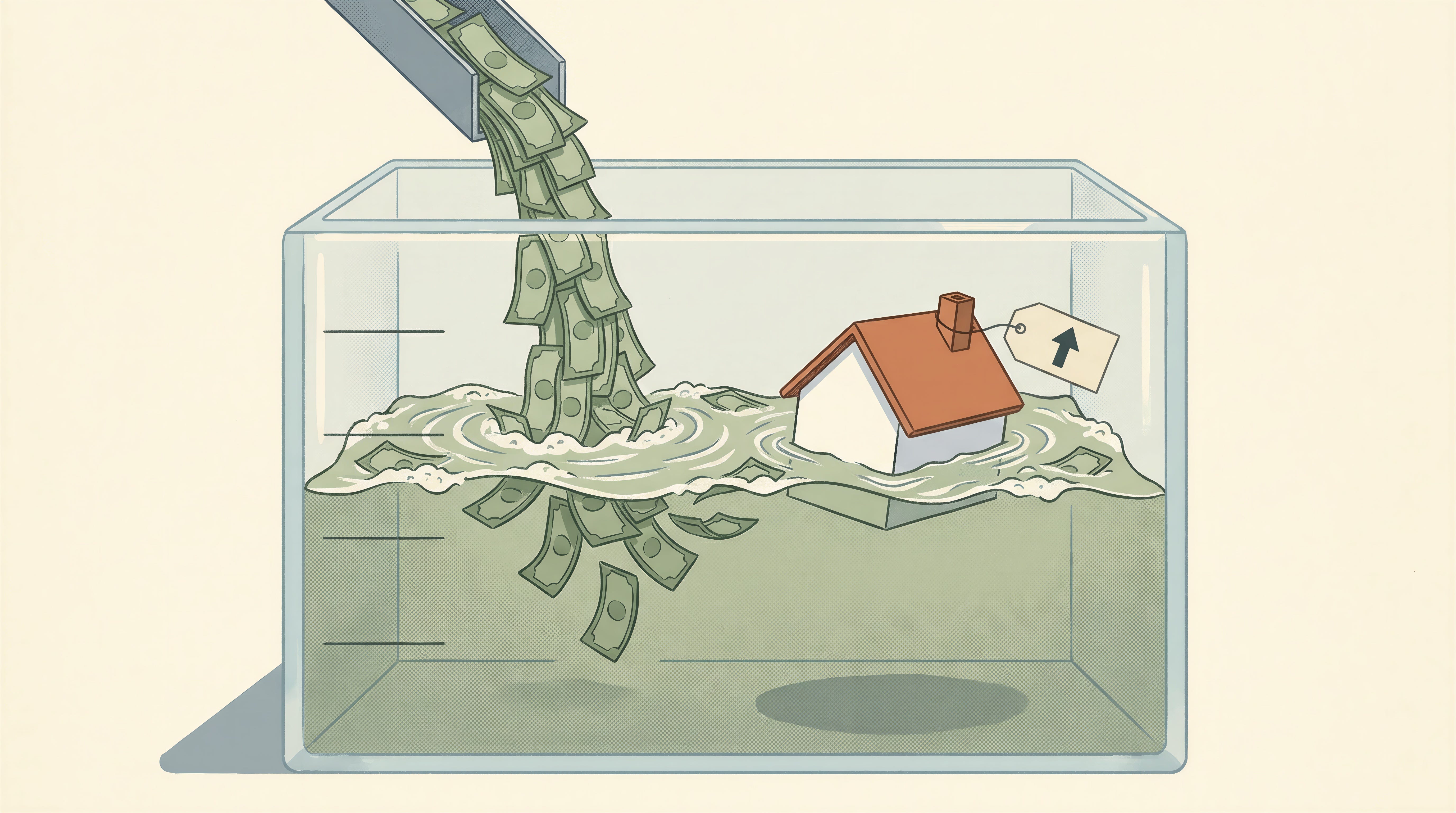
Last week, Gavin Newsom posted a video about billionaires.
In his own words:
“It’s time for a national billionaires tax and a new social contract. 10% of Americans own two-thirds of the wealth. Wages have stagnated. The cost of living has skyrocketed. The system is fundamentally broken. The federal tax code, a corporate code, and an inheritance code were written for a different set of Americans. It’s time for an economic reset.”
The facts he cited are true.
10% of Americans do own two-thirds of the wealth.
Wages have stagnated. The cost of living has skyrocketed.
The American dream feels out of reach for tens of millions of people, especially Gen Z.
But none of those problems exist because the government doesn’t have enough money.
And none of them get fixed by taxing the rich.
The problem isn’t that Gavin said something false.
It’s that the problems he’s naming have almost nothing to do with the solution he’s selling.
Now, Gavin is right that the tax system needs an overhaul.
It’s so complex that “tax specialist” is a career.
With due respect to tax specialists: if a system for paying taxes is so complicated you need expertise to navigate it, something is wrong with the system.
America was founded without an income tax.
The government ran on tariffs and excise taxes.
Simple systems that were easy to follow.
The income tax started as a temporary measure to fund the Civil War, and was repealed a few years after it ended.
It came back for good in 1913, with the 16th Amendment.
And when it did, it was sold as a tax on the rich. Fewer than 1% of Americans earned enough to pay it.
Then it grew.
War expanded it.
The government never gave it back.
And the thing that started as a tax on the wealthy became the code every working American files under today.
Now it’s so complicated that it’s become a game.
A game the rich pay hundreds of thousands of dollars to specialists to win.
In theory, anyone can invest hundreds of hours or pay hundreds of thousands of dollars to win the game. In that sense, it’s “fair.”
But it shouldn’t be a game anyone has to play.
And it’s a valid source of resentment for the average person.
But there’s a second game going on here. And it’s as old as politics.
Using the anger of the public to sell a solution that feels good but doesn’t fix what they’re angry about.
That’s what Gavin Newsom is doing.
The Fairness Problem
Before talking about Gavin, I want to address the reaction from some of the right.
You’ll hear some people on the right say the rich already pay most of the taxes in America.
That’s true.
But it misses the point.
The average person pays close to the full rate — because they don’t have the funds or expertise to win the tax game.
The rich pay less — because they do.
And to be clear, none of this is cheating.
The rich follow the same tax rules as everyone else.
They’ve just engineered their rate down further than you reasonably can — because they can afford the experts who know how.
Here’s a personal example.
A friend of mine recently paid his tax guy around $20,000 to set up a special kind of trust that shrinks his tax bill.
Most people don’t know that option exists — and definitely don’t have $20,000 lying around to use it.
The tax system is a game most people can’t afford to win.
We can recognize this without hating the players — but we should all hate the game.
We should fix that by making the tax system simple, intuitive, and fair — not a game.
But the reason to fix it is social cohesion — not because the government needs more money.
Fix it because nothing poisons a society faster than class hostility and a sense of unfairness.
It creates an environment of suspicion and the perception of bad faith.
The average person stops trusting elites.
Elites wall themselves off.
Everyone loses.
It gets so toxic that even generosity gets rejected.
When Mark Zuckerberg gave $75 million to a public hospital in San Francisco — the largest private gift any public hospital had gotten — activists spent years trying to scrub his name off the building.
That’s where class hostility leads.
But the Government Doesn’t Need More Money
Let’s separate the two things Gavin has bundled together.
The tax code is unfair.
Fixing it, or taxing billionaires, will bring down your cost of living.
Two doesn’t follow from one.
That becomes obvious when you consider two questions:
Do you think the reason your rent is high is that the government doesn’t have enough money?
Do you think your wage is flat because the government is short on cash?
Because that’s the actual claim hiding under “tax the billionaires.”
That the government needs more money, and that once it gets more money, your life gets cheaper and your paycheck gets bigger.
Say it plainly and it falls apart. If we wired the federal government another trillion dollars tomorrow, walk me through what happens to the price of a house in your city. What happens to your wage. Trace the steps. There aren’t any. The trillion dollars doesn’t pour a foundation, frame a wall, or train a nurse. It never touches the thing making your life expensive.
And we don’t have to guess about this, because we can look at exactly where the cost of living exploded and where it didn’t.
Over the last 25 years, some things got dramatically cheaper. TVs fell roughly 97%. Toys, software, and cell phone service got cut in half or more. Clothing, furniture, and cars stayed roughly flat while everything else inflated.
And some things went vertical. Hospital services more than tripled. College tuition more than doubled. Childcare, healthcare, housing — all climbing far faster than wages.
Now put the two lists side by side. The things that got cheaper are made in competitive markets, open to global competition, with relatively little government in the mix. The things that got more expensive are the most subsidized, most regulated, most supply-constrained sectors we have.
Healthcare. Education. Housing. Childcare.
The pattern is so clean that economists have a nickname for the chart that shows it.
They call it the chart of the century.
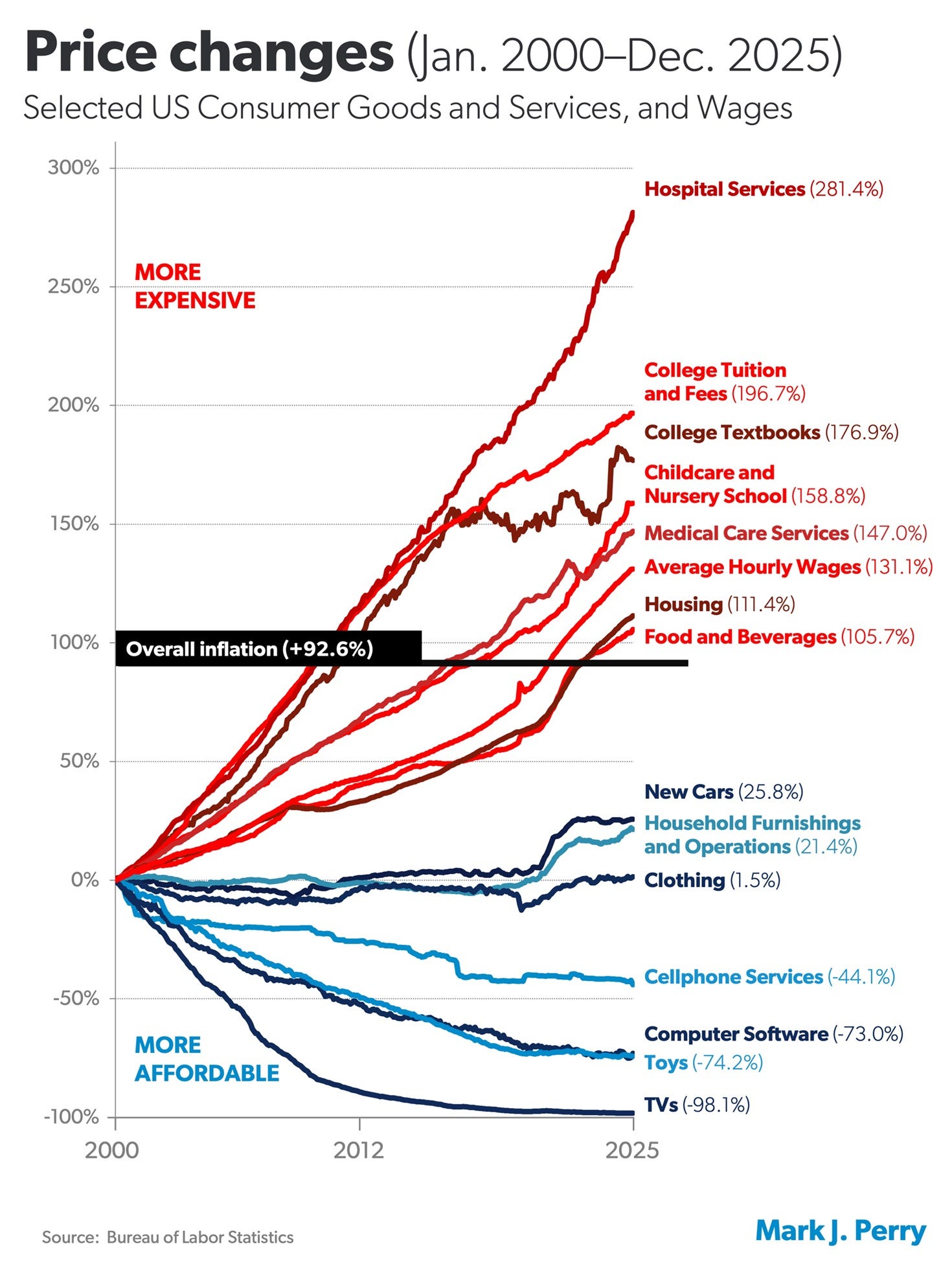
The sectors crushing the middle class are not the ones we starved of public money.
They’re the ones we flooded with it.
Pouring more government money in has not made these things cheaper.
Often it’s done the reverse, because when you subsidize demand for something whose supply is capped, you don’t lower the price. You raise it.
So why did they get so expensive?
Take the two that hit people hardest.
Housing and healthcare.
Start with housing.
Housing isn’t expensive because we underfunded it.
It’s expensive because we made it almost impossible to build.
And for evidence of that, just look at the state Gavin governs: California.
Zoning laws say you can’t build. Permitting takes years. Environmental reviews and lawsuits pile on cost before a shovel touches dirt.
California spent decades letting anyone with a lawyer freeze a project under “environmental review” that had nothing to do with the environment.
Make supply that hard, and prices go up.
A billionaire tax builds zero homes.
Letting people build, builds homes.
Healthcare doesn’t suffer for a lack of money either.
Same story, different costume.
It’s not starved of money — we spend more on it than almost anyone on earth.
It’s expensive because it barely works as a market at all.
Look at your medicine. Between you and the pill sits a middleman called a pharmacy benefit manager.
Three of them control about 80% of all prescriptions. And they’re owned by the same giants that own your insurer and your pharmacy.
So the company deciding which drug you get, the company insuring you, and the pharmacy filling it are often the same company.
They mark the price up, pocket the difference, and steer you to themselves.
And for about 20 years, it was effectively illegal for Medicare — the biggest drug buyer in the country — to negotiate prices at all.
These things didn’t get expensive because the government spent too little.
They got expensive because the market got rigged, capped, or blocked — and the government either did the rigging or let it happen.
So the answer isn’t for the government to replace the market.
It’s for the government to protect the market.
Keep it fair. Keep it open. Strip out the rules that exist to block competition instead of protect people.
That’s the fix. Not a bigger check to Washington.
Wages? Nobody Fully Knows. But Not This.
What about wages?
Gavin’s right that they’ve lagged what workers produce. Ask the economists why, and you get a stack of answers — globalization, automation, the decline of unions, health insurance eating raises.
You know what you won’t get from a single serious labor economist, even the most pro-worker ones?
“Wages stalled because we didn’t tax billionaires enough.”
I won’t pretend I’ve cracked why pay split off from productivity. It’s one of the hardest questions in economics.
But I don’t need to crack it to spot the hole in Gavin’s pitch.
If your fix for stagnant wages is a billionaire tax, you have to show how one causes the other.
He didn’t. Because there’s no line connecting them.
This Is the Oldest Trick in Politics
I want to be clear about something: I’m not here to hand you a new enemy.
Not politicians as a group.
Not Gavin Newsom as an individual — despite my frustration with the state of California.
I’m tired of that. I’m tired of every problem in this country getting pinned on some group or person.
Black vs. white.
Rich vs. poor.
Immigrant vs. native.
Pick a villain, aim the anger, feel righteous, fix nothing.
It’s great for winning elections. But it never fixes the thing people are actually angry about.
I don’t believe billionaires are evil, nor do I think politicians are evil.
But frankly, I think the discussion itself is a waste of time, because no one will ever agree on what good or evil even is.
And even if we could — who on earth is so holy that they get to decide how good or evil someone else is?
What we do know is that billionaires are people.
They do what every single person does — act in their self-interest.
From the person scraping by on minimum wage to the richest man alive, everybody looks out for themselves.
That’s simply the human condition.
I’d pay hundreds of thousands to win the tax game if I could.
I’m guessing you would too.
So if we don’t like how people’s incentives interact with the system, change the system.
It’s the same with politicians.
They simply follow incentives — Gavin included.
His incentive is to get elected.
And the fastest way to get elected is to give people someone to be angry at.
He’s following the same incentives anyone in his chair would.
I’m not writing this because I think Gavin Newsom is evil.
I’m writing it because I think he’s wrong.
And although I get the pain of those who want a billionaire tax, I think this manifestation of it is wrong.
We already covered that there’s no revenue problem.
So a national billionaire tax wouldn’t fund anything that makes your life cheaper.
It would just take wealth, because taking it feels like justice.
These people minimize taxes by winning a game that shouldn’t be a game.
Going looking for new ways to seize what the winners legally earned is a different thing entirely, and a worse one.
That instinct — find the wealth, take the wealth — is just another war on the most successful people we have.
And it’s a war nobody wins.
It will just build more resentment, running in both directions.
The Social Contract
Gavin talked about needing a new social contract. I agree.
The one between the rich and the rest has broken down.
But a contract is voluntary, not forced. And it only holds if both sides keep their end.
Right now, both sides are breaking the deal.
Aristos is ancient Greek for “best,” or “noblest.” It’s where we get the word aristocracy.
And the idea baked into it was this: whoever was given the most, owed the most back.
Status came with a debt to society.
And both ends of that deal have broken.
From below, resentful voices sell the myth that the successful are villains — that billionaires are evil and shouldn’t even exist.
But the dividing line between good and evil is not at the third comma.
It’s between the angels and demons on each of our shoulders.
From above, too many who did well stopped paying the debt back — leaning on the parts of the system tilted in their favor instead of giving through it.
Both ends have to show up.
It’s in the rich’s own interest to serve. Joy comes from a community that loves you, and no amount of wealth will protect you from a society that hates you.
And it’s in everyone’s interest to honor the people who build and give — because a society that spits on its builders ends up with fewer of them.
So call out problems. But shame actions, not groups.
Because if the successful are damned whether they give or not, then most of them… won’t.
And you can’t fund hospitals with resentment.
Stop Looking for Enemies
There is no uniquely evil group of Americans. There’s no secret villain behind your rent.
There’s just people — all of us, all humans with hopes, dreams, and needs that add up to what we call self-interest — and a set of systems that decide how all that self-interest gets balanced.
Some of those systems are dumb. Some of them let a handful of people’s interests drown out everyone else’s.
That’s the problem. Not a person. A system.
We are on the same team here.
The goal is not to find a better enemy. It’s to build a better system.
So if it’s not the billionaires, and it’s not the government’s empty wallet — what is the actual problem? And what do we do about it?
Below, I’ll show you exactly what’s broken, why “tax the rich” leaves it completely untouched, and the one reform that would actually fix it.
From here, you’ll learn:
The mechanism showing how enormous campaign spending dilutes your vote, and why a billionaire tax completely leaves this system untouched.
A breakdown of how a $100M corporate lobbying budget legally killed a free, simple government filing program that would have saved American taxpayers $23 billion.
The precise, unglamorous campaign finance and market-protection reforms required to force down the costs of housing and healthcare without relying on political scapegoats.
The Actual Problem: Billions Louder Than Millions
Gavin was right that we have a money problem.
But it’s not that the government doesn’t have enough money.
