



Yesterday, Luigi Mangione admitted that he shot and killed UnitedHealthcare CEO Brian Thompson.
He killed Brian Thompson on December 4, 2024.
The following week, Emerson College ran a survey.
24% of registered voters age 18-29 said Luigi killing Brian was “somewhat acceptable,” 17% “completely acceptable.”
So 41% of people age 18-29 considered the murder at least somewhat acceptable.
This is a problem.
And it’s not helpful to simply dismiss these people as depraved.
That’s not going to change their minds.
My goal with this piece is to help you put words to exactly why this is a problem.
Because that’s our best shot at both fixing the fact that 41% of young people are sympathetic to murder, and fixing healthcare in this country.
Of Course We Need to Fix American Healthcare
The American healthcare system needs major reform.
Luigi Mangione wrote three words on the shell casings he left behind: deny, defend, depose.
Whatever you think of him, he did not invent those words.
They came from a book about how the insurance industry handles claims, and millions of Americans recognized them instantly, because they have lived them.
You pay every month for years.
Then the moment comes when you need it.
And what you meet is not a person saying no. It’s a process of endless obstacles.
A form that needs another form. A code that was entered wrong. A specialist who is out of network for a reason nobody can explain. An appeal window that closed while you were in the hospital. A phone number that puts you on hold and then disconnects you.
And eventually a lot of people just stop.
They give up.
It’s easy to see how this labyrinth gets constructed.
When a company saves money every time a customer quits, that company will never be in a hurry to make the process simpler.
Sometimes it’s by denying people coverage that they had a reasonable expectation of receiving.
Sometimes it’s by not denying coverage, but making people go through a maze to access it.
It doesn’t have to be that way.
It’s not a necessary evil of capitalism.
Because the healthcare market does not behave like a healthy free market.
It is a market distorted by regulations that excessively favor corporations, because those corporations are influencing our politicians.
The healthcare lobby is the biggest lobby in America.
A record $868 million was spent by the healthcare industry to lobby politicians in 2025.
They aren’t lobbying to make healthcare affordable.
Or to have laws that are fair to both the companies and the customers.
These are companies acting in their self-interest - and the primary incentive of a business is to make money, just like the primary incentive of a living being is to live.
That’s not inherently a problem.
The problem is that customers’ self-interests are not getting properly represented - because the politicians who are supposed to be representing our interests are beholden to corporations.
As I’ve mentioned in prior pieces - we simply have too much money in politics.
But just like socialism is not the solution to the problems of capitalism, killing healthcare CEOs is not the solution to healthcare.
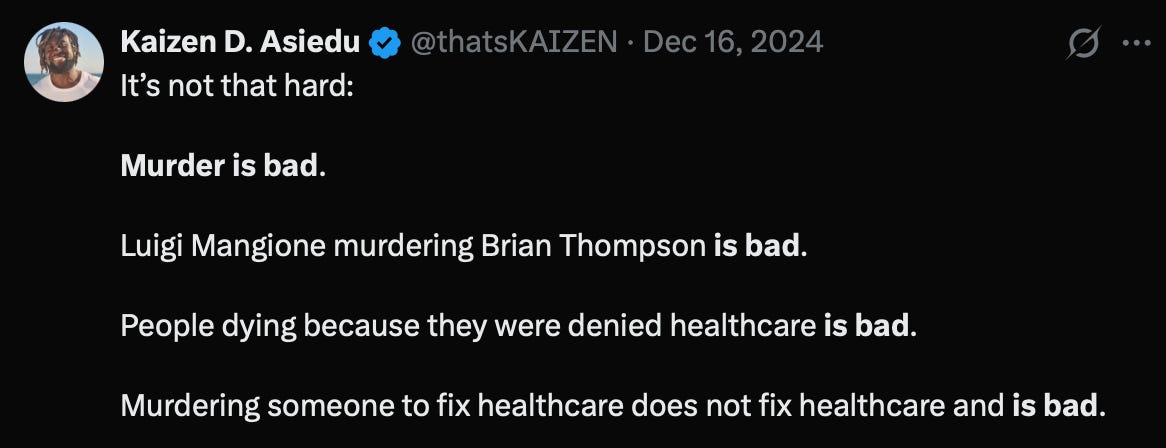
It feels emotionally validating to people who are understandably frustrated.
But it’s strategically ineffective, self-defeating, and morally confused.
Let’s address the strategic inefficacy first.
The Two Halves of the Story
If you look at the media coverage of this case, you’ll see a very clear difference between how the left and the right are framing this.
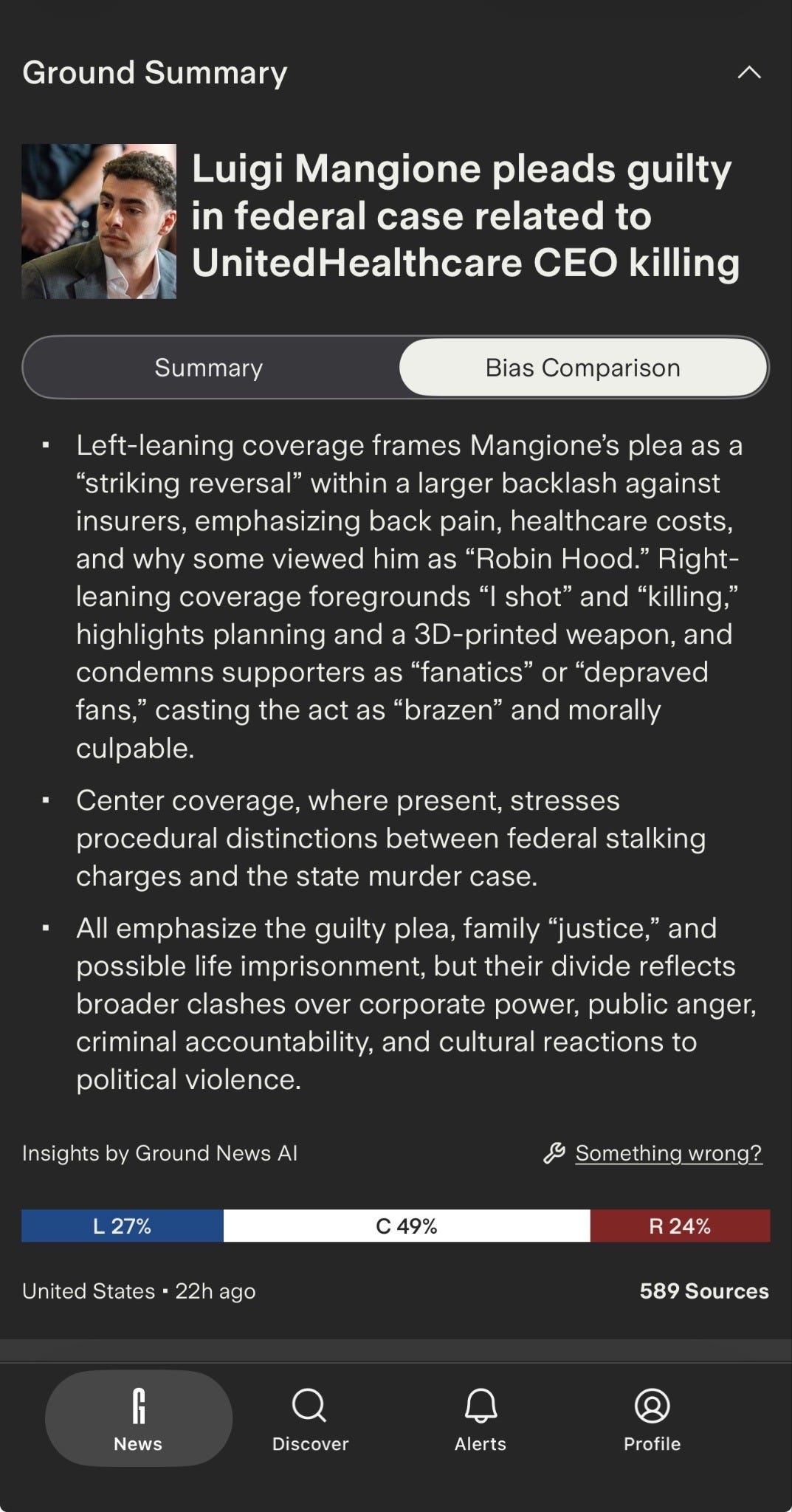
Left-wing media emphasize Luigi’s grievances and the grievances of his supporters.
Right-wing media emphasize what Luigi did, how it was pre-meditated, and condemnation of his supporters.
As you can imagine, if this is where the conversation ends we’ll have gone nowhere - the two sides are talking past one another.
That was a screenshot from the Bias Comparison feature from Ground News.
Ground News has been my favorite news source for two years now, since well before they ever sponsored me.
It aggregates reporting from thousands of sources and gives you a summary.
But its most useful function is that it helps me see exactly what the biases in reporting are, so I get a clearer picture.
Every time I check the Bias Comparison tab, I see essentially the same trend when there’s political violence.
The Left explains the emotional state and legitimate grievances of the people doing the violence.
The Right emphasizes the immorality of the violence.
The Left fails to properly explain why the violence is a problem, irrespective of legitimate grievances.
The Right fails to properly acknowledge the legitimate grievances.
I recommend you give Ground News a try so you can see this for yourself.
It has greatly enhanced my ability to see the gaps in reporting from both sides and see outside of my algorithm, which is right-leaning.
You can get 40% off the Vantage plan, their top tier, at groundnews.com/kaizenx.
Signing up keeps you informed, and it directly supports the work I do here.
The Logic Chain
Calling people fanatics, depraved, or crazy doesn’t change those people’s minds.
Ad hominem - attacking the person, rather than the point - is an effective strategy for galvanizing people who agree with you, but it’s a terrible strategy for persuading those who don’t.
So I want to help you put words to what the issue is with 41% of young people thinking Luigi’s action was even somewhat acceptable.
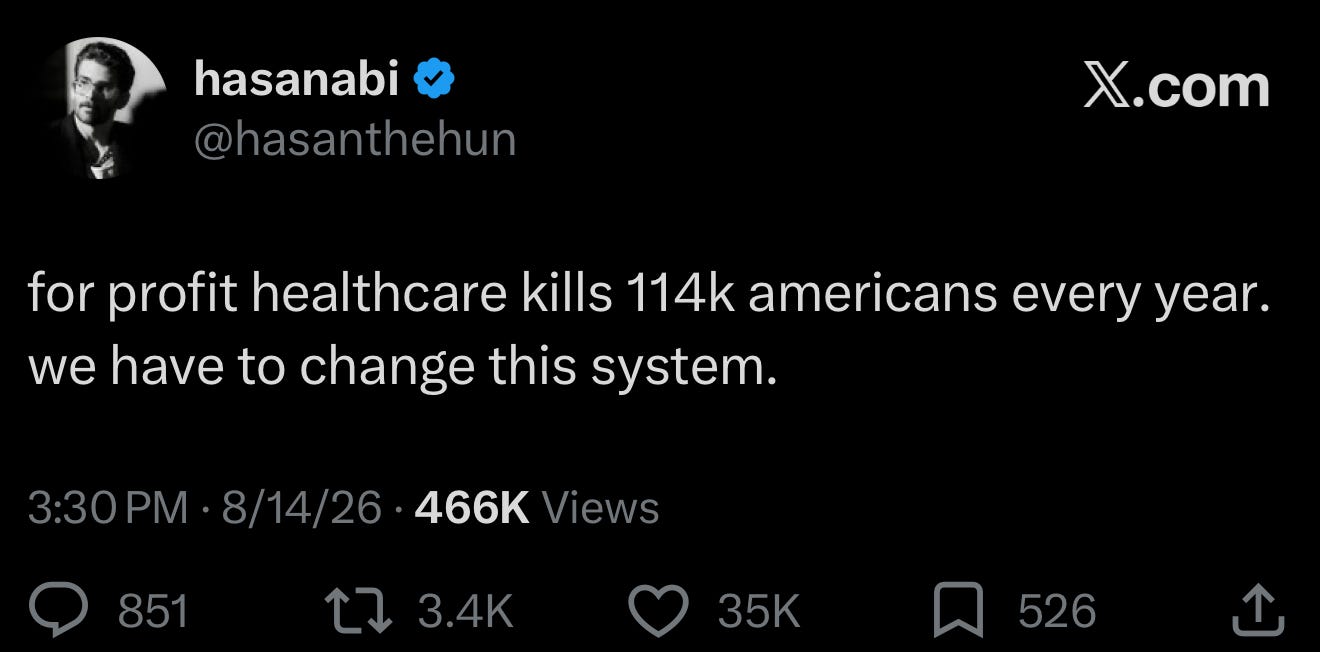
This is a tweet from left-wing commentator Hasan Piker, made on the day Luigi Mangione publicly confessed.
I don’t know if he was commenting on Luigi. It’s reasonable to guess he was, though.
Regardless, the comment is a useful anchor for how a lot of people are thinking right now.
Note the word “kills.”
The logic chain goes something like this:
Healthcare is a human right.
When you deny someone a right, you aren’t refusing them a service. You’re taking something that was already theirs.
So when an insurance company denies a claim and that person dies, the company killed them.
Brian Thompson ran the largest health insurer in America.
So Brian Thompson killed people. A lot of them.
So killing Brian Thompson is acceptable.
The confusion arises from the first 2 links in the chain.
“Killing” vs “Saving”
That 114,000 figure is from a study. Yale School of Public Health, posted July 24 of this year. It hasn’t been peer reviewed yet.
Here’s what it says: if America switched to a single-payer system, we would save 114,174 lives a year.
Save.
The tweet says “kills.”
The study is measuring lives a different system would save.
The tweet is describing the system as killing people.
Those are not the same claim.
The first positions a person, system, or company as not saving the people that it can.
The second positions them as a murderer.
And in most societies, murderers get the death penalty.
This is a crucially important point, because it determines whether you view a healthcare CEO as a mass murderer who got the death penalty, or the leader of a business that could be saving more lives if it focused less on profits, but isn’t.
You can think both are bad, but they are distinctly different moral categories of bad.
To make this intuitively obvious - I’m sure you’ve all seen ads that say something like “You can save an African child from starving for just $3 a day.”
That is different from saying “If you do not give a starving African child $3, you will kill them.”
But equating the healthcare industry or its leadership with killing people is the exact kind of category error that causes 41% of young people to think that a young man shooting another man with a gun is acceptable.
Words have precise definitions.
Definitions determine decisions - like the decision to murder someone versus condemn them.
This is not a semantic quibble.
It’s a fundamental point, and the stakes of getting the semantics wrong are life and death.
So in Brian Thompson’s case, what could someone reasonably call a moral failing?
Brian was the CEO of UnitedHealthcare.
In 2023, UnitedHealth denied 33% of in-network claims on the ACA marketplace, against a market average of 19%.
A federal watchdog report this June found UnitedHealthcare denied 66% of inpatient rehab requests.
Sixteen other Medicare Advantage insurers denied 41%.
That’s a company denying care at higher rates than its competitors.
There’s a good case to be made that even in a bad healthcare system, UnitedHealthcare was particularly bad.
Now - in a world with better healthcare industry regulation, less healthcare lobbyist influence over our politicians, and the proper balance of customer vs company incentives - would UnitedHealthcare have provided coverage to more people?
Yes.
In that world, would fewer people be dead?
Yes.
Does that make Brian a murderer?
No.
Does that mean Brian deserved to be murdered?
No.
Why Political Violence Is Never Acceptable
Hopefully that helped you put words to the moral confusion gripping the 41% of young people who think Luigi Mangione’s action was even somewhat acceptable.
But there’s a deeper, and even more important reason why it was completely unacceptable.
Political violence is violence used to accomplish some political goal.
Luigi murdered Brian to make a point about healthcare. So it’s political violence.
Some people may legitimately think Brian Thompson was an evil person by virtue of his position as UnitedHealthcare CEO.
So this section is addressed to them.
Maybe you think Brian got what was coming to him.
Maybe you think that this is what needs to be done for change.
I won’t tell you to feel sad.
But I do want to show you where this is headed.
Because when Luigi squeezed the trigger, he didn’t just shoot at Brian.
He shot at all of us.
Political violence is on the rise, against political and business leaders.
Melissa Hortman. Paul Pelosi. Josh Shapiro. Donald Trump. Charlie Kirk. An arson attack at Sam Altman’s home.
In every single one of these cases, there was someone absolutely convinced they were doing the right thing.
Someone who found a way to justify physical violence.
Someone who said “what about what he did?”
They didn’t just think they were right, they were so convinced in their moral authority that they acted as judge, jury, and executioner.
Our opinions are abstract.
But physical violence is concrete.
It’s understandable that you’re frustrated with the American healthcare system.
It can and should be a lot better.
But amidst your critiques, do not forget this.
Nature is governed by violence.
For most of human history, disputes were settled by violence.
Before civilization, in some places 50% of people were murdered.
Half the people would kill the other half.
That’s why we gave governments - not individuals - the right to use force.
But sometimes as individuals, we find an individual so repulsive we are convinced it’s okay, just this one time.
“I don’t condone violence…but” the statement begins.
That “but” is a dark whisper.
There should be no “but.”
Everything after “but” is permission for the next bullet.
Any political killing should be considered the highest threat.
But we’ve become desensitized to violence.
We think it’s just pixels on a screen.
We think it will go as far as we want, but no further.
So we judge people we don’t know.
Our tribe becomes the jury.
And we applaud the executioner.
But here’s the thing.
It’s never just one bullet.
The gun that is aimed at your enemy today gets aimed at you tomorrow.
Today, the bullet might be aimed at a leader you hate.
Tomorrow, it might be aimed at someone you love.
Next week, it could be you.
Suddenly, the cheers around you now become the silence around your own grave.
This is why we must condemn everything that comes after the “but.”
Even if it comes from our own side.
Yet, we’ve become arrogant.
Certain we know the whole truth.
That all the angels are in our tribe, all the demons in theirs.
We are obese with knowledge, but starved for wisdom.
We think we see the world as it is - when in fact we see the world as we are.
The message that was sent by Luigi was clear - I am above civilization.
I know what’s right and wrong.
I get to express my grievances with bullets.
This wasn’t just an assassination.
It was an attack on civilization.
Our nation is held together by a thread, and that thread is fraying.
Social fabric is tearing, and we must unite to weave it anew.
We need humility.
We need to attack ideas with words, not people with bullets.
So we all have a choice to make.
We can choose to heal.
Or we can choose an eye for an eye.
Until we are blind and cannot see.
When the next bullet is aimed at you.
Or, it could be me.
Destructive vs Constructive Anger
People are understandably angry about healthcare in this country.
The question is not the validity of the emotion, but the efficacy of the solution.
When confronted with the challenges of life, we are perpetually faced with two choices - to be constructive or destructive.
Luigi chose destruction. Not just of Brian’s life, but his own.
But there is a constructive path ahead.
And we need to be aware of it, lest it become the road less taken.
So let’s talk rationally about what’s wrong and how to fix it.
Below the paywall, five more analyses:
The 41% — who they actually are, what the polling says about the age split, and why the number is a warning rather than a verdict
What Brian Thompson actually controlled — the decisions a CEO makes versus the ones written into statute, and why the distinction is the entire argument
The denial-rate numbers everyone cites — where they come from, what they do and don’t prove, and how to use them without overstating them
Why the killing set the cause back — the specific reforms that lost momentum in the weeks after, and who benefited from the shift in attention
The four-second conversation — what to say when someone in your family posts the meme, and the opening line that keeps the exchange alive
