


On Tuesday, Joe Kent - the Director of the National Counterterrorism Center - resigned, posting a letter to President Trump on X.
His core claims: Iran posed no imminent threat to the United States, the war was started due to pressure from Israel and its powerful American lobby, and the administration was deceived into action by an Israeli misinformation campaign.
Within hours, the letter had millions of views. Tucker Carlson gave him a two-hour interview. Anti-war voices on the left and right celebrated it. “I knew it,” people said. “Finally, someone on the inside confirmed what we’ve all been thinking.”
I get why this went viral.
Kent isn’t some random guy on the internet. He was the Director of the National Counterterrorism Center - the president’s principal counterterrorism adviser. He’s a retired Green Beret. A former CIA paramilitary officer. Eleven combat deployments.
When someone with that résumé and that title says something, people take it more seriously. And they should. Of course you’re going to give more weight to a claim from the Director of Counterterrorism than from a stranger in your comments section.
But here’s where clear thinking matters.
Authority is a complement to evidence. It is not a substitute for it.
Now let’s examine his letter to see what’s going on.
-----
Read Kent’s resignation letter.
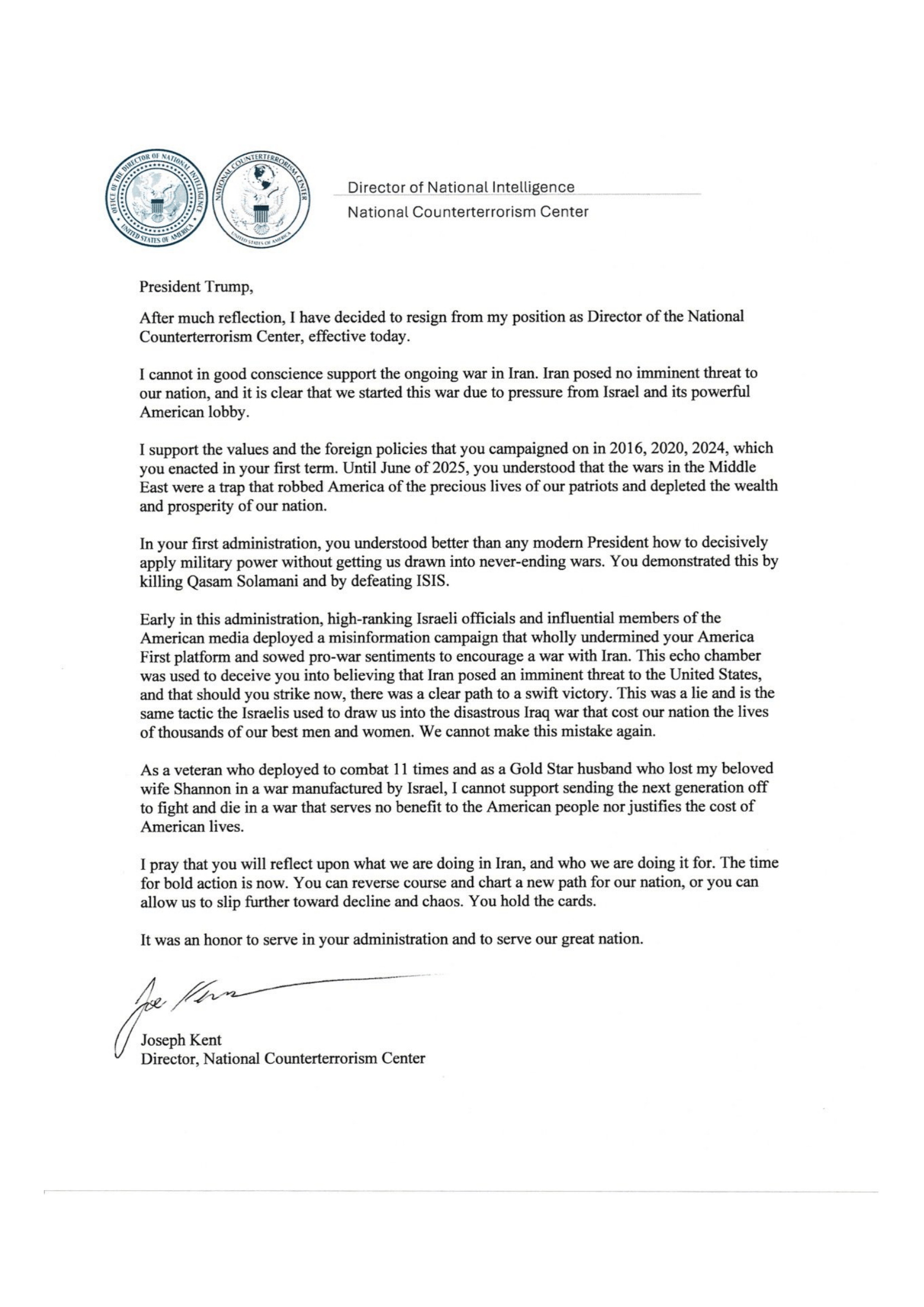
Here’s what you’ll find: a lot of strong opinions, stated emphatically, as if they’re obvious. What you won’t find is evidence.
The only verifiable fact in the letter is that we are at war. Everything else - that Iran posed no imminent threat, that Israel deceived Trump, that this is Iraq all over again - is opinion.
Those opinions might be right. But we shouldn’t evaluate whether they’re right based on whether they fit our current view of the world. We should evaluate them based on whether there is evidence.
Take his central claim: this war is about Israel.
I’m not going to pretend Israel has no influence here. Of course they do. But influence is a spectrum. How much are we talking about? 1%? 10%? 50%? 100%? Kent states it as if it’s simply about Israel - without acknowledging any of the other reasons why Iran might be a threat independent of Israel.
Every single president for the last two decades has considered Iran a nuclear threat. They’ve disagreed on methodology - Obama tried the JCPOA, Biden tried sanctions, Trump is bombing them - but the underlying assessment that a nuclear Iran is dangerous has not changed across administrations, across parties, across intelligence agencies.
You can disagree on methodology.
You can argue there were better options than war. You can argue we should have exhausted diplomacy first.
Those are legitimate debates.
But Kent doesn’t make those arguments. He skips past all of that and goes straight to: it’s Israel’s fault.
This is called a strawman.
I should also note context that emerged after the resignation.
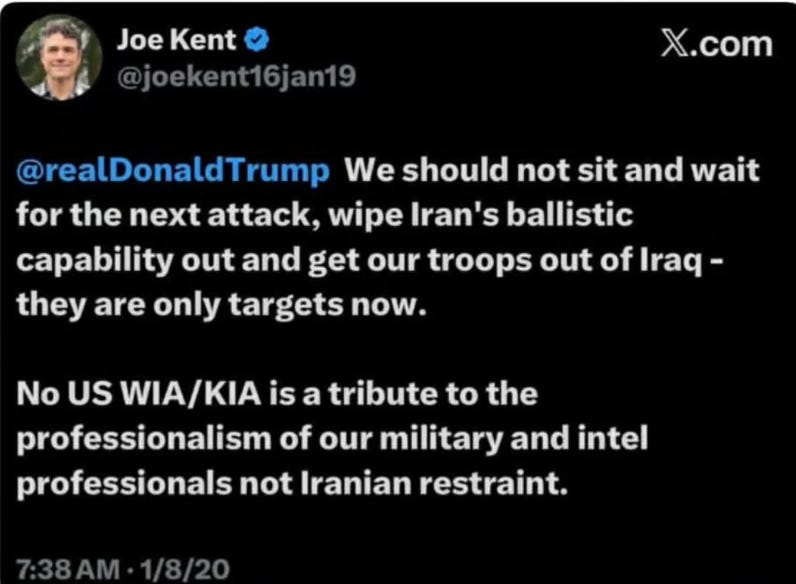
According to Fox News, Semafor, Axios, NBC, CBS, and the AP, Kent had been under FBI investigation for allegedly leaking classified information - and that investigation predated his resignation by months. According to administration officials, he had been cut out of presidential intelligence briefings months ago. It’s also worth noting that in 2020, after the Soleimani strike, Kent publicly urged the administration to “wipe Iran’s ballistic capability out” - which is essentially what Trump is now doing.
Does that mean his claims are wrong? No. Could Trump just be retaliating? Yes. We’ll see what details come out about the timing of the investigation in the coming days.
But it’s context that matters when evaluating a source’s credibility and motivation, and most people who shared the letter never saw it. That’s the problem with authority-based reasoning - it asks you to trust the messenger instead of examining the message.
Then there’s the word “imminent.”
Kent says Iran posed no imminent threat. What does imminent mean? Days? Weeks? Years?
Here’s what we know. As of June 2025, Iran had stockpiled 440 kilograms of uranium enriched to 60% purity - enough for multiple nuclear weapons if enriched further to 90%. The IAEA said this level of enrichment has “no civilian justification whatsoever.” Going from 60% to 90% takes weeks, not years.
After that, it’s much harder to track what they do — especially if they move operations underground.
Iran’s parliament - 71 members of it - formally called for changing the country’s nuclear doctrine to permit weapons. Their intelligence minister said a “cornered cat may behave differently.” Their Supreme Leader’s own fatwa against nukes was never even written down - it was oral, never listed on his website alongside his other fatwas, and after his death, his successor’s first public letter didn’t mention the nuclear program at all.
Fast forward to recent months: Iran was rapidly replenishing its conventional missile stockpile.
The logic here matters: if Iran rebuilds enough missiles, it becomes exponentially harder to take military action against their nuclear program - because now they can retaliate at scale against the entire region.
Rubio has been quite clear about this reasoning. You don’t have to agree that it justifies war.
But we should at least know the argument exists before dismissing it.
Is that imminent? Reasonable people can disagree. But it’s not nothing. And stating “no imminent threat” as if it’s self-evident, without engaging with any of this, is not the mark of someone making a rigorous case. It’s the mark of someone making a persuasive one.
But there's something deeper going on here - a blind spot I keep seeing on both the left and the right - and it’s about the nature of radical Islam.
